Best AI Models for Internal Tools: Dense vs MoE vs Reasoning
Compare dense, MoE, reasoning, and state-space AI models for internal tools by cost per task, latency, self-hosting hardware needs, and governance.

What is the best AI model for internal tools: dense, MoE, or reasoning?
The best AI model for building internal tools isn't the one topping this week's leaderboard. It's the one whose architecture fits your tool's actual constraints: cost per finished task, latency, and whether the data can leave your infrastructure at all. Dense models are the safe, general-purpose default. Mixture-of-experts models give you frontier capability without frontier inference cost, if you can rent them instead of hosting them. Reasoning models buy accuracy on hard problems at a real token tax. State-space and hybrid models exist to make long documents and long-running agents cheaper. Picking among them is a cost and governance decision wearing a technical costume.
TL;DR
- A 132B-parameter mixture-of-experts model might only activate around 36B parameters for any given request, which cuts per-token compute cost.
- Total parameters determine your hardware footprint, so a model can be cheap to query and brutally expensive to host.
- Pushing reasoning effort to maximum raises coding and agentic benchmark scores by roughly 20%, at 5 to 10 times the output-token cost.
- Self-hosting DeepSeek V4-Pro needs roughly 862GB of GPU memory, which runs to about $265,000 to $275,000 of hardware.
- Cost per accepted task matters more than cost per token, and a given model can be 53% cheaper or 41% more expensive than a frontier peer depending on the workload.
- Reasoning models are overkill for classification, extraction, and routing, so match the architecture to the tool rather than the other way around.
What does "model architecture" actually mean here?
Every large language model you can call today is some variation on the transformer, plus a handful of design choices that change what happens per token. You don't need to read the papers to make a good decision. You do need four concepts straight before you compare anything:
- Dense vs. sparse. A dense model runs every parameter on every token. A sparse mixture-of-experts (MoE) model routes each token through only a fraction of its parameters.
- Total vs. active parameters. Total parameters set the memory footprint you store. Active parameters set the compute you spend per token. For MoE models, these are very different numbers.
- Test-time compute. Reasoning models spend extra generation steps "thinking" before answering, trading latency and tokens for accuracy.
- Attention vs. state. Standard transformer attention scales quadratically with context length. State-space models (SSMs) and hybrids swap some or all of that for a mechanism that scales closer to linear.
Each of these shows up on your invoice and your latency dashboard, not just in a paper.
Which architectures are in play right now?
Dense decoder-only transformers
This is still the baseline: every token passes through the full network, every time. It's predictable, easy to reason about, and it's what most general-purpose closed models, and plenty of open ones like Qwen's smaller checkpoints, still ship as. The tradeoff: capacity and compute cost scale together. A bigger dense model costs proportionally more, on every single query.
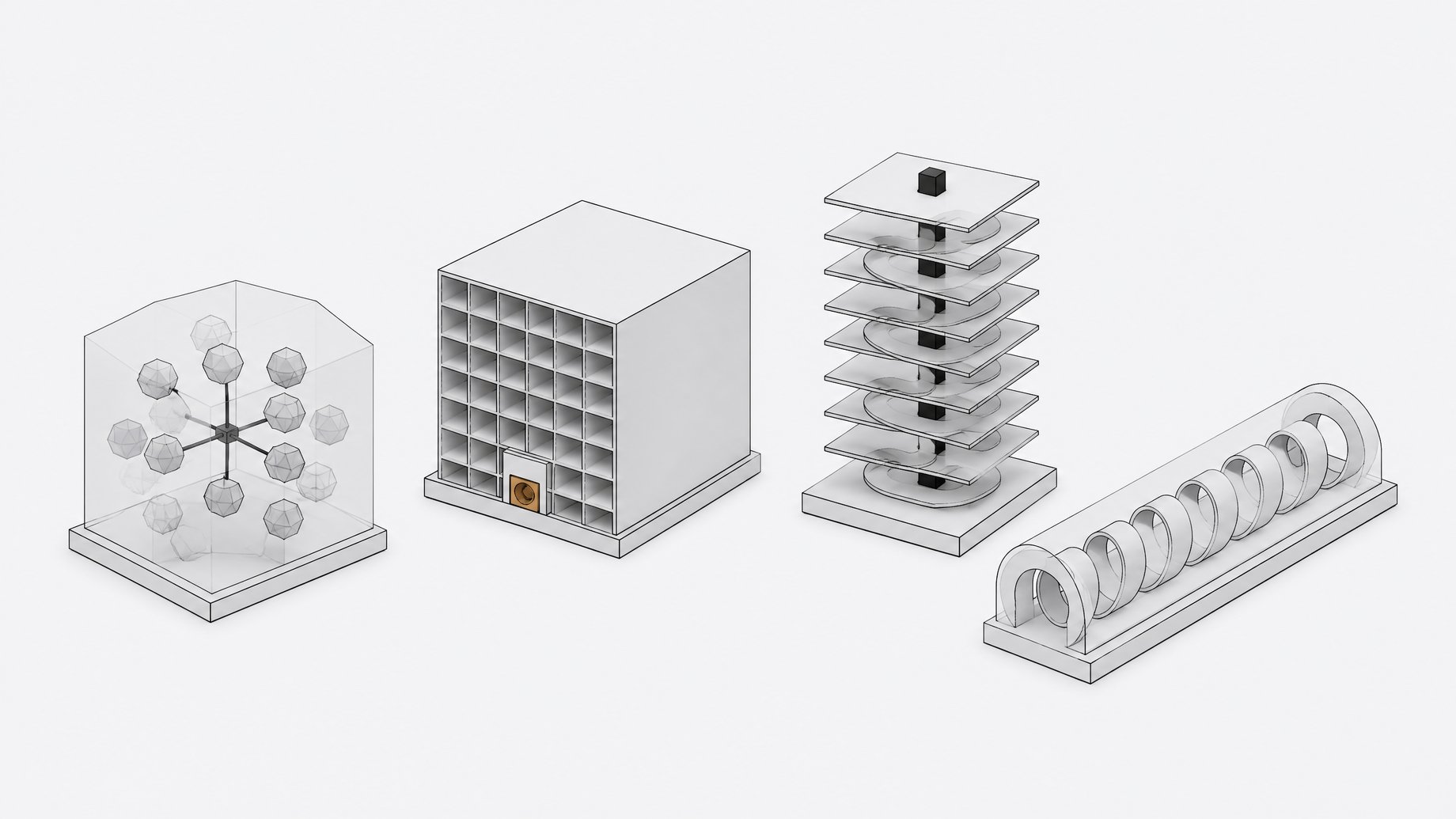
| Per-token cost | Self-hosting footprint | Added latency | Long-context efficiency | |
|---|---|---|---|---|
| Dense transformerpredictable, small-to-mid general-purpose tools | High | Medium | Low | Low |
| Mixture-of-Experts (MoE)frontier capability rented via API rather than self-hosted | Medium | High | Low | Low |
| Reasoning (test-time compute)verifiable, high-stakes multi-step tasks | High | Medium | High | Medium |
| State-space / hybridlong documents and long-running agent traces | Low | Medium | Low | High |
Mixture-of-Experts (MoE)
MoE architectures attach a learned router to each layer that sends every token to a small subset of "expert" sub-networks instead of the whole model. This decouples total capacity from per-token cost: a 132B-parameter MoE model might only activate around 36B parameters for any given request. That's how DeepSeek, Mixtral, and GPT-4-class systems scale up without scaling inference cost at the same rate.
The catch, and it matters if you're thinking about self-hosting: total parameters determine your hardware footprint even though active parameters determine your compute bill. A model can be cheap to query and brutally expensive to host.
Reasoning models and test-time compute
Models like OpenAI's o-series, DeepSeek-R1, and Claude's extended thinking mode generate extra chain-of-thought tokens, visible or hidden, before producing an answer. This measurably improves coding, math, and planning accuracy. It also inflates the bill: reasoning-heavy queries can burn 5 to 20 times more tokens than a direct answer, and pushing reasoning effort to maximum raises coding and agentic benchmark scores by roughly 20%, at 5 to 10 times the output-token cost.
State-space and hybrid models
Standard attention gets quadratically more expensive as context grows. State-space models like Mamba replace that with a mechanism that scales closer to linear, and hybrid architectures (Jamba, Nemotron-H, Hunyuan-TurboS) mix SSM blocks with a thinner layer of attention and MoE routing. Nemotron-H replaced 92% of its attention layers with Mamba2 blocks and delivered up to 3x faster throughput than similarly sized transformers, holding accuracy steady on MMLU, GSM8K, HumanEval, and MATH. If your internal tool chews through long documents, long chat histories, or long-running agent traces, this is the architecture family built for exactly that problem.
How do you evaluate a model for an internal tool?
Leaderboard scores are a starting filter, not a decision. The practical questions are narrower:
- Cost per accepted task, not cost per token. A cheaper-per-token model that needs three retries to pass your tests isn't cheaper. A U.S. government evaluation (CAISI) found DeepSeek V4 Pro ranged from 53% cheaper to 41% more expensive than a U.S. frontier model per correctly solved task, depending on the benchmark. Direction flips by workload. Measure your own.
- Agentic reliability on your actual task shape. SWE-bench's February 2026 leaderboard refresh put Claude 4.5 Opus, Gemini 3 Flash, and MiniMax M2.5 within a point of each other on real-world coding tasks, with GLM-5, Kimi K2.5, and DeepSeek V3.2 also landing in the top ten. The open-vs-closed capability gap for agentic coding work has narrowed faster than most procurement decisions assume.
- Latency budget. A dashboard query a human is watching load needs sub-second response. A nightly batch classification job doesn't. Reasoning models and large MoE checkpoints both add latency; know which of your tools can absorb it and which can't.
- Context window fit. Don't pay for a 1M-token context window to summarize a two-page form. Match the window to the document, not the other way around.
For teams juggling more than one internal tool, the honest answer is often not one model but a small roster: a cheap fast model for routing and classification, a stronger one for the hard cases. Stop Searching for the "Best" AI Model covers how to build that roster without turning it into its own maintenance project.
Should you self-host an open-weight model?
Self-hosting an open-weight model earns its keep in two narrow situations: a small model running on hardware your team already controls, for privacy-sensitive or offline work, or a large deployment where you have the staffing to run a full checkpoint in production. Open weight does not mean cheap. Licensing terms, checkpoint size, and infrastructure dependency vary wildly model to model: GLM 5.2 ships MIT-licensed at roughly 1.5TB in BF16, while MiniMax M3 requires a commercial license above $20M in revenue.
The hardware gap between model tiers isn't marginal, it's an entire class. DeepSeek V4-Pro needs roughly 862GB of GPU memory just to hold its weights, which runs to about $265,000 to $275,000 of hardware, typically four NVIDIA B300 GPUs. A smaller model like Qwen3.6-27B fits comfortably on a single GPU. If you're sizing an internal-tool deployment, that difference decides whether you're buying a server or a small data center. For a narrower, team-sized version of this question, see The 5 Best Small AI Models for Local Inference in 2026, which covers what actually runs on a laptop CPU or a single 16GB GPU.
When is a reasoning model worth the extra cost?
Reasoning earns its keep when the task has a verifiable right answer and getting it wrong is expensive: multi-step code generation, complex SQL, financial reconciliation logic. It's overkill for classification, extraction, routing, and most CRUD-shaped internal tools, where a fast dense or small MoE model hits the same accuracy ceiling for a fraction of the cost. The 20% accuracy bump from maxing reasoning effort is real. So is the 10x output-token bill that comes with it. Reserve it for the subset of your internal tools where that trade actually pays off.
How does shadow AI shape the architecture you didn't choose?
Here's the part teams skip. Architecture decisions are already being made inside your company, by whichever employee opened whichever chatbot was free that afternoon. Microsoft WorkLab found 78% of AI users bring their own AI tools to work, and EY's 2025 Work Reimagined survey of 15,000 employees across 29 countries found between 23% and 58% bring and pay for their own AI tools depending on sector. Every one of those tools runs on some architecture, with some data-handling policy, that nobody in IT signed off on. Choosing a model deliberately for your internal tools isn't just a performance decision. It's a governance lever that closes off a path shadow AI would otherwise walk through unsupervised.
What happens when the wrong architecture meets a regulated workflow?
The failure mode in regulated industries usually isn't model capability. It's infrastructure and governance that never got built around the model. Over 80% of enterprise AI implementations fail within six months, and MIT NANDA research found 95% of enterprise agentic AI pilots fail to deliver expected ROI, with the root causes being broken retrieval pipelines, missing integration layers, and absent observability, not the model itself. Regulated enterprises feel this acutely: only 34% have a generative AI system actually in production, deployments take 2.4x longer than unregulated peers, and 71% of banks piloting AI choose retrieval-augmented generation over fine-tuning specifically because it's auditable and easier to constrain. Architecture choice and governance choice are the same decision wearing different hats once a workflow touches compliance.
What does a practical decision framework look like?
Match the architecture to the tool, not the other way around:
- Simple dashboard or CRUD tool: small dense or small MoE model, low context, no reasoning mode. Optimize for latency and cost per call.
- Long-document search or summarization: hybrid or long-context model with efficient attention. This is where SSM-hybrid architectures earn their cost advantage.
- Autonomous or multi-step agent: reasoning model for the planning step, cheaper model for execution steps, with a router in between. See HydraFusion vs OpenRouter for how production systems split that work.
- Regulated or high-stakes workflow: favor auditability over raw capability. RAG over fine-tuning, closed or well-documented open-weight models, logging on every decision.
This is also where the build-vs-rent math changes. An AI-compiled internal tool, backend, database, auth, deployment, now commonly costs $100 to $500 in tokens and lands in an afternoon instead of the weeks and tens of thousands of dollars a traditional dev-shop build used to run. That number only holds if the model and infrastructure choices behind it are sound.
The model-of-the-week will keep changing. The question that doesn't change is whether you picked an architecture that fits the job, or inherited one by accident.
Frequently Asked Questions
What is the best AI model architecture for building internal tools?
There isn't one best architecture across the board. Dense models suit simple CRUD tools and dashboards. Mixture-of-experts models give you more capability per dollar when hosted by a vendor. Reasoning models are worth it for coding or multi-step logic tasks where accuracy matters more than speed. State-space or hybrid models fit long-document and long-context workloads where attention's quadratic cost becomes the bottleneck.
Should I self-host an open-weight model for my internal tools or use an API?
Self-hosting only pays off in two cases: a small model on hardware you already control for privacy-sensitive or offline work, or a large deployment where you have the staffing to run a full checkpoint. Large open-weight models like DeepSeek V4-Pro need over 800GB of GPU memory, roughly $265,000 to $275,000 in hardware, which makes renting a hosted API cheaper for most teams.
Are reasoning models worth the extra cost for internal tools?
Only for tasks with a verifiable right answer where mistakes are expensive, like multi-step code generation or financial logic. Maxing reasoning effort lifts coding and agentic benchmark performance by about 20% but can cost up to 10 times more in output tokens, so it's overkill for routine classification, extraction, or CRUD-style tools.
Do open-weight models like DeepSeek or GLM actually compete with closed models like GPT or Claude for coding tasks?
Yes, more than most teams assume. SWE-bench's February 2026 leaderboard refresh showed MiniMax M2.5 within a point of Claude 4.5 Opus and Gemini 3 Flash on real-world coding tasks, with GLM-5, Kimi K2.5, and DeepSeek V3.2 also placing in the top ten. The open-vs-closed gap for agentic coding work has narrowed substantially.
Why does model architecture matter for regulated or compliance-heavy internal tools?
Because architecture choices like RAG versus fine-tuning affect auditability, not just accuracy. Only 34% of regulated enterprises have a generative AI system in production, and deployments there take 2.4 times longer than at unregulated peers, largely due to governance and compliance review rather than model capability.
How we source, write, and correct our articles. Editorial standards