PlatformAudit Log
The audit log you would otherwise never build.
Every Remy app keeps an enterprise-grade record of who did what, when, from where, and to what, across the workspace and inside the running app itself. The developer instruments nothing. It is a property of the platform.
The first thing a security review asks for
Audit logging is one of the hardest things to retrofit onto an app, and one of the first things a security review asks to see. A hand-built app threads logging through every handler by hand, and the best it usually manages is proof a route was hit, not a record of what a person did. A Remy app inherits the opposite by construction: a trail that reads like a sentence, tied to a real identity, immutable, and exportable to the tools the security team already runs.
Without Remy: the access log
POST /api/approve 200
a route and a status. not who, not what, not whether it should have been allowed.
With Remy: the audit event
Alice approved a vendor request
- Actor
- Alice Chen · alice@acme.com · ApproverSign in with Remy → workspace member
- Action
- method.execute · Approve Vendor Request
- Resource
- Vendor Request #4821
- Outcome
- success · 142 ms
- Context
- 203.0.113.42 · San Francisco, US · session
- Time
- 2026-02-14 · 17:02:04 UTC
Immutable · append-only · exportable (OCSF 1.8.0)
One path in
Every backend method call passes through a single execution point, and that is where the platform captures it. Three things make the record meaningful, and none of them are the developer’s job:
- One edge
- The same capture, for every app, with no way to opt out or forget.
- Methods are contracts
- A method has a human name and a description, so the log records the meaning of the action (“Approve Vendor Request”), not a URL and a status code. That is the difference between an access log and an audit log.
- Real identities
- Authentication is the platform’s job, so every event names a resolved person, and the true principal is kept even when someone acts on another’s behalf.
Capture is fire-and-forget, so it never blocks or breaks a request. The developer writes no audit code; the app gets who did what, when, and from where, at a semantic level, for free.
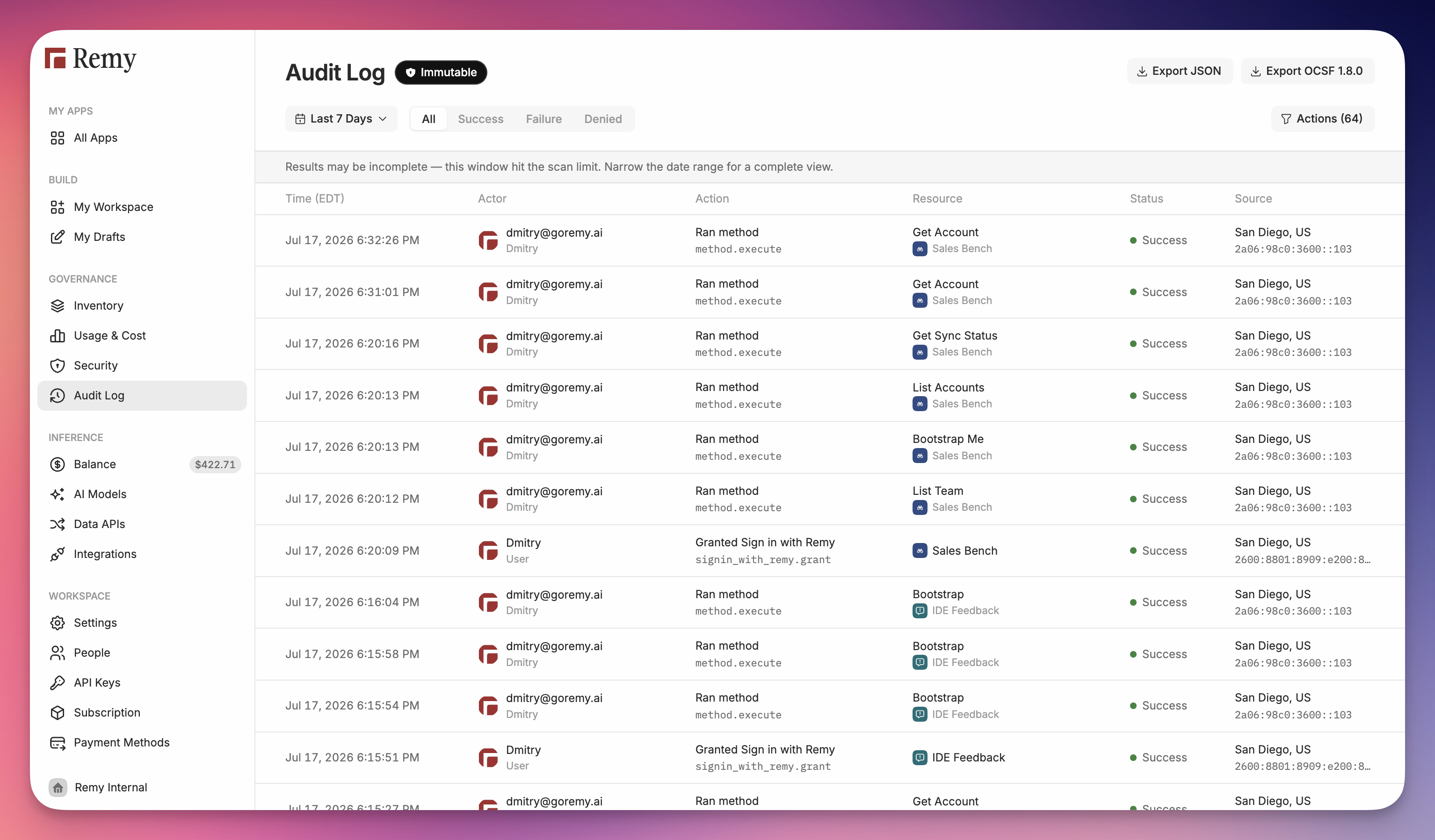
The log, newest-first. Filterable by action, actor, app, and outcome, with a live recent-activity feed.
One trail, three scopes
Most systems audit the control plane or the application. Remy records both, in one schema, so a single trail runs from “an admin changed a role” down to “a user ran a method.”
- Workspace
- Who administers the organization.Roles, settings, API keys, billing.
- App lifecycle
- Who builds, deploys, and configures an app.Deploys, secret reveals, custom domains.
- Inside the app
- Every method an authenticated person invokes.
That last scope is the one almost nobody else has. It fires only for authenticated humans, so the log stays signal, not noise, and each entry reads as the method’s real name, never a handler.
Built to pass the review
- Complete
- The full control plane plus activity inside the app.
- Trustworthy
- Written to immutable, append-only storage with
S3 Object Lock. It cannot be edited or deleted, even by an owner, and reading it is itself logged. - Exportable
- Any date range, as
NDJSONorOCSF 1.8.0, the schema Splunk and other SIEMs ingest natively. - Access-controlled
- Viewing takes an explicit permission, and tenant isolation is enforced on every read.
{
  "category_uid": 6,
  "class_uid": 6003,
  "time": 1784327546722,
  "status_id": 1,
  "message": "method.execute: Get Account",
  "metadata": { "version": "1.8.0", "log_name": "remy-audit" },
  "actor": { "user": { "name": "dmitry@goremy.ai" }, "app_name": "Remy" },
  "src_endpoint": { "ip": "2a06:98c0:3600::103", "location": { "city": "San Diego" } },
  "unmapped": { "outcome": "success" }
}Exported to your SIEM. Any date range downloaded as OCSF 1.8.0 or NDJSON, server-assembled and org-filtered.
The same edge that records also meters
Every call already passes through one platform edge to get logged. That edge also knows what the call cost, per method, per user, per model, split between building the app and running it. Because every paid model call routes through the platform, this is true unit economics, not a bill you reverse-engineer after the fact.
None of it assembled by hand
Enterprise audit logging is normally a line item, an integration, and a permanent instrumentation burden. Here it is ambient: every app, no effort, tied to real people, immutable, and ready for the security team’s existing tools. It is a large part of how an app someone described in a sentence clears a real security review.
Start building on Remy.
Everything you just read is standard in every app, running from the first deploy.
Start building← Back to the Platform