Local vs Cloud Dev Environments: Which Is Better for Developers?
Compare local and cloud dev environments on speed, offline use, toolchain control and cost, with data on SaaS spend, 37signals savings and AI coding agents.

Which is better for developers: local or cloud dev environments?
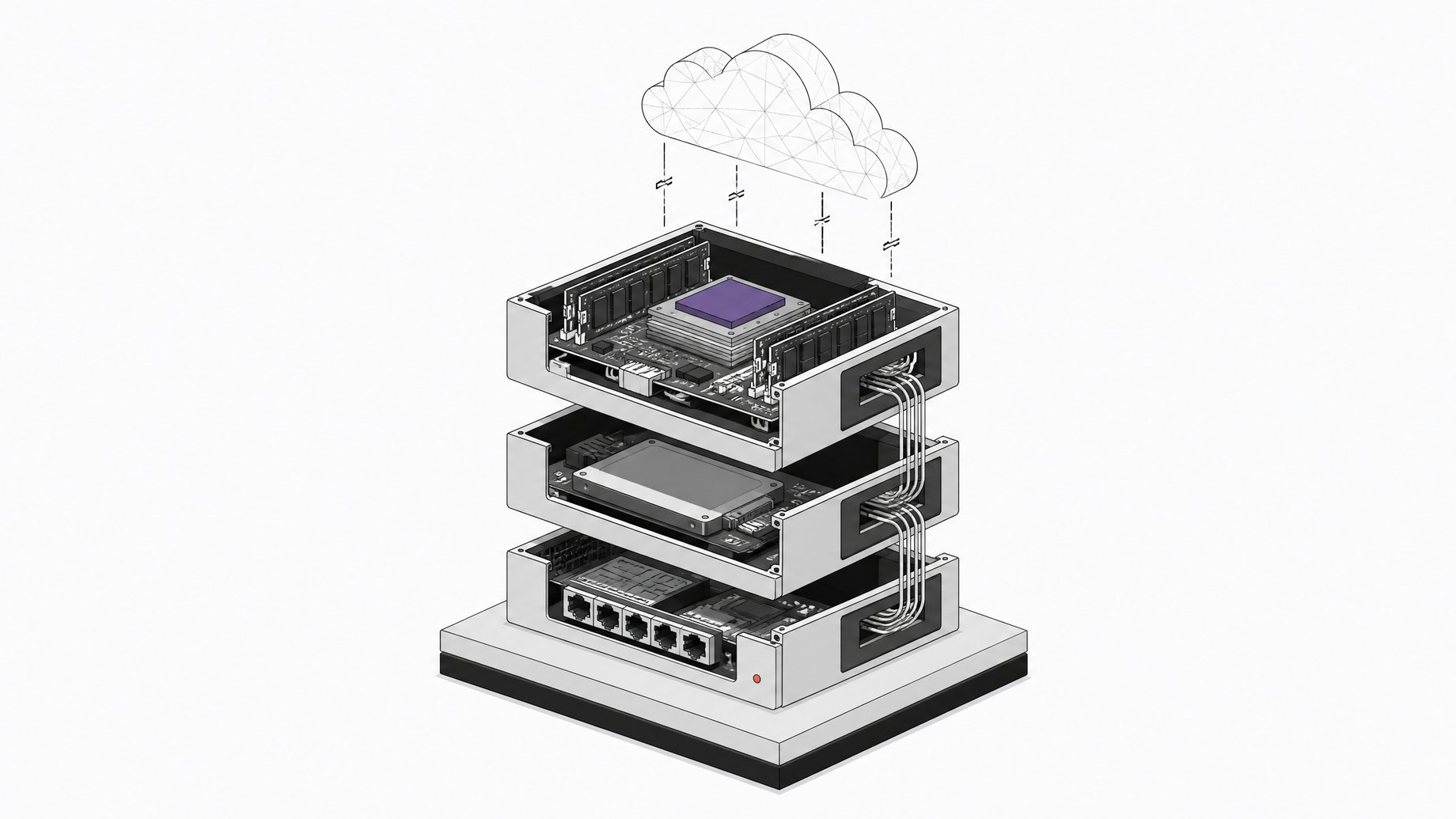
Developers prefer local development environments because they're faster, they work without a network connection, they put the toolchain under one person's control, and they cost nothing per seat once they're built. No spinner while a cloud IDE boots. No outage taking down your terminal. No per-seat invoice creeping upward every renewal cycle. That's the whole answer. Everything below is the math behind it.
TL;DR
- Developers favor local environments for speed, offline use, toolchain control, and no per-seat cost once they're built.
- Average enterprise SaaS spend hit $4,830 per employee in 2025, a 21.9% year-over-year increase.
- 83% of enterprise CIOs now plan to repatriate at least some workloads from the public cloud.
- 35% of enterprises have already replaced at least one SaaS tool with a custom-built alternative.
- 78% of knowledge workers using generative AI at work bring their own AI tools rather than relying on employer-sanctioned ones.
How did the dev stack get rented out from under developers?
For most of the last decade, "setting up a dev environment" stopped meaning installing software on your own machine. It meant provisioning access: a cloud IDE seat, a hosted CI/CD pipeline, a managed database, a SaaS secrets vault, a per-seat AI coding assistant. Each piece made sense in isolation. Together they turned the developer's workstation into a thin client pointed at a dozen vendors.
The bill for that fragmentation shows up in the numbers. Average enterprise SaaS spend hit $4,830 per employee in 2025, up 21.9% year over year, the first increase in both average spend and app count since 2021, driven by vendor price hikes, more complex licensing tiers, and a wave of AI-feature upsells. Zylo's 2024 index found organizations wasting an average of $18 million a year on unused or duplicate licenses. That's not a rounding error. That's a structural tax on every team that let its toolchain sprawl across a dozen monthly invoices instead of a stack it owns.
How much does rented infrastructure actually cost?
The clearest receipts come from a company that did the math and walked.
37signals, maker of Basecamp and HEY, moved every application off the public cloud and onto its own Dell hardware in two colocation data centers in 2023. DHH's back-of-napkin estimate at the time: at least $1.5 million a year in savings versus renting from AWS, without growing the ops team. The company later put the five-year number at roughly $10 million, a reduction in infrastructure costs of between half and two-thirds.
That's one company, one workload profile, one set of assumptions. But it's a real, audited data point in a conversation usually dominated by vendor pricing pages. That's why 37signals' exit keeps getting cited every time this debate resurfaces.
The macro data backs the direction of travel. In the 2024 Barclays CIO Survey, 83% of enterprise CIOs said they planned to repatriate at least some workloads from the public cloud, up from 43% in late 2020. IDC's June 2024 report found roughly 80% of respondents expected some level of compute or storage repatriation within twelve months. Cloud rental was never free optionality. It was a lease, and leases get renegotiated when the math stops working.
Why do developers want the machine back under their desk?
Executives repatriate for the invoice. Developers want local control for reasons that are more immediate, and they show up every day as small frictions:
- Latency. A local editor responds in milliseconds. A cloud IDE round-trips to a server for every keystroke, autocomplete, and file save.
- Offline capability. A laptop on a plane, a flaky office connection, a VPN outage: none of it should stop you from writing code. Ink & Switch's "local-first software" framework names this directly: software should let you work offline and keep full ownership of your data, instead of treating the network as a dependency for basic function.
- Full toolchain control. Your linter, your git hooks, your debugger, your extensions: configured once, exactly how you want them, with no admin console standing between you and a settings change.
- No vendor lock-in. A local setup doesn't vanish because a SaaS vendor raises prices, changes a feature tier, or gets acquired.
- Debugging speed. Stepping through a stack trace on your own machine, with your own breakpoints and your own data, is faster than reproducing a bug inside someone else's hosted sandbox.
| Round-Trip Latency | Works Offline | Toolchain Control | Vendor Lock-In Risk | Marginal Per-Seat Cost | |
|---|---|---|---|---|---|
| RecommendedLocal Dev Environmentdevelopers who want speed, control, and no recurring invoice | Low | Yes | High | Low | $0 once built |
| Cloud/Rented Dev Environmentteams prioritizing zero-setup onboarding over long-run cost or control | High | No | Low | High | Recurring per-seat subscription |
The market has already voted on this with its feet. The 2025 Stack Overflow Developer Survey, with more than 49,000 respondents across 177 countries, found that Visual Studio Code (75.9%) and Visual Studio (29%) remained the dominant development environments for a fourth consecutive year. Subscription-based, AI-enabled IDEs, despite heavy venture funding and aggressive marketing, have not displaced them. Developers tried the rented alternative. Most went back to the editor on their own disk.
Why do agentic coding tools make build cheaper than buy?
What's new isn't developers wanting local control. That preference is old. What's new is that AI coding agents just made it dramatically cheaper to build your own tools instead of renting someone else's. That raises the stakes on owning the environment those tools run in.
McKinsey's State of AI 2026 global survey, covering 1,719 respondents across 97 countries, found that 32% of organizations have already decided against buying at least one software product or feature because they could build it in-house with agentic coding tools instead. In the technology sector that figure rises to 41%, and among AI "high performers" it approaches half.
Retool's 2026 Build vs. Buy report, surveying 817 builders, puts a number on how far this has already gone: 35% of enterprises have replaced at least one SaaS tool with a custom-built alternative, and 78% expect to build more custom tools in 2026. That shift is explored in more detail in this build-vs-buy breakdown of the SaaS math, but the short version: once an agent can scaffold a working internal tool in an afternoon, a $50-a-month subscription stops making sense.
That logic extends naturally to the environment itself. If you can build the tool, why rent the IDE, the CI pipeline, and the staging environment it runs in?
Are builders already doing this without permission?
This isn't waiting for IT's blessing. It's happening in parallel, often invisibly.
Retool found that 60% of builders across seniority levels have shipped software outside official IT oversight in the past year. Microsoft's 2024 Work Trend Index, surveying 31,000 knowledge workers across 31 markets, found 75% of global knowledge workers were already using generative AI at work, and 78% of those users were bringing their own AI tools rather than relying on anything employer-sanctioned. Over half weren't willing to admit it to their managers.
That pattern of unsanctioned, self-built software is the same pattern this publication tracks as niche SaaS losing ground to tools built in-house. The demand for owned, local environments isn't a hypothetical trend piece. It's already running inside your org chart, mostly off the books.
What does 'out of the box' mean now?
The shape of the rebuilt stack is getting concrete:
- Local LLMs. Running on developer hardware for code completion and internal tooling, instead of a metered API call for every keystroke.
- Devcontainers and reproducible local setups. Let any engineer spin up the exact same environment without a cloud dependency, something covered in detail in this guide to emulating cloud services locally.
- Self-hosted internal tools. Replacing SaaS category by category, from project tracking to analytics, as laid out in this category-by-category self-hosting guide.
- Local-first data architectures. Built on the Ink & Switch principles of offline capability and user-owned data, rather than cloud-dependent state.
- In-house build platforms. Including agent-assisted ones that let a team generate and own its internal tools instead of licensing them indefinitely.
None of this is nostalgia for 2005. It's the same destination, a developer who owns the full stack from editor to database, reached with better tools than were available the first time around.
How can teams get ownership without chaos?
Here's the honest counterpoint. A workforce quietly building its own tools and running its own infrastructure, with 60% of that building happening outside IT oversight, is not automatically a win. Unmanaged local builds create their own risk: undocumented dependencies, unpatched local databases, nobody owning the backup plan when the one engineer who built it leaves.
Owning your stack is not the same as having no process around it. It means the opposite: clear accountability for what gets built, where it runs, and who maintains it, instead of outsourcing that accountability to a vendor's terms of service. The teams getting this right treat local-first and self-hosted tooling as infrastructure to govern, not a loophole to exploit. A self-hosted setup for blocking network trackers with DNS is a small example of that kind of owned infrastructure.
Why did renting make sense until it didn't?
Cloud and SaaS dev tooling solved a real problem: nobody wanted to run their own servers in 2015, and renting was faster to start. That tradeoff held as long as rented infrastructure was cheap and building your own tools was slow and expensive.
Both of those conditions just flipped. SaaS spend per employee is rising faster than it has in four years. Agentic coding tools have made building your own software a matter of days, not quarters. And developers, given the choice, keep going back to the editor and the toolchain they actually control. The pendulum isn't swinging toward a trend. It's swinging back toward arithmetic that was always true, just temporarily masked by how cheap "easy" looked for a decade.
Frequently Asked Questions
Why do developers prefer local development environments over cloud-based IDEs?
Local environments respond faster, since there's no network round-trip for every keystroke, and they keep working when the internet doesn't. They also give developers full control over their toolchain and leave no per-seat subscription bill behind. The 2025 Stack Overflow survey shows this preference in the data: locally run editors like VS Code and Visual Studio still dominate, even against well-funded subscription-based AI IDEs.
How much does cloud infrastructure cost compared to owning your own hardware?
37signals estimated it would save at least $1.5 million a year, later projected at up to $10 million over five years, by moving off AWS onto owned hardware in colocation data centers. Separately, average enterprise SaaS spend per employee hit $4,830 in 2025, up 21.9% year over year, showing rented software costs are climbing, not falling.
Are companies actually moving workloads back from the cloud?
Yes. The 2024 Barclays CIO Survey found 83% of enterprise CIOs planned to repatriate at least some cloud workloads in 2024, up from 43% in late 2020, and IDC reported about 80% of organizations expected some repatriation within 12 months.
Why are AI coding agents changing the build-vs-buy decision for dev tools?
Agentic coding tools have cut the cost of building software in-house to the point where buying no longer wins by default. McKinsey found 32% of organizations have already skipped a software purchase because they could build it internally, and Retool found 35% of enterprises have already replaced a SaaS tool with something custom-built.
What is local-first software?
Local-first software is a set of design principles, articulated by Ink & Switch in 2019, that prioritize offline capability, user ownership of data, and freedom from dependence on centralized servers, while still supporting collaboration. It's the architectural backbone of the current shift toward owned, local developer environments.
How we source, write, and correct our articles. Editorial standards