Self-Hosted Alternatives to SaaS: The Category-by-Category Guide
A category-by-category map of self-hosted alternatives to SaaS, backed by cost data, sovereignty stats, and real government case studies.

What are the self-hosted alternatives to SaaS, category by category?
Self-hosted alternatives to SaaS now exist for nearly every core business category: Nextcloud for files, Mattermost or Rocket.Chat for chat, Jitsi for video, Gitea for git, Outline for docs, NocoDB for spreadsheets-as-databases. This isn't about picking one tool to replace one subscription. It's a category-by-category migration off rented cloud infrastructure, and it's happening at the level of national governments and defense agencies, not just cost-conscious startups.
TL;DR
- Sixty-one percent of Western European CIOs and IT leaders say geopolitical factors will push them toward local or regional cloud providers.
- Roughly 51% of purchased SaaS licenses go completely unused, wasting an estimated $19.8 to $21 million per organization annually.
- Mature open-source projects now cover nearly every major SaaS category, from files and chat to CRM, analytics, and git hosting.
- Governments such as France and Germany are rolling out Nextcloud to roughly 300,000 employees each, and the U.S. Department of Defense runs Mattermost for data sovereignty.
- Self-hosting trades a predictable per-seat subscription for a smaller infrastructure bill plus variable ops cost, which rarely pays off for a five-person team but usually does for a 50-person engineering org.
- Teams should start with categories that score high on sensitivity and waste and low on criticality to prove the model safely.
Why is this a board-level question now, not a homelab hobby?
Self-hosting used to mean a sysadmin running their own email server on a Friday afternoon. That's not what's driving the current wave. Sixty-one percent of Western European CIOs and IT leaders now say geopolitical factors will push their organizations toward local or regional cloud providers, and Gartner expects more than 75% of enterprises outside the U.S. to have a formal digital sovereignty strategy by 2030. That's a compliance and procurement conversation, not a tinkering hobby.
At the same time, 55% of those same CIOs say open-source technology will be a meaningful part of their future cloud strategy. Self-hosted open source isn't a fallback anymore. It sits next to "switch to a European cloud vendor" as a legitimate answer to the sovereignty question, and it's often the faster one to execute.
What three forces are pushing teams off rented infrastructure?
Three separate pressures are converging on the same conclusion, and each has numbers behind it.
- Geopolitical and jurisdictional exposure. European cloud providers now hold under 15% of the European cloud market, down from a much larger share nine years ago, while Amazon, Microsoft, and Google control more than 70% between them. U.S. companies also hold at least 59% of Europe's enterprise software market, with Salesforce dominating CRM specifically. Laws like the U.S. Cloud Act give American authorities a legal path to data stored by U.S.-headquartered vendors regardless of where the servers sit, which is exactly the concern Sweden's Försäkringskassan cited when it moved away from foreign cloud dependency.
- Cost sprawl that keeps compounding. Average SaaS spend hit $4,830 per employee in 2025, up 21.9% year over year, and total organizational SaaS spend reached roughly $55.7 million in 2026. Worse, 51% of purchased licenses go completely unused, wasting an estimated $19.8 to $21 million per organization annually. That's not a rounding error in a budget review. It's a line item big enough to justify an engineering sprint.
- Vendor and platform lock-in. Once your files, chat history, CRM records, and analytics all live inside one vendor's proprietary format, switching costs become a moat that works against you. Every renewal negotiation happens from a position of weakness because migrating out is expensive and risky.
What are the category-by-category replacements?
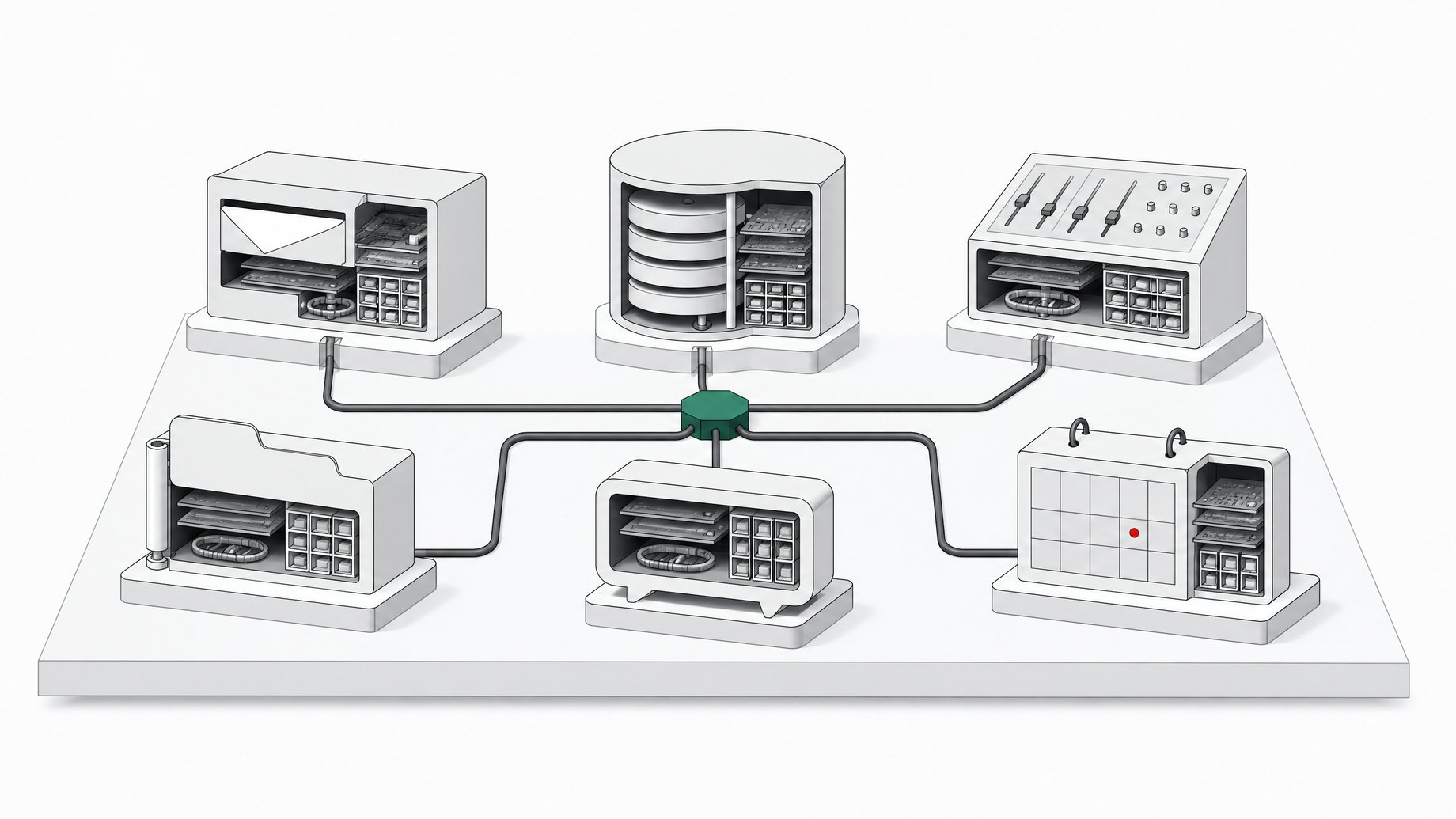
Here's the practical map. For each major SaaS category, there's now a mature, actively maintained open-source project that a small ops team can deploy, often inside a single day via Docker.
- Files and storage (replacing Dropbox, Google Drive): Nextcloud. Full sync, sharing, and collaborative editing, self-hosted on your own storage.
- Team chat (replacing Slack, Microsoft Teams): Mattermost or Rocket.Chat. Mattermost in particular is trusted at the highest security tiers, including inside the U.S. Department of Defense.
- Video conferencing (replacing Zoom): Jitsi Meet. Open source, no per-host license fees.
- Project management (replacing Trello, Asana): Planka or Wekan for Kanban-style boards, Plane for a fuller Asana-style workflow.
- CRM (replacing Salesforce, HubSpot): Twenty is the open-source option practitioners cite most often as a workable swap.
- Notes and internal wiki (replacing Notion, Confluence): Outline for the closest Notion-like experience, or BookStack for a more traditional wiki structure.
- Email (replacing Gmail, Google Workspace): Mailcow, a full self-hosted mail server stack.
- Git hosting (replacing GitHub, GitLab): Gitea, with repository hosting, issues, and pull requests built in.
- Analytics (replacing Google Analytics): Plausible or Umami, both lightweight and privacy-respecting by design.
- Forms (replacing Typeform): Formbricks.
- Spreadsheet-as-database tools (replacing Airtable): NocoDB or Baserow.
One practitioner who mass-migrated across nearly every one of these categories described the result plainly: the monthly bill went from "probably 200+ per month to basically the cost of a small VPS." The bigger obstacle wasn't technical difficulty. It was knowing which project to trust for each category before spending a weekend on it. If you want a narrower starting point before committing to a full category migration, five single-binary tools already cover a big chunk of this list without the operational overhead of a multi-service deployment.
Who is already doing this at scale?
This isn't speculative. Governments have already run the migration with six-figure user counts.
- France's Ministry of Interior is rolling out Nextcloud to scale to its full 300,000 employees.
- Germany's federal government (ITZBund) deployed Nextcloud on-premises for roughly 300,000 federal employees after a 5,000-user pilot proved it out.
- Sweden's Försäkringskassan cited national security concerns tied to foreign legal access to data, specifically the U.S. Cloud Act, as the reason to move off dependency on foreign cloud infrastructure.
- The U.S. Department of Defense runs Mattermost on Platform One specifically to guarantee, in its own words, "complete data sovereignty" for secure cross-organizational communication.
When a defense department and multiple national governments independently land on the same tooling for the same reason, that's a signal worth taking seriously, not a fringe experiment.
What does self-hosting actually cost, and what doesn't it save?
Be honest about the trade. A VPS running a Nextcloud, Mattermost, and Gitea stack can cost less per month than a single SaaS seat, and at scale that gap widens fast given SaaS averages of $4,830 per employee annually. But the sticker price of self-hosting isn't the whole cost. Someone has to patch the server, manage backups, handle SSL renewals, and respond when something breaks at 2 a.m. That labor has a real dollar value, even when it's absorbed into an existing ops role rather than billed separately.
The honest framing: self-hosting trades a predictable per-seat subscription for a smaller infrastructure bill plus a variable, sometimes lumpy, ops cost. For a five-person team, that trade rarely pencils out. For a 50-person engineering org already running infrastructure, it usually does, especially once license waste (that 51% unused-seat number) is factored in. Teams weighing this decision across their whole toolchain will find a similar build-vs-buy framework in the open-source infrastructure boom piece, which walks through the same math for data infrastructure specifically.
How do you decide whether a swap is right for your team?
Not every category is worth migrating on day one. Run each SaaS line item through a short checklist before committing engineering time.
- Data sensitivity. Does this tool touch regulated data, customer PII, or anything with jurisdictional exposure? If yes, sovereignty concerns move it up the priority list regardless of cost.
- Compliance requirements. Are you already subject to data residency rules that a self-hosted deployment satisfies more cleanly than a SaaS contract's data processing addendum?
- Team size and ops capacity. Do you have someone who can own patching, backups, and incident response for this service, or would it become an orphaned system nobody maintains?
- Criticality of the tool. Is downtime here a minor inconvenience or a business-stopping event? Higher criticality means you need a real on-call plan before you self-host it, not just a Docker Compose file.
- Migration cost versus recurring waste. Does the current SaaS seat count include a meaningful share of that 51% unused-license waste, making the case for change stronger regardless of the target tool?
| Upfront cost | Recurring cost | Data sovereignty | Ops burden | Time to deploy | Vendor lock-in risk | |
|---|---|---|---|---|---|---|
| RecommendedSelf-hosted open sourceteams with existing ops capacity and sovereignty concerns | Engineering time + VPS | Small VPS bill | High | High | ~1 day per tool | Low |
| SaaS subscriptionsmall teams without ops capacity | $0 | Per-seat, compounding | Low | Low | Immediate | High |
Start with the categories that score high on sensitivity and waste and low on criticality. Those are the lowest-risk places to prove the model before touching anything customer-facing. Teams that have already moved chat and files often look at their AI tooling and API spend next, where the same waste-and-sovereignty math applies.
What is the bottom line?
The sovereign stack isn't about ideology. It's about who controls the switch, who can subpoena the data, and where the money goes every month. Software you run is an asset on your books. Software you rent is a recurring liability that someone else can revoke, reprice, or hand over to a foreign court order. As sovereignty rules tighten and SaaS spend keeps climbing past $55 million a year for the average enterprise, this migration is likely to keep expanding, not stay a niche move for security-obsessed teams. The tools already exist. The only remaining question is which category your team migrates first.
Frequently Asked Questions
What are the best self-hosted alternatives to SaaS tools?
The strongest, most mature options by category are Nextcloud for files and storage, Mattermost or Rocket.Chat for team chat, Jitsi Meet for video conferencing, Gitea for git hosting, Outline for docs and wiki, Mailcow for email, and NocoDB for Airtable-style spreadsheets. All are open source and deployable via Docker.
Is self-hosting actually cheaper than paying for SaaS?
Often yes on raw infrastructure cost, since average SaaS spend runs $4,830 per employee annually and 51% of licenses go unused, but the real cost includes ops labor for patching, backups, and incident response, which isn't free even if it's not billed separately.
Why are governments moving to self-hosted tools instead of commercial cloud?
Jurisdictional exposure. Laws like the U.S. Cloud Act give American authorities potential legal access to data held by U.S.-headquartered vendors regardless of server location, which is why France and Germany have rolled out Nextcloud to roughly 300,000 employees each and Sweden's Försäkringskassan cited the same concern explicitly.
How long does it take to self-host a SaaS replacement?
Most of the tools in this category, including Nextcloud, Mattermost, Gitea, and Jitsi, can be deployed via Docker in under a day. The bigger time cost is usually vetting which open-source project fits your needs, not the technical setup itself.
Which SaaS category should a team replace first?
Start with categories that combine high license waste with low operational criticality, such as internal wikis, analytics, or forms, before tackling higher-stakes systems like email or CRM where downtime and data sensitivity carry more risk.
How we source, write, and correct our articles. Editorial standards