Klarna AI vs Human Support: Which Does Klarna Use Now?
Klarna's AI assistant did the work of 700 agents, yet the company rebuilt a human support layer in 2025. See what changed, why, and how its hybrid model works.

Which does Klarna use now: AI or human customer support?
Klarna now uses both. It brought back human customer service because its all-AI model, fast and cheap as it was, let quality slip on the cases that mattered most, and CEO Sebastian Siemiatkowski admitted the company had let cost become "a too predominant evaluation factor." The fix wasn't abandoning AI. It was rebuilding a human layer underneath it.
TL;DR
- Klarna's AI assistant did the work of 700 outsourced agents and resolved issues far faster than humans, but that figure described displaced vendor contracts, not laid-off Klarna staff.
- Quality slipped on complex, emotionally loaded cases, and the CEO admitted cost had been "a too predominant evaluation factor" in organizing support.
- Klarna did not give up on AI, since the assistant's workload grew to around 850 agent-equivalents according to Forbes.
- The rebuilt model adds a dedicated specialist tier of roughly 100 people for complex and sensitive cases, alongside a flexible human agent pool.
- Klarna's headcount fell by roughly 40% between December 2022 and December 2024, and the human-support correction landed as the company prepared for its IPO.
- The broader lesson is to measure quality separately from speed and cost, and to build the human escape hatch before you need it.
What did Klarna actually claim in 2024?
In February 2024, Klarna announced that its OpenAI-powered assistant had handled 2.3 million customer service chats in its first month, about two-thirds of all conversations the company fielded. The company said the bot did the work of 700 full-time agents, resolved issues in under two minutes versus 11 minutes for a human, and cut repeat inquiries by 25%. Klarna projected a $40 million profit improvement for 2024 from the deployment alone.
Siemiatkowski flagged one detail that got lost in the headlines: those 700 agents weren't Klarna employees. The company relies on outsourced customer service providers, and it normally needed about 3,000 of their agents to cover demand. After the AI launch, that need dropped to a little over 2,000. The 700-agent figure was a real efficiency number, but it described displaced vendor contracts, not laid-off Klarna staff. That distinction matters for what came next.
By every metric Klarna published, the launch worked: faster resolutions, fewer repeat contacts, lower cost per interaction. The announcement became one of the most-cited AI-replaces-humans case studies of 2024. Worth noting: Klarna's bot was essentially a high-volume support queue handler, the same category of software AI agents are displacing across customer service, documentation, and routine ticketing more broadly.
Why did Klarna bring back human customer service?
Fifteen months later, the story flipped. In May 2025, Siemiatkowski told Bloomberg that Klarna was launching a recruitment drive so customers would always have the option to talk to a real person. He didn't dress up the reason:
"As cost unfortunately seems to have been a too predominant evaluation factor when organizing this, what you end up having is lower quality," he said. "Really investing in the quality of the human support is the way of the future for us."
That quote traveled fast. It was an unusually plain admission from a CEO who'd spent the prior year as one of AI's loudest enterprise champions. Klarna's own messaging acknowledged the trade-off: "AI gives us speed. Talent gives us empathy. Together, we can deliver service that's fast when it should be, and empathic and personal when it needs to be," said chief marketing officer David Nordstrom, confirming the course correction. Klarna still credited the AI assistant with an 82% improvement in response times and the same 25% drop in repeat issues it had announced the year before. This wasn't a repudiation of the technology. It was an admission that the technology had been asked to carry a job it wasn't suited to do alone.
What operational reality couldn't the AI handle?
The gap between Klarna's 2024 numbers and its 2025 backtrack comes down to case mix. An AI assistant can resolve a password reset or a payment-date question in under two minutes. It struggles with a dispute that requires judgment, a customer who needs to feel heard, or an edge case the model has never seen. Fast Company reported that six months after the all-AI push, customer satisfaction at Klarna had fallen sharply and service quality had turned inconsistent.
Klarna's experience tracks with how customers generally feel about chatbot support. A Verint survey found more than two-thirds of customers have had a bad chatbot experience, and a Five9 survey found 86% believe empathy and human connection matter more than speed. Even independent testing of Klarna's bot at the height of its acclaim came back unimpressed: tech writer Gergely Orosz found it mostly recited documentation and routed users to a human fairly fast, which suggests it worked more as a triage filter than a full-service replacement, even while Klarna was celebrating it loudest.
That's the real corrective to the 2024 narrative. The bot wasn't failing at everything. It was succeeding at the volume layer, routine, repeatable, low-stakes requests, while complex, emotionally loaded cases kept slipping through to a thinner, more stretched human layer. Shrink an outsourced agent pool by a third expecting AI to absorb the overflow, and the first thing to erode is handling for the hard 20% of tickets, not the easy 80%. Klarna built its 2024 metrics on the easy 80%.
Was it really a 'failure', and what was the CEO's pushback?
Siemiatkowski has pushed back hard on the "Klarna gave up on AI" framing. In an interview with Big Technology's Alex Kantrowitz, he said the assistant's workload had actually grown: it was still handling about 1.3 million customer errands a month, equivalent to roughly 800 people's worth of work, up from the original 700. He also said the bot was increasingly handling more complex, "level-two" support, not just simple queries.
Forbes later put that figure even higher, around 850 agent-equivalents, while noting that Klarna's outsourced human agent pool had fallen from 3,000 to 2,300 and that the company had separately hired a dedicated team of around 100 specialists to handle the complex and sensitive cases the AI couldn't resolve well.
Read together, those numbers describe a scope correction, not a reversal. AI's footprint in Klarna's support operation kept expanding. What changed was Klarna's willingness to let AI own the entire stack with no human floor underneath it. The company didn't un-automate the easy cases. It re-staffed for the hard ones.
How does Klarna's hybrid support model work?
Klarna's rebuild has three visible pieces:
- An "Uber-style" flexible human workforce. Klarna piloted a gig-style customer service model with remote freelance agents choosing their own schedules, starting pay around 400 Swedish krona, roughly $41, per day. The goal was a smaller, more flexible human pool, not a return to a large fixed outsourced staff.
- A dedicated specialist tier. The roughly 100-person team hired to handle complex and sensitive cases functions as the escalation layer the all-AI model lacked, a human escape hatch for cases outside the bot's competence.
- Internal redeployment ahead of the IPO. By September 2025, Klarna was moving its own engineers, marketers, analysts, and legal staff, whose prior roles had been eliminated, into customer support through an internal talent pool rather than hiring externally for every seat.
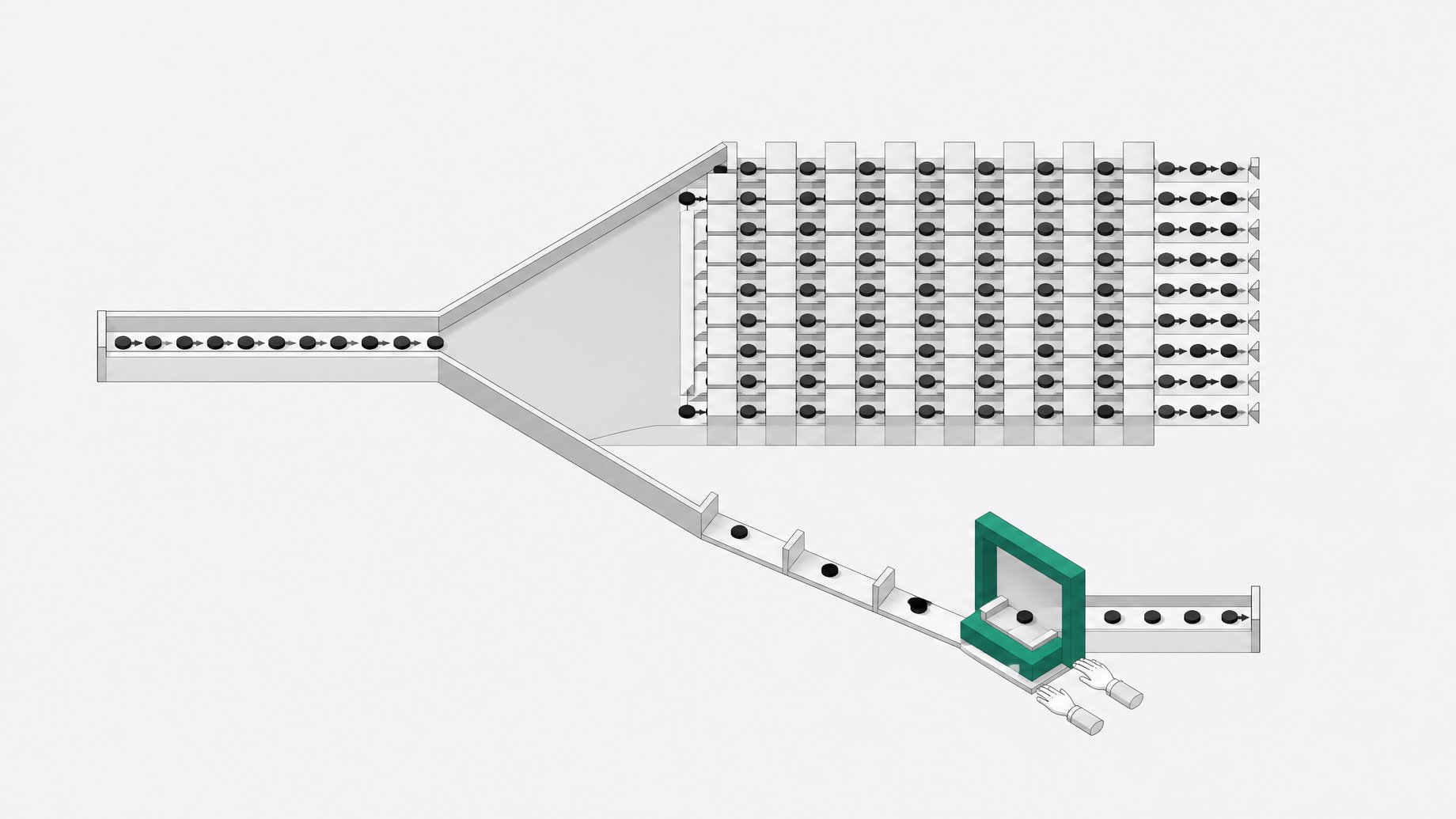
The architecture that emerged looks less like "AI versus humans" and more like a division of labor: AI absorbs routine, high-volume, low-ambiguity requests, and trained humans own anything with emotional weight, legal exposure, or genuine complexity. That split shows up whenever a company tries to build durable automation around a workflow that touches real customers rather than internal tooling. The question isn't whether AI can do the job. It's whether the organization has built a reliable path for the cases AI can't handle, treating human escalation as a built-in part of the system rather than an afterthought.
How did the IPO and business pressure shape the shift?
None of this happened in a vacuum. Klarna's headcount fell from 5,527 full-time employees at the end of December 2022 to 3,422 by the end of December 2024, a roughly 40% reduction that the company's own IPO prospectus partly attributed to AI leverage. Siemiatkowski confirmed the shrinkage directly to CNBC, calling it "the truth" about where the company's workforce had landed.
Klarna delayed its IPO in April 2025 amid tariff-driven market volatility, then filed to go public again in September 2025, planning to raise roughly $1.27 billion. The timing matters. The AI-first narrative built investor appeal around cost discipline and operating leverage, and the human-support correction landed right as Klarna needed to show both efficiency and durability to public-market investors. A company heading into an IPO has every incentive to tell a clean story about AI-driven margins. It also has every incentive to avoid a customer-satisfaction crisis landing in headlines during the roadshow.
What lessons apply to companies automating mission-critical workflows?
Klarna's experience is less a cautionary tale about AI failing and more a case study in what happens when a single metric set, speed and cost, gets treated as the whole picture. A few takeaways carry past customer service:
- Measure quality separately from speed and cost. Klarna's 2024 numbers were all throughput metrics: resolution time, repeat-contact rate, profit impact. None of them captured whether customers with hard problems were being served well. Satisfaction and escalation rates need their own dashboard, not a footnote.
- Don't let automation outrun institutional knowledge. When outsourced agent headcount dropped from 3,000 toward 2,000, Klarna lost depth exactly where complex cases needed it most. That's the same failure mode behind AI incident response breaking down when something goes seriously wrong: nobody left who understands the system well enough to fix the hard cases fast. Preserving a core of experienced staff who can handle the long tail isn't redundancy. It's insurance.
- Build the human escape hatch before you need it, not after. Klarna's fix was a 100-person specialist team and a flexible agent pool, built in response to a crisis. Designing that layer up front, as a permanent part of the architecture rather than a recovery plan, is cheaper and faster.
- Treat vendor and internal claims about AI as claims, not proof. Even at Klarna's celebrated peak, independent testing found the assistant mostly routed users to documentation and human agents rather than fully resolving complex requests. The gap between a press release and daily reality is often where the real story lives.
- Expect most AI deployments to underdeliver on scale, not just quality. Only about 1 in 4 enterprise AI projects deliver their promised ROI, and just 16% get scaled company-wide, according to an IBM survey of 2,000 CEOs. Klarna's assistant did scale and did deliver measurable efficiency. What it lacked was a plan for the fraction of cases efficiency metrics don't capture.
Klarna didn't abandon its AI bet. By its own account, the assistant now does more work, not less, than it did in 2024. What changed is the assumption that AI could carry the whole workflow unsupervised. The company that announced it had replaced 700 agents ended up proving, in public, exactly where that replacement stops.
Frequently Asked Questions
Why did Klarna bring back human customer service?
CEO Sebastian Siemiatkowski said cost had become too dominant a factor in how Klarna organized its AI-first support model, and quality suffered as a result. In May 2025 he launched a recruitment drive so customers would always be able to reach a human, while keeping the AI assistant in place for routine requests.
Did Klarna actually replace 700 jobs with AI?
Not direct employees. The 700-agent figure referred to outsourced customer service providers, not Klarna staff. The company normally needed about 3,000 outsourced agents; after the AI launch that fell to a little over 2,000.
Is Klarna using less AI now than it was in 2024?
No. Siemiatkowski told Big Technology that the AI assistant's workload grew to roughly 800, and later reporting put it near 850 agent-equivalents, up from the original 700. What changed was the addition of a human layer for complex cases, not a reduction in AI use.
What did Klarna change about its customer service model?
Klarna added a roughly 100-person specialist team for complex and sensitive cases, piloted a flexible gig-style human agent model, and began redeploying its own engineers, marketers, and other staff into support roles ahead of its IPO.
What's the broader lesson from Klarna's AI reversal?
Speed and cost metrics can look great while quality quietly degrades on complex, high-stakes cases. Companies automating mission-critical workflows need separate quality metrics, a preserved human escalation path, and skepticism toward any single efficiency number used to justify full automation.
How we source, write, and correct our articles. Editorial standards