5 Examples of AI Agents Replacing Software (And Where They Still Fall Short)
From CAD licenses to customer service queues, AI agents are already displacing specific categories of software. Here's what the data actually shows, and where the replacement stops.

- 01Over 35% of surveyed teams have replaced at least one SaaS tool with a custom AI-built alternative.
- 02Despite logging $60 million in AI-driven savings, Klarna's customer service costs still rose in 2025.
- 03AI agents now create 80% of new databases on Databricks, displacing traditional subscription dev tools.
- 04Purchased AI tools succeed 67% of the time, roughly twice the success rate of internal AI builds.
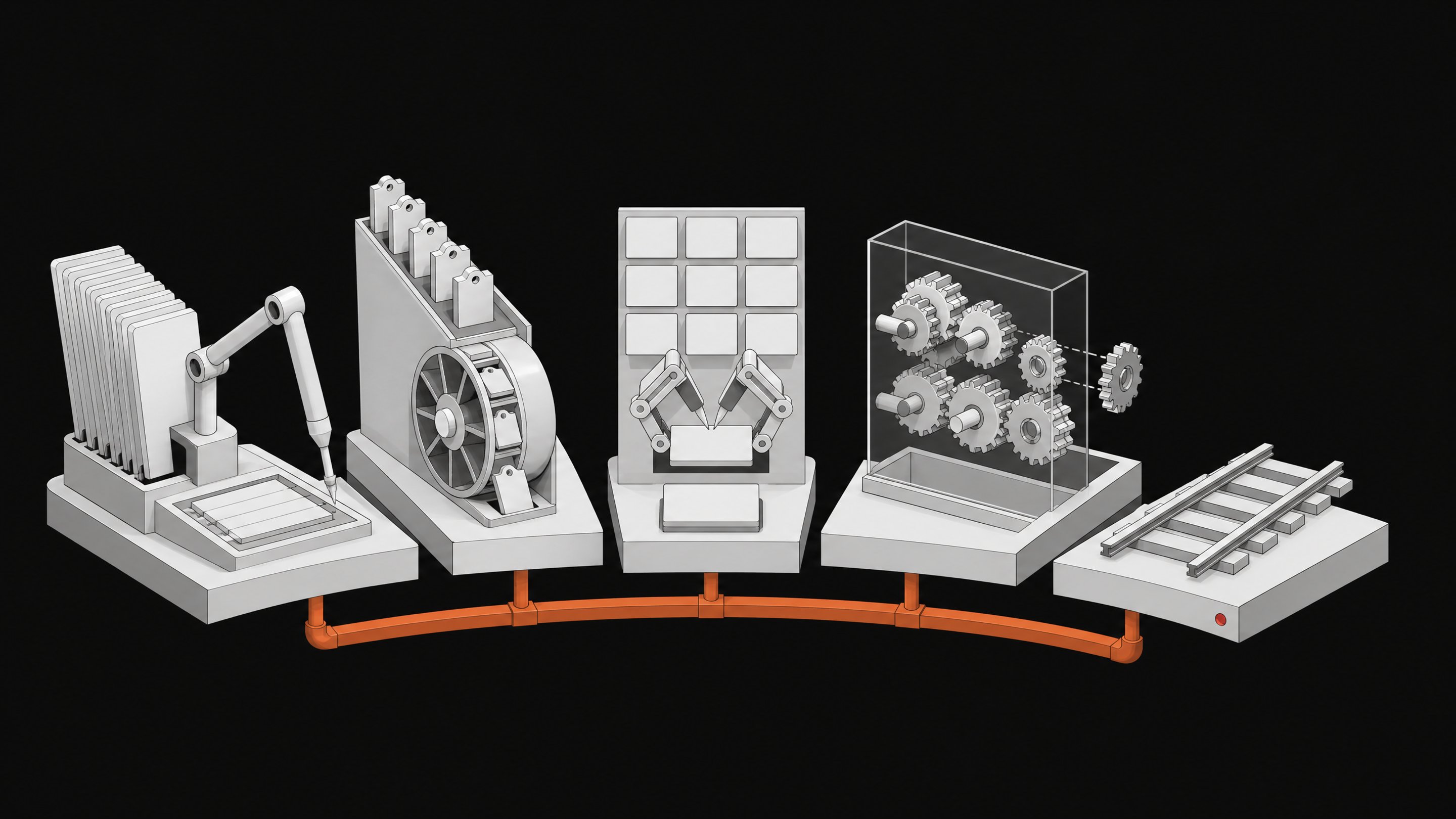
AI agents are already replacing purchased software in four categories: workflow automation tools, CAD licenses, internal admin apps, and parts of customer support. Full replacement of software teams is rarer. It depends heavily on governance, and it often gets reversed within a year or two.
This isn't a thought experiment. Gartner logged a 1,445% surge in enterprise inquiries about multi-agent systems between Q1 2024 and Q2 2025.1 Databricks found multi-agent system usage on its platform grew 327% in just four months.2 Something changed in how companies buy software, and it's showing up in real budgets, not roadmap slides.
Here are five places it's happening right now, plus the caveats that keep this from being a clean story.
1. Workflow automation and internal admin tools are the first to go
This is the least controversial category. The evidence is already in the numbers. Retool's 2026 Build vs. Buy Report found that 35% of surveyed teams have already replaced at least one SaaS tool with a custom AI-built tool, and 78% plan to build more in 2026.3 Workflow automation and internal admin tools top the list of SaaS categories most at risk, cited by 35% and 33% of respondents respectively.3
The case studies behind those numbers are concrete. ClickUp built six AI tools connected to Salesforce, Zendesk, and Snowflake instead of buying more automation software, cutting $200,000 a year in software spend on top of avoided headcount costs.3 Harmonic replaced a $20,000-a-year third-party tool by rebuilding it internally and now runs 33 internal apps.3
This is the category where the math is simplest: a narrow, well-understood internal process, a known integration surface, and a build cost that AI coding agents have pushed down far enough to beat a subscription. Teams reaching this conclusion increasingly turn to platforms like Remy to spin up these internal tools without staffing a full engineering effort for each one. It's the same category-by-category substitution covered in our guide to self-hosted alternatives to SaaS.
Are AI agents actually replacing customer service jobs?
Klarna is the case everyone cites, and for good reason. By Q3 2025, the company's AI customer service agent was doing the work of 853 full-time-equivalent agents, up from 700 at its 2024 launch, and Klarna credits it with $60 million in annual savings while automating roughly two-thirds of chats.4
But the fuller number tells a different story. Even with those savings, Klarna's customer service and operations costs were $50 million in Q3 2025, up from $42 million a year earlier.4 The company began rehiring human customer service staff in May 2025 after customers complained about generic, unresolved answers to complex queries.4
Gartner's forecast suggests Klarna's pattern will repeat elsewhere. The firm predicts that by 2027, half of companies that attributed customer-service headcount cuts to AI will rehire staff to do similar work, often under different job titles.5 That's not a failure of the technology. It's evidence that customer support replacement works well for volume and triage, and badly for anything that requires judgment or de-escalation.
Can an AI agent replace your CAD license?
This is the least talked-about example, and one of the clearest. Zoo.dev's Zookeeper is a conversational CAD agent built on a text-to-CAD engine that generates production-ready, boundary-representation 3D models from natural-language prompts.67 It's positioned not as a plugin for existing CAD software but as a native alternative to it.
The economics are stark. Zoo.dev charges $0.50 per minute of API usage after a free monthly allowance.8 A single SOLIDWORKS Standard seat runs $2,820 a year, and the Premium tier runs up to $4,716.9 A single AutoCAD subscription costs $2,095 a year.10 Even heavy usage of a pay-as-you-go text-to-CAD agent is hard to push past traditional per-seat licensing costs.
The academic backing matters here too. A framework developed by researchers at ETH Zürich and Inspire AG used an LLM-agent workflow with a visual-inspection feedback loop to generate CAD geometries from text prompts, hitting success rates over 50% for most geometry types, compared to roughly 25 to 45% for single-shot baseline approaches.11 The same team carried a topology-optimized aerospace bracket from a text prompt through additive manufacturing on a metal 3D printer with minimal human input.11 That's not a demo. That's a design-to-part pipeline running with an agent in the loop instead of a licensed CAD seat.
4. Multi-agent coding teams are replacing dev-tool subscriptions, and some work outside engineering
The most self-referential example is agents replacing the tools used to build software. Databricks' 2026 State of AI Agents report found that AI agents now create 80% of new databases on its platform and generate 97% of database testing and development branches, up from just 0.1% two years ago.2 Multi-agent system usage on the platform grew 327% in four months.2
That kind of growth reshapes what a subscription-based dev tool stack even needs to include. Teams running coordinated agent workflows for testing, provisioning, and code review are quietly displacing tools that used to require dedicated seats, an idea explored further in our breakdown of self-hosting a serious AI coding agent stack. Retool's build vs. buy data reinforces the direction: teams that already build one internal tool with AI assistance are far more likely to build the next one instead of shopping for it.3
5. Shadow AI: employees are building the replacements IT never approved
The least visible version of this shift is happening without a purchase order at all. Retool found that 60% of builders have built software, workflows, or automation outside official IT oversight in the past year, with 31% saying they can build faster than IT and 25% saying existing SaaS tools don't meet their needs.3
PagerDuty's shadow AI survey adds the risk side of that picture. Sixty-six percent of office professionals at companies with $500 million or more in revenue have used AI tools at work they believed were not permitted by company policy.12 Eighty-eight percent have shared work-related information with public AI tools like ChatGPT, Claude, or Gemini, and 31% have shared financial or confidential company documents through them.12
This is the part of the story that doesn't show up in a vendor's case study. Software is getting replaced by agents built inside individual teams, on personal accounts, with no security review. That's not a build-vs-buy decision. It's a governance gap, and it's growing faster than most IT departments can track.
Why full replacement is harder than the headlines suggest
The caveats aren't small. MIT NANDA's 2025 research on generative AI adoption found that 95% of generative AI pilots fail to deliver measurable business return.13 The same research found tools purchased from specialized vendors succeed about 67% of the time, roughly twice the rate of internally built AI tools.13 Building your own replacement is not automatically the safer bet.
Reasoning limitations are still real too. Mercor's APEX-Agents benchmark tested leading models from Google, Anthropic, and OpenAI on complex multi-tool reasoning tasks, and none answered more than 25% of the questions correctly.14 Databricks' own data shows only 19% of organizations have deployed AI agents beyond limited pilots.2 The headline numbers about agents replacing software are true in narrow, well-scoped categories. They get shakier once the task requires judgment, multi-step reasoning across unfamiliar tools, or an edge case nobody wrote a prompt for.
What this means for build vs. buy decisions now
The pattern across all five examples is consistent: agents replace software fastest in categories with narrow scope, clear success criteria, and low blast radius when something goes wrong. Here's a rough way to sort what you're looking at:
| Task scope clarity | Evidence strength | Risk if the agent is wrong | Human oversight needed | |
|---|---|---|---|---|
| Workflow automation & internal admin toolsnarrow, well-scoped internal processes | High | Strong (Retool, ClickUp, Harmonic case studies) | Low | Low |
| CAD & design generationbounded design tasks with clear success criteria | High | Strong (Zoo.dev pricing, ETH Zürich/Inspire AG research) | Low | Low |
| Customer support & triagehigh-volume, low-ambiguity requests | Medium | Mixed (Klarna savings alongside rehiring) | Medium | Medium |
| Complex multi-tool reasoning tasksnothing yet, without heavy human review | Low | Weak (Mercor APEX-Agents under 25% accuracy) | High | High |
- Safe to replace now: workflow automation, internal admin tools, CAD and design generation, routine dev-environment provisioning. These have bounded inputs, and a bad output is cheap to catch and fix.
- Replace with a human in the loop: customer service and support triage. Klarna's experience shows agents handle volume well but need an escalation path for anything ambiguous.45
- Not ready for full replacement: compliance-heavy workflows, anything requiring multi-tool reasoning under ambiguity, and any process where a shadow AI build could leak confidential data.1214
The practical move isn't picking a side between building and buying. It's matching the category to the evidence. Workflow automation and CAD generation have real numbers behind agent replacement. Customer service has real numbers behind both the savings and the rehiring. And the shadow AI trend means some of this replacement is already happening inside your company whether IT signed off or not, which is exactly why governance needs to catch up to the builders before the builders catch up to the company's risk tolerance.
Documented cases include Zoo.dev's text-to-CAD agent replacing CAD license seats, Klarna's customer service agent handling work equivalent to 853 full-time agents, ClickUp and Harmonic building internal tools to replace SaaS workflow automation and admin apps, and AI agents generating 80% of new databases on Databricks' platform.
Not yet in most cases. MIT NANDA research found 95% of generative AI pilots fail to deliver measurable business return, and Databricks found only 19% of organizations have deployed AI agents beyond limited pilots. Replacement is real but concentrated in narrow, well-scoped software categories.
Klarna's AI agent saved an estimated $60 million a year and handled the workload of 853 agents, but customers complained about generic answers to complex queries, prompting rehiring in May 2025. Gartner predicts 50% of companies that cut customer service headcount due to AI will rehire by 2027.
Retool's 2026 survey found workflow automation (cited by 35% of respondents) and internal admin tools (33%) are seen as the SaaS categories most likely to be replaced by custom AI-built tools, ahead of other software categories.
Shadow AI is software or automation employees build using AI tools without IT approval. Retool found 60% of builders have done this in the past year, and PagerDuty found 66% of office professionals have used AI tools they believed violated company policy, with 88% sharing work information with public AI tools.
- 1Multiagent Systems in Enterprise AIGartner
- 2State of AI Agents 2026Databricks
- 3The build vs. buy shift: how vibe coding and shadow IT have reshaped enterprise softwareRetool
- 4Klarna says its AI agent is doing the work of 853 employeesCX Dive (Informa TechTarget)
- 5Gartner Predicts Half of Companies That Cut Customer Service Staff Due to AI Will Rehire by 2027Gartner
- 6Zookeeper: The Conversational CAD Agent For Parametric ModelingZoo (docs.zoo.dev)
- 7Zoo: ML CAD Model Generator | Create CAD Files With Text (Zookeeper)Zoo.dev
- 8Turning on billing for Text-to-CADZoo.dev
- 9SOLIDWORKS Design Offer Plans and PricingDassault Systèmes / SOLIDWORKS
- 10AutoCAD License & Subscription FAQAutodesk
- 11From text to design: a framework to leverage LLM agents for automated CAD generationCambridge University Press (Proceedings of the Design Society, ICED25) — authors from Inspire AG / ETH Zürich
- 12PagerDuty Report Finds Two-Thirds (66%) of Office Professionals Have Used Unauthorized AI Tools at WorkPagerDuty
- 13MIT report: 95% of generative AI pilots at companies are failingFortune
- 14AI Is Eating SaaS Alive — and Enterprise Software May Never Be the SameBuilt In