Is Local AI Worth It? Cost vs ChatGPT and Claude Plans
Break-even math on local AI: a $4,000 machine over three years versus ChatGPT or Claude plans, plus what data sovereignty and access are worth.

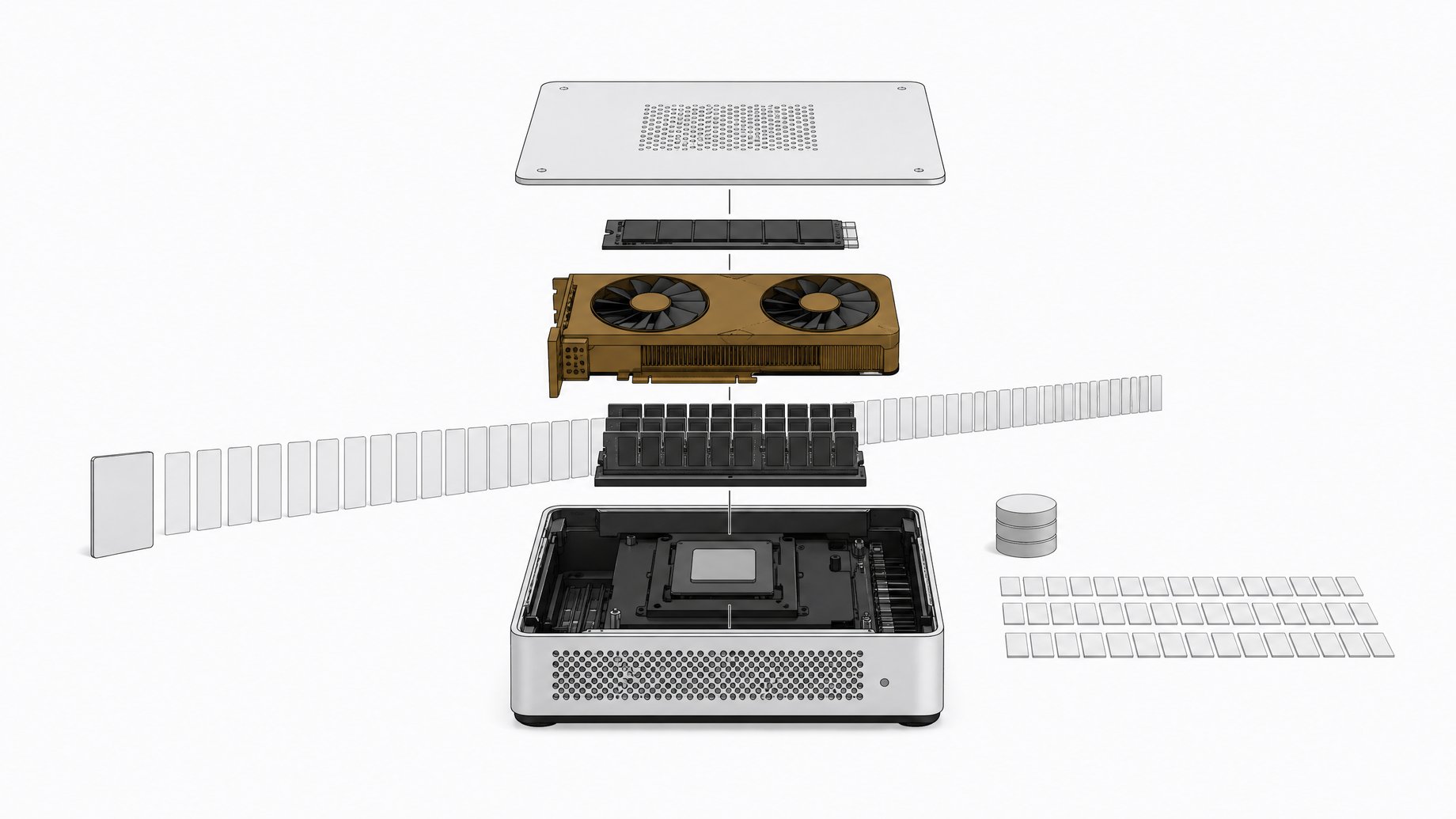
Is local AI worth it compared with ChatGPT or Claude?
For most people, not on cost. A $4,000 machine amortized over three years comes to about $111 a month before electricity, which is more than a $20 plan and roughly the price of a $100 plan. The models you can run on that hardware also sit below the frontier. Local AI earns its place through data sovereignty, guaranteed access, and offline use, not savings.
TL;DR
- Amortized hardware costs more than a typical plan. $4,000 over 36 months is about $111 a month, against $20 to $100 a month for common ChatGPT and Claude tiers.
- Local models trail the frontier. Near-frontier open-weight models are huge and do not fit on consumer hardware, even quantized.
- Tokens per second decides usability. Roughly 15 to 30 is only good for simple Q&A, while 70 to 100 is workable, and both numbers get split across any parallel agents.
- Local and open-weight are different things. Open-weight models hosted by a cloud provider are not local, and they can be very strong.
- The real case for local is control. Your data stays home, no lab can cut you off, and the model works without internet.
- Setup is still a hobbyist task. Even tools built to simplify it, like LM Studio, require you to think about hardware and model differences.
What is the difference between local AI and open-weight AI?
People use the terms interchangeably. They are not the same.
Local AI means the model runs on your own device. Disconnect the internet, ask a question, and it still answers.
Open-weight (often called open-source) AI means a lab has published the model's weights for anyone to download. Every local model has to be open-weight. The reverse is not true. Cloud providers and neoclouds take open-weight models, load them onto their own GPUs, and serve them to customers. That is open-weight AI without being local.
The distinction matters for the cost argument. The strongest open-weight models, generally a step below the best closed frontier models, are massive. Serving them takes racks of GPUs, which means hundreds of thousands or millions of dollars of hardware for a handful of users. You can use them cheaply through a host, but you cannot run them at home.
How much does local AI cost per month?
Start with what you pay now. The subscription tiers mentioned in the discussion run from $20 to $100 a month, with heavier plans at $200 and $500 for people who hit usage limits.
Now amortize a local rig. Divide the purchase price by the months you expect to use it:
| Hardware budget | 3 years (36 mo) | 4 years (48 mo) | 5 years (60 mo) |
|---|---|---|---|
| $4,000 | ~$111/mo | ~$83/mo | ~$67/mo |
| $5,000 | ~$139/mo | ~$104/mo | ~$83/mo |
| $8,500 | ~$236/mo | ~$177/mo | ~$142/mo |
These figures cover hardware only. Electricity and your setup time come on top, and neither is free.
For reference, the source cites an RTX 4090 at close to $5,000 and an RTX 5090 with 32 GB at about $8,500, and notes the 5090 is hard to find at all. Prices like these push the break-even point further out.
The comparison against a $20 plan is lopsided. You would need years of use before a $4,000 machine matched what a basic subscription costs, and by then the hardware may be outdated. Against a $200 plan the math gets closer, but only if the local setup can do the same work.
Does local hardware actually match frontier quality?
No, and the gap comes down to model size. Getting near frontier intelligence means running some of the largest open-weight models available, in the range of trillions of parameters. Those do not run on consumer hardware.
Quantization helps. It shrinks a model so it fits in less memory, at some cost in quality. Even then, you are limited in speed.
A single high-end consumer card can run a compact model. The source gives one example: an RTX 4090 running a roughly 27B-parameter Qwen model with a tight fit, producing about 25 to 40 tokens per second. That is a capable model for its size, but it sits at the low end of usable and is not a stand-in for a frontier model on hard work.
If you want the plot on an intelligence-index versus monthly-cost chart, local setups cluster at moderate intelligence and a monthly cost near or above the subscriptions. Frontier plans sit higher on intelligence at a lower monthly price. The exceptions are expensive multi-GPU builds, which close some of the gap but cost far more.
Why do tokens per second matter so much?
Social posts about local AI tend to report which model someone got running. They rarely report speed, and speed decides whether the setup is useful.
- 15 to 30 tokens per second with one agent: basically not usable beyond simple questions and answers.
- 70 to 100 tokens per second: quite usable, but for a single agent.
Parallelism is the harder limit. One GPU running inference has a fixed token budget. Run five or ten agents at once and that budget gets split across all of them. Frontier services handle this by spreading load over data centers. A home machine cannot, unless you build something close to a small data center with racks of DGX Spark units or several 5090s. That route can run a large model, but it still will not match frontier speed or total output, and it costs a lot of money and time to get working.
Is there any cost advantage to running local 24/7?
Yes, in one narrow case. You have already paid for the hardware, so the more tokens you push through it, the more effectively you spread its cost over three, four or five years. A local model can run around the clock on background jobs. A subscription will hit quota limits first, and the next step up is a $200 or $500 plan.
This only pays off if you have enough useful work to feed the machine, and if the local model is good enough to do that work. An idle GPU is just an expensive depreciating asset.
What are the real benefits of local AI?
Cost is the weakest argument. The stronger ones are about control.
- Data sovereignty. With hosted AI you send your data to the provider. Many people already accept this with email, documents, and social media. Still, keeping data on your own machine is a real advantage, and it matters more for companies than for individuals.
- Access you can't lose. Labs can change what their subscriptions allow. The creator in the source points to Anthropic restricting use of its subscriptions with OpenClaw at that tool's peak, with the rules shifting repeatedly. OpenAI has historically been more permissive, but any lab can cut you off if its business incentives change. A model on your disk can't be revoked.
- Offline use. Local models work with no connection. For people with reliable cellular or satellite internet this is an edge case. It still makes sense as a backup, and in that scenario you probably don't need frontier quality or high speed.
- Owning your intelligence. Some people dislike the idea that everyone depends on a few frontier labs for intelligence. Running models at home spreads that power out.
Who is local AI for right now?
Mostly hobbyists and people with a specific privacy or access requirement. Setup is hard even for experienced engineers. You have to account for GPU architectures, operating systems (Windows, Mac, Linux), parameter counts, and model architectures that vary a lot between releases. LM Studio is among the easiest ways in, and it still isn't plug-and-play.
If your goal is getting work done today, a hosted frontier model is the practical default. If your goal is control, or you enjoy tuning systems, local is a reasonable hobby and a hedge. Consider a hybrid: use a subscription for hard tasks and a smaller local model for private or offline work.
Frequently Asked Questions
Is running AI locally cheaper than a ChatGPT or Claude subscription?
Usually not. A $4,000 machine over three years is about $111 a month before power, and that buys a weaker model than the frontier. A $20 plan is far cheaper, and even a $100 plan roughly matches the amortized hardware cost.
Is local AI the same as open-source AI?
No. Open-source or open-weight models have published weights that anyone can use. Local AI means running such a model on your own device. Many open-weight models are hosted by cloud providers and are not local.
What speed do I need for a local model to be usable?
The source suggests 15 to 30 tokens per second is only good for simple questions, while 70 to 100 is quite usable. Those speeds hold for one agent. Running several tasks in parallel divides the throughput among them.
When does local AI make sense despite the cost?
When you need data to stay on your machine, want protection from a lab changing its rules, or need offline access. Heavy 24/7 workloads can also justify it, since hardware you already own has no quota.
Can I run the best open-weight models at home?
Generally no. The strongest ones are very large and need racks of GPUs. Quantization shrinks them, but you lose some quality and still face speed limits on consumer hardware.
How we source, write, and correct our articles. Editorial standards