Frontier vs Open-Weight Model: How to Decide With Step-Down Tests
How to decide if you can replace a frontier model with a self-hosted open-weight one: build a swap layer, step down generation by generation, then fine-tune.

How do you decide whether to replace a frontier model with a self-hosted open-weight one?
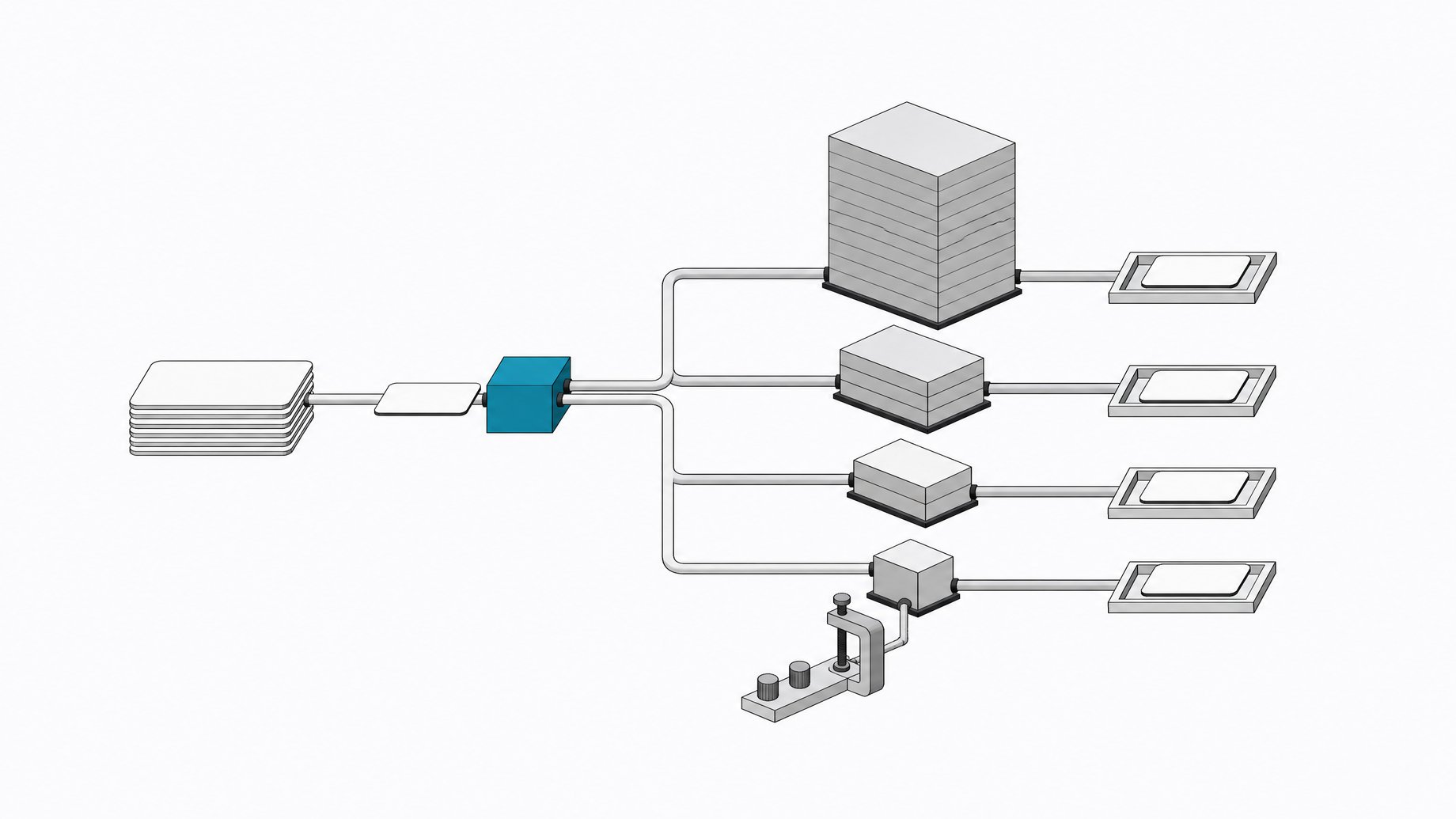
Run a step-down test. Build a layer that lets you swap models with one change, then send your real tasks to the smartest model available. If it passes your quality bar, move back one generation and test again. Repeat until quality fails. If the last passing model is at or below the level of the best open-weight model, self-host that open model and fine-tune it for your tasks.
TL;DR
- Build a swappable model layer first, so switching providers or models is a configuration change, not a rewrite.
- Start testing at the top, with the smartest model you can access, to learn whether your task is solvable at all.
- Step back one generation at a time and stop when output drops below the quality bar your organization sets.
- Compare the stopping point to the best open-weight model. If the open model matches or beats the last passing model, self-hosting is on the table.
- Fine-tuning is where open weights pay off, especially for repetitive, well-documented tasks where you hold lots of examples.
- Owning the stack removes a dependency. No provider can change terms, raise prices, or cut you off.
Why are companies looking at open-weight models at all?
The argument in the source material comes down to three points: price, capability headroom, and control.
On price, the creator cites Anthropic's Claude models at roughly $2 to $10 per million input tokens and OpenAI's flagships at roughly $10 to $60 per million input tokens (higher with fast modes), with output tokens costing more. He contrasts that with Moonshot's Kimi K3.1 Pro at about $2 per million input tokens through Moonshot's own hosted API. Treat these as a snapshot. Prices move often, so check current rate cards before you build a business case.
On capability, the claim is that most business tasks no longer need the top model. The Lindy founder is quoted as saying, "you don't need God to write your email." Many workloads are routine: drafting, classification, customer support replies, simple UI generation. A model that is fast and reasonably capable can handle them.
On control, the concern is that sending queries to a closed provider means your prompts, processes, and intellectual property leave your company. Running open weights on your own hardware keeps that data inside your boundary.
The source also reports a broad shift in usage. It says Chinese models now carry a large share of OpenRouter tokens and that companies such as Coinbase and Airbnb use them. I could not verify those figures independently here, so treat them as the creator's claims. The decision procedure below does not depend on them being exact.
How does step-down testing work?
The procedure has five steps.
| Step | Action | Pass condition |
|---|---|---|
| 1 | Build a model-agnostic layer | One switch routes all requests to a different model |
| 2 | Run your task on the smartest available model | It meets your quality bar |
| 3 | Move back one generation and retest | Quality still meets the bar |
| 4 | Repeat until quality fails | You find the oldest or cheapest model that passes |
| 5 | Compare against the best open-weight model | Open model is equal or better, so self-host |
The logic is simple. The top model tells you whether the task is feasible. Each step back tells you how much capability you are paying for and not using. The failure point shows how much intelligence the task really needs.
What should the model layer look like?
The first step is infrastructure, not model selection. The source describes building something like OpenRouter inside your company. OpenRouter is a marketplace that exposes many models behind one API, giving your agents a replaceable call format.
Your internal version should let you press one button, or change one config value, and send every request to a different provider. That means keeping the request structure consistent, including how you pass reasoning effort settings and other parameters. A few practical points:
- Keep prompts, tool definitions, and output schemas in your own code, not tied to one vendor's SDK.
- Normalize responses so downstream code does not care which model answered.
- Log inputs and outputs per model so you can compare them later.
- Keep one evaluation set of real tasks you can replay against any model.
Without this layer, step-down testing is painful. With it, each generation test is a quick replay.
How do you set the quality bar?
The source says to continue until the model "can no longer do your task at the level of quality you within your organization believe it needs to." That bar is yours to define, and it should be written down before you test.
Use real examples from production, not public benchmarks. Benchmarks help you pick candidates, but your own data decides. Include hard cases and edge cases. Decide in advance who grades the outputs, whether humans, an automated check, or a mix. For structured tasks, such as extraction or classification, scoring is easy. For open-ended writing, expect to invest in a rubric.
Also test for the things benchmarks skip: latency, formatting consistency, and how often the model refuses or goes off script.
Is the best open model good enough to replace the winner?
At step five, you compare two things: the oldest or cheapest model that still passed, and the best open-weight model available. The rule from the source is direct. If the passing model is at or below the level of the best open model, go open.
The creator uses Kimi as the example. He notes that frontier models from Anthropic and OpenAI were close to Kimi K3.1 Pro on a range of benchmarks at the time of recording, and that its base intelligence may look slightly lower than Opus on some tests. He also says Moonshot planned to release the full K3.1 Pro weights on Hugging Face on a stated date. Check the actual release status and license terms yourself before planning around it. Licenses vary on commercial use, redistribution, and modification, and your legal team should read them.
If your task needs something beyond what any open model passes, stay with the frontier model. The test is meant to give you that answer too.
What does it take to self-host and fine-tune?
Self-hosting is not free. Large open models need serious GPU capacity, and the source acknowledges you should "verify you have the infrastructure or the means to acquire" it. The creator frames this as realistic for larger companies with the budget to spin up their own clusters, or to rent capacity from a provider they trust. I have no primary hardware figures for Kimi models here, so get exact memory and throughput requirements from the model's own documentation before sizing anything.
Once the model runs, the sequence is:
- Get it serving on your infrastructure.
- Optimize for speed or cost, for example with quantization or a tuned serving stack, and re-run your evaluation set to confirm quality held.
- Fine-tune on your own task data.
Fine-tuning matters most for repetitive work where you have many examples of the task done correctly. The source argues this is where open models can beat a larger general model: a tuned model on a narrow, rote task can outperform a stronger model that was never trained on your patterns.
What are the trade-offs and risks?
Self-hosting changes your cost structure. You trade per-token fees for fixed infrastructure and engineering time. At low volume, the hosted API may be cheaper. At high, steady volume, owning the hardware can win.
Using a hosted open model is not the same as self-hosting. In the source's demo, the creator notes that using the Kimi chat app sends data to the provider's servers, presumably in China. The privacy benefit only applies when you run the weights on infrastructure you control.
There is also the question of provenance. The creator mentions open questions about how some of these models were trained. Your security and legal reviewers should weigh that.
Finally, keep the swap layer in place after you switch. New models arrive often, and the step-down test is worth rerunning periodically.
Frequently Asked Questions
Do I need to start with the most expensive model?
Yes, at least for a first pass. Testing the strongest model tells you whether the task is achievable and sets a ceiling for comparison. Stepping down from a known pass is easier to reason about than stepping up from a failure.
What if the open-weight model is better than the last passing proprietary model?
Then self-hosting is a strong candidate. The rule is to go open when the open model is at or above the level you need. You still need to confirm that your infrastructure budget and the model's license fit your situation.
Is fine-tuning required?
No. You can self-host a base open model and stop there if it meets your bar. Fine-tuning is an optional step that tends to help most on narrow, repetitive tasks where you have plenty of good examples.
Does using a Chinese open-weight model mean my data goes to China?
Not if you self-host the weights. The source makes this distinction: using the provider's hosted app or API sends data to their servers, while running downloaded weights on your own hardware keeps data within your company.
How often should I repeat the test?
Whenever a significant new model ships, or when your task changes. Because the model layer makes replays cheap, rerunning your evaluation set on a schedule is a reasonable habit.
How we source, write, and correct our articles. Editorial standards