Local AI Hardware vs. ChatGPT Plus: Which Costs Less?
Compare a $1,000-$2,500 local AI rig with ChatGPT Plus or Claude Pro: break-even in 11-24 months, electricity costs, and open-model quality tradeoffs.

Is local AI hardware cheaper than ChatGPT Plus or Claude Pro?
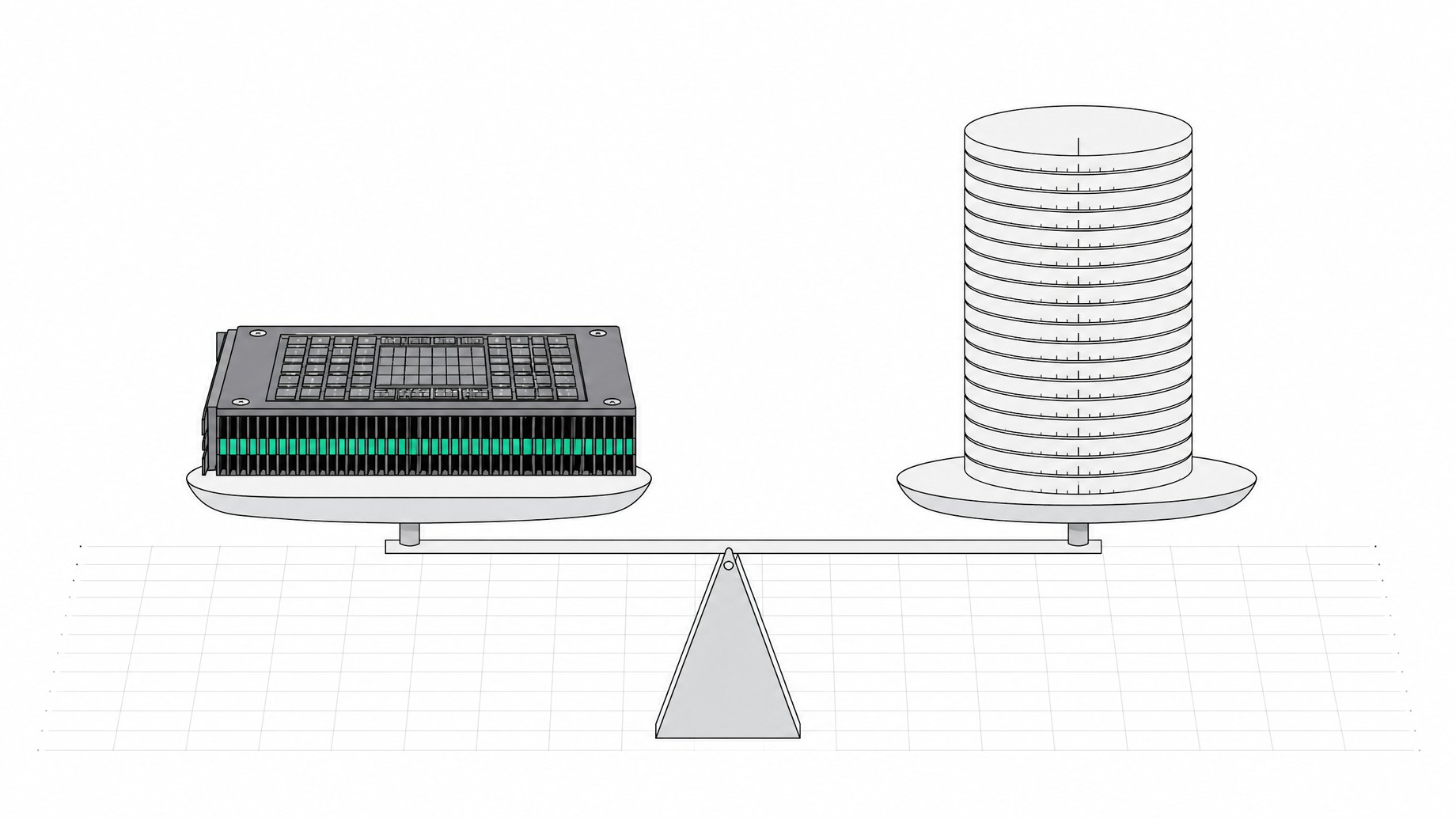
A $1,000-$2,500 local AI workstation built around a used RTX 3090 or an Apple Silicon Mac typically breaks even against a single ChatGPT Plus or Claude Pro subscription in about 11-24 months, and against a multi-seat SaaS AI stack in a matter of months. Whether that math works for you depends on how many hours a week you actually use the thing, and whether you can live with open-weight models that still trail the frontier by a real, shrinking margin.
TL;DR
- A used RTX 3090 or Apple Silicon workstation typically breaks even in about 11-24 months against a single ChatGPT Plus or Claude Pro subscription.
- Power users quickly burn through base plans, so serious users get pushed up to expensive pro tiers at $100 to $200 a month.
- Once the hardware is bought, electricity is the only recurring cost, roughly $15-$40 a year at typical usage.
- At team scale, a one-time on-premise box crosses over per-seat subscription spend early in year two, against roughly $3,600-$4,500 a year for 15 seats.
- Open-weight local models still trail frontier cloud models by roughly 4 to 10 months in capability.
- Light users under 5 hours a week of AI usage should keep renting, since the breakeven window never arrives for them.
What does $1,000 to $2,500 buy in local AI hardware?
The entry point for serious local inference is a used NVIDIA RTX 3090. It has 24GB of VRAM and 935GB/sec of memory bandwidth, which is why it's the GPU r/LocalLLaMA keeps recommending over newer, more expensive cards. Prices moved around in 2025, from a 12-month average near $958 up to $1,199 on eBay at peaks, down to roughly $700 in quieter stretches. Build a rig around one of those and you land in the $1,000-$1,500 range, capable of running 13B-30B parameter models comfortably and 70B models in quantized form.
Three rough tiers to think in:
- Budget tier (~$500-$900): An RTX 5060 Ti or similar 16GB card, good for 7B-13B models. One cost model puts a full 3-year total of ownership for this tier, hardware plus electricity, at $490.
- Mainstream tier (~$1,000-$1,500): A used RTX 3090, the sweet spot for 24GB VRAM and real 30B-class performance.
- Frontier-adjacent tier ($2,000-$5,000+): Dual RTX 3090s, an RTX 4090, or a Mac Studio/DGX Spark with 64-96GB of unified memory. This is the tier where 70B models, which need roughly 40-45GB of VRAM at 4-bit quantization, actually fit and run.
That top tier is where local AI stops meaning "a decent chatbot you own" and starts meaning "frontier AI you own." The case for owning your AI compute gets a lot stronger once a unified-memory Mac can hold a 70B model in RAM, no subscription meter running.
What does a ChatGPT or Claude subscription actually cost?
The "it's just $20 a month" framing hides how many tiers actually exist. ChatGPT's current ladder runs Free, Go at $8/month, Plus at $20/month, three Pro tiers at $100, $200, and $500/month, and Business and Enterprise plans priced per seat. Over three years, Plus alone totals $720; Pro at $200/month runs $2,400 a year.
Claude's ladder mirrors this almost exactly: Pro at $20/month, then two Max tiers at $100/month (5x usage) and $200/month (20x usage). The gap between the entry tier and what power users actually need isn't theoretical. One developer tracking Claude Code usage found that a real day of Opus-driven coding work burns $100-$500 in raw API tokens, and that the $200/month Max 20x tier "pays for itself in about two productive days" against buying that usage à la carte. Pro's quota gets exhausted fast under real coding load, which is exactly why serious users keep getting pushed up the ladder.
Teams compound this further. ChatGPT Business runs roughly $20-25 per user per month; fifteen people on it costs around $3,600-$4,500 a year before adding Copilot-style tools on top. Multiply that across a company and you land in a broader trend: average SaaS spend per employee hit $4,830 in 2025, up 21.9% year over year, driven largely by AI tool adoption. The $20 line item was never staying $20 once a team is involved.
There's also a second cost line that catches builders off guard: the API bill. OpenAI's GPT-4o API bills per token, separate from any ChatGPT subscription, at $2.50 per million input tokens and $10 per million output tokens. For teams embedding AI into a product instead of a chat window, that usage-based bill can run into the tens of thousands of dollars a month at volume, with no ceiling.
Is electricity really the only recurring cost of local AI?
Once the hardware is bought, the only recurring cost of local inference is power. A GPU under load for inference draws roughly 150-500 watts. At typical usage, a few hours a day, that works out to about $15-$40 a year in electricity at the 2025 US average residential rate of 17.30 cents per kilowatt-hour.
Compare that to a cloud subscription running $240-$2,400 a year depending on tier, every year, forever, with no asset to show for it at the end. It's the structural difference that keeps surfacing in this math: a subscription is rent, and rent never builds equity. A GPU sitting in a tower under your desk does.
The electricity math shifts at the extreme end. Enterprise-grade inference hardware like an H100 GPU costs around $30,000 upfront, and the break-even point against renting equivalent cloud compute at roughly $5/hour sits around 6,000 hours of use, about 3.4 years at five hours a day. That's a different calculus from a $1,000 desktop GPU, and a reminder that "local is cheaper" isn't a universal law. It's a function of how heavily and how continuously you run the hardware.
When does local AI hardware pay for itself?
For an individual replacing ChatGPT Plus, the numbers converge on something like this. A local Llama 3.3 70B setup on an RTX 5060 Ti totals $490 over three years including electricity, against ChatGPT Plus's $720 over the same period. At roughly 10 hours of weekly usage, that's a breakeven point of about 11 months. Heavier users get there faster; light users may never cross the line, which is the point of a usage-gated decision rather than a universal recommendation.
The math gets more dramatic at team scale. A 15-seat office paying ChatGPT Business or Copilot-style per-seat pricing runs roughly $3,600-$4,500 a year, every year, scaling with headcount. A comparable $5,000-class Mac Studio or DGX Spark-tier on-premise setup is a one-time cost. That crosses over cumulative subscription spend early in year two, and every year after is pure savings. This is the same arithmetic behind Mac Studio vs. cloud API costs for local AI agents: the hardware bill is scary once, the subscription bill is scary forever.
None of these breakeven windows account for setup and maintenance time, or the fact that an outage in someone else's infrastructure costs you nothing when you own the box.
Do open-weight models still trail frontier cloud models?
Here's the part "cancel your subscription" posts gloss over: open models are good, not equal. Llama 3.3 70B scores around 82% of GPT-5.2-class quality on MMLU in one direct comparison. Independent benchmark trackers find open models sitting roughly 8-10 months behind the closed frontier on private benchmarks, and 4-6 months behind on public ones. That gap is real, narrowing, but not closed.
Speed is the other tradeoff. On a Mac Studio M3 Ultra with 96GB of unified memory, a roughly $3,500-$5,300 machine, Llama 3.3 70B at Q4 quantization decodes at about 13 tokens per second. Usable for most work, but noticeably slower than hitting a cloud API. You're trading dollars for both quality and speed at the 70B tier, not just dollars for quality.
The honest framing isn't "local beats cloud." It's "local is close enough for most everyday work, and the savings compound fast enough that close-enough is usually the right trade for a heavy user." The threshold for where open models are genuinely good enough is covered in local AI models vs. API cost: the real break-even math.
Where does local AI win outright on privacy, compliance, and unlimited usage?
Dollar math aside, there are reasons to own hardware that have nothing to do with price:
- Data sovereignty. Nothing leaves the building. For regulated work under GDPR or HIPAA-adjacent constraints, that's not a nice-to-have, it's the whole requirement.
- No rate limits. Once the hardware is paid for, there's no quota to burn through mid-afternoon the way Claude Pro's Opus allocation disappears inside 30 minutes of real coding work.
- No repricing risk. A vendor raising Pro from $20 to $200 isn't hypothetical; it already happened once Max tiers launched. Hardware you own can't be repriced by someone else's board meeting.
- No landlord to lock the door. Rented intelligence comes with rented terms. Owning the weights means the terms can't change under you.
It's the logic behind exfiltrating your weights instead of renting them indefinitely.
| Upfront Cost | Recurring Cost | Data Privacy/Control | Frontier Model Access | Breakeven vs. Owning Hardware | |
|---|---|---|---|---|---|
| Local AI Hardware (RTX 3090-class)Heavy individual or small-team use, privacy-sensitive work | $1,000-$2,500 | $15-$40/yr (electricity) | High | Medium | Baseline |
| ChatGPT Plus/ProOccasional use or need for the absolute frontier model | $0 | $240-$6,000/yr | Low | High | Local hardware pays for itself in 11-24 months |
| Claude Pro/MaxHeavy coding workloads needing frontier reasoning | $0 | $240-$2,400/yr | Low | High | Max 20x 'pays for itself' in ~2 productive days vs. raw API |
| Multi-seat SaaS stack (10+ users)Teams on per-seat AI subscriptions | $0 | $3,600-$5,400/yr (15 seats) | Low | High | Shared on-prem box crosses over inside ~2 years |
Who should buy local AI hardware, and who should keep renting?
The scannable version, for a person or a team deciding right now:
- Under 5 hours a week of AI usage. Keep renting. The breakeven window never arrives before the hardware is obsolete.
- 5-15 hours a week, solo or small team. Buy the RTX 3090-class rig. Expect breakeven in roughly 11-24 months depending on intensity.
- A team of 10+ seats on per-user AI subscriptions. Price out a shared Mac Studio or DGX Spark-class box now. The crossover against $3,600-$4,500/year in per-seat fees happens inside two years, and it only gets more favorable as headcount grows.
- Need the absolute frontier model for a specific hard problem. Keep a cloud subscription for that narrow use case even after buying local hardware. The 8-10 month capability gap is real, and some work genuinely needs the best model available, not the best you can host.
- Regulated data, compliance mandate, or zero tolerance for vendor repricing. Buy hardware regardless of the dollar math. Ownership is the actual requirement here, not a cost optimization.
None of this is an argument against cloud AI. It's a usage-gated decision, and for most individuals and small teams doing real, repeated work, the gate opens faster than the sticker price on a used RTX 3090 suggests.
Frequently Asked Questions
Is a local AI workstation actually cheaper than ChatGPT Plus?
Over three years, yes, for moderate-to-heavy users. One cost model puts a local 70B-capable setup at $490 total over three years versus $720 for ChatGPT Plus over the same period, with breakeven around 11 months at roughly 10 hours of weekly usage. Light users who log on for a few minutes a week may never cross that breakeven line.
What's the cheapest GPU that can run a useful local AI model?
A used RTX 3090 with 24GB of VRAM is the most commonly recommended option, typically running $700-$1,200 depending on market conditions. It handles 13B-30B models comfortably and 70B models in quantized form, making it the practical anchor for a sub-$1,500 local AI build.
Do open-weight local models match ChatGPT or Claude in quality?
Not quite. Open models like Llama 3.3 70B score around 82% of GPT-5.2-class quality on MMLU, and independent trackers put open models roughly 8-10 months behind the closed frontier on private benchmarks. The gap is real but has been narrowing steadily.
How much does it cost to run a local LLM in electricity?
Very little. A GPU under inference load draws roughly 150-500 watts, and at a few hours of daily use that works out to about $15-$40 a year at the 2025 US average residential rate of 17.3 cents per kilowatt-hour, a small fraction of any monthly subscription.
When does it make sense for a company, not just an individual, to buy local AI hardware?
Once a team hits roughly 10 or more seats on per-user AI subscriptions. A 15-seat office can spend $3,600-$4,500 a year on ChatGPT Business or similar per-seat pricing, while a comparable $5,000-class Mac Studio or on-premise server is a one-time cost that crosses over cumulative subscription spend early in year two.
How we source, write, and correct our articles. Editorial standards