What Is MCP Shadow IT? How Employees Bypass Enterprise AI Plans
MCP shadow IT is when employees link personal AI accounts to Slack, Notion, and Gmail. See the data, the Asana leak, and how IT teams can respond.

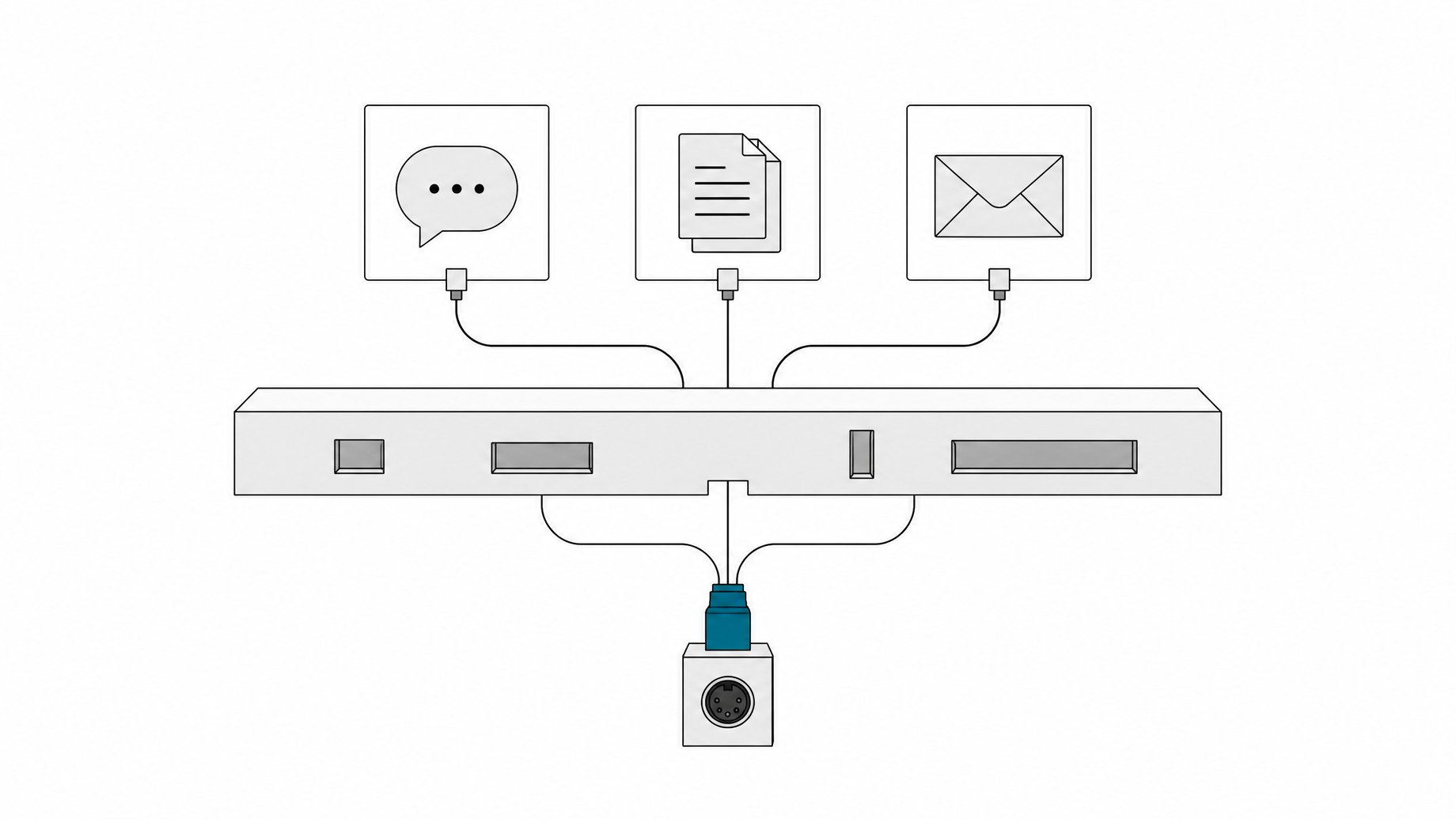
What is MCP shadow IT, and how do employees use it to bypass enterprise AI plans?
MCP shadow IT is when employees connect personal AI accounts, like a $20/month ChatGPT or Claude subscription, directly to company systems using the Model Context Protocol, without IT's knowledge or approval, so they can skip costly enterprise AI tiers. The Model Context Protocol (MCP) is an open standard that lets an AI assistant plug into outside tools, Slack, Notion, Gmail, GitHub, a database, and actually act on them: read a channel, write a page, send an email, run a query. People call it "USB-C for AI" because it's a universal plug. That's also why it's more dangerous than old-school shadow IT.
Classic shadow IT was an unapproved app sitting on your network, storing data somewhere IT didn't track. MCP shadow IT, often shortened to "shadow MCP," is an unapproved app with hands. As one security research team put it, MCP servers "give large language models hands, not just brains," which means an untracked connector doesn't just hold a copy of your data. It can act on your systems with whatever privileges it was handed. OWASP now treats this seriously enough to give it a formal name, MCP09:2025: Shadow MCP Servers, unapproved deployments running outside security governance, frequently on default credentials or permissive configurations. Researchers at Mend.io describe the same pattern from the codebase side: these servers get installed on company resources with security teams finding out last, if at all.
TL;DR
- Employees bypass costly SaaS tiers by connecting personal AI subscriptions to company systems via MCP, with no procurement ticket or vendor review.
- Mid-size companies currently run roughly 200 unsanctioned AI tools per 1,000 employees.
- Breaches at organizations with high shadow AI use cost an average of $670,000 more than breaches at organizations with low or no shadow AI.
- Asana's own official MCP server exposed data across organizations, showing that even a sanctioned integration can leak when built on this architecture.
- Rather than banning MCP, organizations should govern agents by putting every remote server behind a single API gateway with short-lived, least-privilege tokens.
- Blocking MCP outright just pushes usage underground, so giving employees an approved, fast path works better than a ban nobody follows.
How do employees bypass enterprise AI subscriptions with MCP?
Here's the mechanism. An employee wants Claude or ChatGPT to read their team's Notion workspace, draft replies in Gmail, or post to Slack on their behalf. The enterprise tier that officially supports this kind of connector often costs $60 to $100 per seat per month. Procurement is slow, budget is tight, or the request simply gets denied.
So the employee routes around it. They keep their personal $20/month AI subscription, add a self-hosted or community-built MCP server for Notion, Gmail, or Slack, and point their own AI assistant at company data using their own login. No procurement ticket, no vendor review, no seat purchase.
The gating is explicit and easy to find if you look. Notion restricts MCP connections for Custom Agents to its Business and Enterprise plans, meaning the deeper, agentic use of Notion through MCP is a paid-tier feature. An employee on a cheaper Notion plan, or one who doesn't want to wait for a plan upgrade, can get equivalent functionality by pairing their personal Notion login with a third-party MCP server and a personal AI subscription. Multiply that pattern across Slack, Gmail, GitHub, and a dozen SaaS tools with similar tiering, and you get an entire shadow integration layer that never shows up on a license spreadsheet.
Why does this look economically rational to employees?
From the employee's seat, this isn't rule-breaking. It's arithmetic. Business Insider profiled a biotech researcher who helped write his own company's AI policy and still used an unapproved personal Google account to run NotebookLM for work, because it took a 150-hour task down to 30 minutes. He weighed what he called a "miniscule risk" of data leakage against the "massive risk" of falling behind competitors who weren't waiting for IT.
That calculation is widespread, not exceptional. A Microsoft survey found 71% of UK workers have used unapproved consumer AI tools at work, with half doing so weekly, and a separate 2024 Microsoft report found nearly 80% of AI-using workers relied on their own tools instead of company-provided ones. Meanwhile Protiviti surveyed 345 company leaders and found about half didn't know the real extent of employee AI use, and only four in ten had a formal AI governance policy in place, even as 90% of IT leaders at large companies planned to raise AI tooling budgets. The gap between what leadership thinks is happening and what's actually happening is the whole story.
How big is the shadow MCP problem?
Shadow MCP isn't a fringe behavior at a handful of companies. It's systemic, and the numbers back that up:
- Mid-size companies run roughly 200 unsanctioned AI tools per 1,000 employees; small companies (11-50 employees) average 269 per 1,000, meaning about 27% of staff are running tools IT never approved.
- OpenAI's services alone account for 53% of all observed shadow AI usage, which concentrates risk around a single ecosystem.
- 20% of breached organizations in IBM's 2025 Cost of a Data Breach Report had an incident involving shadow AI.
- Breaches at organizations with high shadow AI use cost $670,000 more on average than breaches at organizations with low or no shadow AI.
- MCP adoption itself has exploded: more than 10,000 active public MCP servers and 97 million-plus monthly SDK downloads across Python and TypeScript as of Anthropic's late-2025 announcement.
Put those together and the picture is simple. The surface area for shadow MCP is large, growing fast, and already showing up as a line item on breach cost reports.
What happens when it goes wrong? Real MCP incidents
The canonical case study is Asana. In June 2025, Asana disclosed a bug in its own official MCP server that could let MCP users in one organization see project data, tasks, comments, and files belonging to other organizations' Asana accounts, a cross-tenant isolation failure. Asana pulled the MCP server offline for about a month while it fixed the flaw. This wasn't a rogue employee plugging in an unapproved connector. It was Asana's own sanctioned MCP integration, and it still leaked data across tenant boundaries, which tells you how unforgiving this architecture is even when a vendor builds it properly.
The Asana incident sits inside a wider pattern. OWASP's MCP Top 10 catalogs risks beyond shadow servers: token mismanagement, privilege escalation through scope creep, and "tool poisoning," where a malicious or compromised MCP tool injects instructions an AI assistant will follow without question. Security researchers have documented prompt injection delivered through everyday channels an MCP-connected agent might read, like GitHub issues or support tickets, turning ordinary inbound text into an attack vector. A misconfigured server, one researcher team wrote, can "give the AI the keys to your data" even when the underlying protocol design isn't at fault.
How are companies and institutions responding with governance?
The institutional reaction has moved fast, which is itself a signal of how seriously this is being taken.
Microsoft's internal CISO organization built a four-layer MCP governance architecture, covering applications/agents, the AI platform, data, and infrastructure, that requires every remote MCP server to sit behind a single API gateway, use short-lived least-privilege tokens, and get vetted and inventoried before approval. Microsoft CISO Swetha Kumar framed the stakes directly: "With MCP, the problem is not the inherent design; it's that every improper server implementation becomes a potential vulnerability. Even one misconfigured server can give the AI the keys to your data." Microsoft's own telemetry shows shadow servers decline as that inventory fills in from endpoint, repo, IDE, and gateway signals.
Microsoft also pushed this into a product: Agent 365 went generally available on May 1, 2026, pitched explicitly as a control plane for observing, governing, and securing agent sprawl, an admission from the largest enterprise software vendor that ungoverned agents and connectors are now a mainstream risk category.
And on the protocol side, Anthropic donated MCP itself to the newly formed Agentic AI Foundation, a directed fund under the Linux Foundation co-founded with Block and OpenAI and backed by Google, Microsoft, AWS, Cloudflare, and Bloomberg. Moving a protocol this consequential out of single-vendor hands and into neutral governance is not a ceremonial move. It's an acknowledgment that MCP is now foundational enough to need the same kind of stewardship as any critical piece of internet infrastructure. For a closer look at how companies are trying to keep pace with agents employees deploy on their own, see how to manage AI agents in the enterprise before they manage you.
What does this mean for SaaS economics and software ownership?
Strip away the security framing for a second and look at what shadow MCP is actually proving: employees are routing around expensive per-seat tiers with duct-taped AI plumbing, and it's working well enough that they keep doing it. Notion gates MCP-enabled agents behind Business and Enterprise pricing. Plenty of other SaaS platforms do the same. Employees are telling procurement, in effect, that the $60-100/seat tier isn't worth the wait, and a $20 consumer subscription plus a community connector gets most of the job done.
That's not an argument for ignoring the gap. It's an argument against pretending the gap doesn't exist. Companies currently pay twice: once for the sanctioned SaaS tier that employees find too slow or too expensive to use as intended, and again in the hidden cost of ungoverned shadow pipelines moving company data through tools no one vetted. The fix isn't blocking MCP outright, since that just pushes usage further underground. It's building and owning the integration layer instead of renting it twice, in the official SaaS contract and in the shadow workaround sitting on an employee's laptop. We've covered the broader version of this trade-off in build vs. buy in the agent era, and the underlying mechanics of what these connectors actually touch in what AI connectors are and why they need your data.
| Upfront cost | Security governance | Speed to deploy | Compliance risk | Scalability | |
|---|---|---|---|---|---|
| Personal subscription + shadow MCPan individual employee moving fast around a blocked request | $20/month | Low | High | High | Low |
| Sanctioned enterprise AI tierorganizations that can absorb procurement timelines | $60-100/seat/month | High | Low | Medium | Medium |
| RecommendedGoverned internal integration layer (build)companies that want to stop paying twice for the same connector | Significant one-time build cost | High | Medium | Low | High |
What should IT and security teams do now?
Blocking every MCP connection outright just pushes the behavior further underground, where it's harder to see and easier to get wrong. A workable response looks more like this:
- Inventory first. You can't govern what you can't see. Pull signals from endpoint telemetry, code repos, CI pipelines, and IDE extensions to find MCP servers already running, the same approach Microsoft used to drive shadow servers down.
- Vet before approval, not after. Every remote MCP server should sit behind a single API gateway and get reviewed before it touches production data, rather than discovered during an incident response.
- Scope tokens tightly. Use short-lived, least-privilege credentials for every MCP connection so a compromised or poisoned tool can't reach more than it needs. The same logic applies to securing database access for internal AI agents.
- Watch for tool poisoning and injection. Treat inbound content an agent might read, support tickets, GitHub issues, shared documents, as a potential attack surface, not just outbound actions.
- Give employees an approved path. The Asana and Notion pattern shows people will find a workaround when the sanctioned option is slow or expensive. An approved, fast alternative beats a ban that nobody follows.
The employees building these pipelines aren't being reckless for its own sake. They're solving a real productivity problem the official tooling didn't solve fast enough. The job now is building the governed version of what they already proved works, before the next Asana-style leak makes the decision for you.
Frequently Asked Questions
What is the Model Context Protocol (MCP)?
MCP is an open standard that lets AI assistants connect to outside tools and data sources, like Slack, Notion, Gmail, or a database, and take actions in them, not just read information. It functions as a universal connector between AI models and the systems people already use.
Why is shadow MCP more dangerous than regular shadow IT?
Traditional shadow IT was an unapproved app storing data somewhere IT couldn't see. Shadow MCP connects an AI assistant with real privileges, the ability to read, write, send, and execute, so an ungoverned connector can act on company systems, not just hold a copy of company data.
What happened in the Asana MCP data leak?
Asana disclosed a bug in its own official MCP server in June 2025 that could let MCP users in one organization see project data, tasks, comments, and files belonging to other organizations. Asana took the server offline for about a month to fix the cross-tenant isolation failure.
How much does shadow AI actually cost companies?
IBM's 2025 Cost of a Data Breach Report found 20% of breached organizations had an incident involving shadow AI, and breaches at organizations with high shadow AI use cost $670,000 more on average than those with low or no shadow AI use.
Can companies block MCP connections entirely?
Blocking MCP outright tends to push the behavior further underground rather than eliminating it. Microsoft's approach instead inventories MCP servers through endpoint, repo, and IDE signals, routes every remote server through a single API gateway, and scopes tokens tightly, while still giving employees an approved, fast path for legitimate use cases.
How we source, write, and correct our articles. Editorial standards