Is It Worth Building Internal Tools With AI? Cost vs. SaaS
Compare the cost of building internal tools with AI coding agents against rising SaaS prices, and learn which tools to build and which to keep buying.

Is it worth building internal tools with AI instead of buying SaaS?
Yes, for a specific and growing slice of your software stack: the simple internal dashboards, trackers, and workflow tools that used to be too annoying or too expensive to build yourself. For the hard stuff, like regulated systems, payment infrastructure, or anything with real network effects, buying is still the right call. The line between those two categories has moved a lot faster than most finance and IT teams have noticed.
TL;DR
- AI coding agents have cut the cost of a custom internal tool from about $50,000 to about $5,000.
- Gartner forecasts that up to $234 billion in enterprise SaaS spend is at risk by 2030 as agents complete cross-system tasks directly.
- Organizations with high shadow AI use saw breach costs average $670,000 higher than organizations with low or no shadow AI.
- MIT research found that 95% of enterprise generative AI pilots deliver zero measurable return, because they are brittle and generic rather than built for one actual workflow.
- Regulated systems, network-effect tools, high-availability infrastructure, and products built on huge datasets are still better to buy.
- Four quick checks (internal only, simple logic, forgiving SLA, and a specific process need) tell you whether to build or keep renting.
[[figure:f1]]
Why is the old build-vs-buy math dead?
For fifteen years, the standard advice was simple: don't build what you can buy. Engineering time was scarce and expensive, every custom tool became a maintenance liability, and SaaS vendors could amortize the cost of a feature across thousands of customers in a way no internal team could match. That advice was correct. It rested on assumptions about build cost that stopped being true sometime in the last two years.
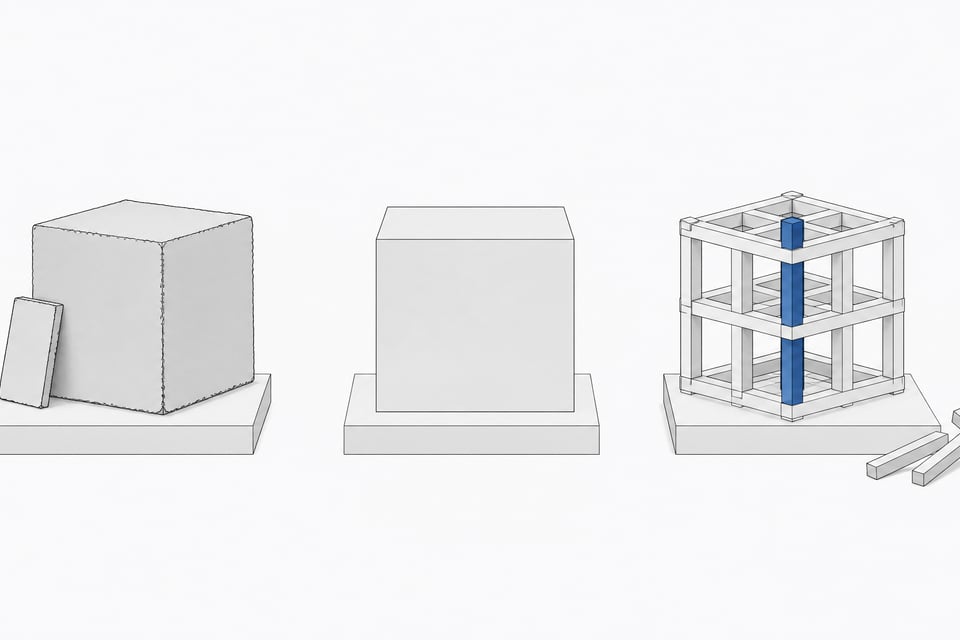
An internal tool build that used to eat a month of team time now takes about a week, with agentic coding CLIs doing the implementation work, not just autocomplete. A custom tool that used to come back from an agency quote around $50,000 can now land closer to $5,000, a developer plus the right AI tooling. That's not a marginal efficiency gain. It's an order-of-magnitude shift, and per Jevons paradox, that kind of shift doesn't just make existing projects cheaper. It makes a whole category of projects worth doing that weren't worth doing before. We laid out the mechanics of that shift in AI Software Factory vs. SaaS: Why Building Wins in 2026.
What actually changed: agents or just autocomplete?
The "AI makes developers faster" claim has been around since Copilot launched, but the early evidence was about typing speed, not finished work. The shift since then is agents that plan, write, test, and iterate on a task with minimal supervision. That's a different kind of speedup.
The hard numbers back this up:
- In a controlled Microsoft/GitHub study, developers using Copilot completed a defined coding task 55.8% faster than a control group, 1 hour 11 minutes versus 2 hours 41 minutes.
- METR's research tracking how long a task an AI agent can complete autonomously shows that duration has been doubling roughly every seven months since 2019, a compounding trend rather than a one-time jump.
- Inference costs for equivalent model performance have fallen roughly 10x per year since GPT-3, per a16z's "LLMflation" analysis, meaning the compute underneath this keeps getting cheaper as the models get better.
- 84% of developers now use or plan to use AI coding tools, up from 76% a year earlier, with 51% of professional developers using them daily, according to Stack Overflow's 2025 survey of over 49,000 respondents.
Put those together: a capability curve rising while the unit cost of using it falls. That combination broke the old math, not hype about any single model release.
Why does the SaaS side of the ledger keep getting worse?
While build costs have fallen, buy costs have climbed, and not gently. Businesses now spend an average of $7,900 per employee annually on SaaS tools, a 27% increase over two years, and 60% of vendors deliberately obscure their pricing to make that increase harder to track. Zylo's 2026 index puts median per-employee SaaS spend even higher, at $9,455, with organizations spending an average of $55.7 million a year on SaaS overall.
Those numbers describe a stack that keeps growing even as individual tools get thinner. A lot of what's in there is exactly the kind of software agentic coding is now good at replacing: a dashboard over a database, a CRUD app with some business logic, a workflow tool that glues two systems together. One practitioner building these tools for himself put it bluntly: if your product is just a SQL wrapper on a billing system, you now have thousands of competitors, because engineers at your customers can build the same thing with an agent on a Friday afternoon. The real math behind that shift, including where SaaS vendors are already feeling it, is laid out in The $20M Prompt: Why AI Is Now the SaaS Killer.
Why is maintenance no longer the killer objection?
The strongest argument against building internal tools was never the build itself. It was what comes after: the bus factor of one person owning a tool nobody else understands, the slow bit-rot of unpatched dependencies, the dread of touching code six months after it shipped.
Agentic coding tools change that curve too, not just the initial build. One developer with the right agent can now maintain what used to need a small team, as we've written about before:
- Codebase explanation. Agents can explain an inherited codebase on demand, which lowers the cost of a key person leaving.
- Dependency migrations. They can handle routine dependency and library upgrades that used to require a dedicated sprint.
- Reference documentation. With a maintained reference file (an AGENTS.md or equivalent), an agent can pick up unfamiliar code and keep working on it without a human walking it through the history first.
None of that erases maintenance. It just means the "who owns this in a year" objection carries less weight than it used to, provided someone keeps the documentation current.
Is this already happening, or only hypothetical?
This isn't a forecast. Employees are already building their own tools, with or without permission. 78% of AI users at work report bringing their own AI tools rather than waiting for IT-approved ones, and Gartner expects low-code and AI-assisted development to account for 75% of new application development by 2026, up from 40% in 2021.
Analysts are starting to price this in at the market level. Gartner forecasts that up to $234 billion in enterprise application software spend, roughly 20% of the enterprise SaaS category, is at risk by 2030 from what it calls "agentic arbitrage," where an AI agent just completes a cross-system task directly instead of routing a human through the vendor's dashboard. That's a structural read from the people whose job is tracking enterprise software spend, not a trend piece.
When does buying still beat building?
None of this is an argument for building everything. Some categories still have a real moat, and pretending otherwise is how build-vs-buy arguments lose credibility.
- Regulated and compliance-heavy systems. If a vendor's whole value is a SOC 2 report, HIPAA compliance, or a history of audits, you're paying for liability transfer as much as code.
- Network-effect tools. Software like Slack or a shared CRM is valuable because everyone else is already on it. You can't build your way out of that.
- High-availability infrastructure. Payment processing, uptime-critical systems, and anything with a strict SLA need engineering discipline most internal teams aren't staffed to sustain.
- Tools built on huge, hard-to-replicate datasets. If the product's edge is years of aggregated data, not the interface, buying is still the rational move.
The categories most exposed are the opposite of these: internal, low-stakes, and essentially CRUD with a UI on top.
Is the real failure mode wasted time or ungoverned sprawl?
The actual risk in this shift isn't that someone wastes a week building a dashboard that didn't need to exist. It's that dozens of people build dashboards, trackers, and automations with no one tracking what exists, who owns it, or what data it touches.
That risk is measurable, not theoretical. Organizations with high levels of shadow AI use saw breach costs average $670,000 higher than organizations with low or no shadow AI, and 97% of AI-related breaches happened at organizations that lacked proper AI access controls. Separately, MIT's GenAI Divide research found that 95% of enterprise generative AI pilots deliver zero measurable return, with the common failure pattern being brittle, generic deployments rather than narrow, iteratively improved tools built for one actual workflow. Read together, those two findings point the same direction: the danger isn't building. It's building invisibly. The fix is usually a narrower, better-owned tool, not a bigger platform rollout.
How should you decide what to build vs. buy?
Before greenlighting a build, run it through four quick checks:
- Is it internal only? If customers or partners will ever touch it, the compliance and support bar jumps, and buying gets more attractive.
- Is the logic simple? CRUD, a dashboard, a workflow that moves data between two systems, these are squarely in agentic coding's wheelhouse.
- Is the SLA forgiving? If downtime for an afternoon is annoying but not a crisis, build. If it's a payment flow or anything customer-facing and time-sensitive, buy.
- Does the market solve it generically, or does your team need it exactly this way? A tool built for your specific process beats a generic SaaS product configured to approximate it.
| Upfront cost | Time to deploy | Maintenance burden | Compliance support | Customization | |
|---|---|---|---|---|---|
| RecommendedBuild with AI agentsSimple internal tools, dashboards, trackers | ~$5,000, about a week | Days | Low | Low | High |
| Buy SaaSRegulated, network-effect, or infrastructure-grade systems | Subscription, little upfront | Days | Low | High | Low |
| Traditional custom buildLegacy approach, now mostly obsolete for simple tools | ~$50,000, about a month | Weeks | High | Medium | High |
Clear all four and building is very likely the better financial call. Fail even one, especially the SLA or compliance check, and you should keep renting. For the edge cases, When to Build vs. Buy Internal Software (And When to Just Prototype It) is worth ten minutes before you commit engineering time.
Bottom line: is it worth building internal tools with AI?
For simple, internal, low-SLA software, yes. Build costs have dropped by roughly an order of magnitude while SaaS per-employee spend keeps climbing, and that combination has flipped the default answer for a huge share of the tools companies rent today. For compliance-heavy, network-effect, or infrastructure-grade systems, no. Buying still wins, and probably will for a while. The mistake isn't building. It's building without anyone tracking what got built, who owns it, and where the data goes.
Frequently Asked Questions
Is it actually worth building internal tools with AI instead of buying SaaS?
For simple, internal, low-SLA software like dashboards, trackers, and CRUD workflow tools, yes. Build costs have fallen roughly 10x while SaaS per-employee spend keeps climbing, which flips the default for a large chunk of the subscription stack. For compliance-heavy, high-availability, or network-effect software, buying still wins.
What kinds of internal tools are safest to build with AI coding agents?
Tools that are internal only, logically simple (CRUD, dashboards, workflow glue between systems), and don't carry a strict SLA. These are the categories where agentic coding tools perform well and where a failure doesn't create a compliance or uptime crisis.
Doesn't building internal tools create a maintenance burden down the line?
It creates less of one than it used to. Agentic coding tools can explain inherited codebases, handle routine dependency upgrades, and reduce the risk of one person being the only one who understands a tool, especially if documentation like an AGENTS.md file is kept current.
What's the real risk of employees building their own software with AI?
The risk isn't the building itself, it's doing it without governance. Organizations with high shadow AI use saw breach costs average $670,000 higher than those with low or no shadow AI, and 97% of AI-related breaches happened where proper AI access controls were missing.
When should a company still buy SaaS instead of building internal tools?
Buy when the software is regulated or compliance-heavy, depends on network effects (like a shared messaging or CRM platform), requires high-availability infrastructure with strict SLAs, or relies on a dataset your company can't replicate on its own.
How we source, write, and correct our articles. Editorial standards