How Does Unlimited OCR 2 Score on 100-Page Documents?
Unlimited OCR 2 scores about 77 on a 100-page document test while most rivals fall under 30. How SR-SWA attention works, plus where the model still fails.

How does Unlimited OCR 2 perform on long-document benchmarks?
Unlimited OCR 2, a document parsing model from Baidu, scores around 77 out of 100 on a 100-page document test, where most competing models drop under 30. The previous version scored zero on the same test. On a benchmark with dozens of pages per document, its lead over models like Qwen and Gemini is only a few points. The gap widens as documents get longer.
TL;DR
- Unlimited OCR 2 reaches roughly 77 out of 100 on the 100-page test, while most compared models fall below 30.
- The first Unlimited OCR scored zero on that same test, so version 2 is a fix for a specific failure, not a small tune-up.
- On the dozens-of-pages benchmark, it leads Qwen and Gemini by only a few points. The real separation shows up at hundreds of pages.
- The mechanism is SR-SWA, a fixed set of reference points that keeps speed and memory almost flat as documents grow.
- A creator's local test showed about 8.3 GB of VRAM in full precision on a single image, and strong results on clean English print.
- Weak spots include non-English scripts, ornate old print, and empty table rows, so outputs still need checking.
What are MP Doc Bench and Marathon Doc Bench?
The authors report results on two document benchmarks, named in the project's GitHub repo as MP Doc Bench and Marathon Doc Bench. One tests documents with dozens of pages. The other tests documents with hundreds. The sources I have do not spell out which name maps to which scale, the exact scoring method, or per-model score tables beyond the headline numbers, so treat the figures below as the ones that were presented, not a full leaderboard.
| Test scale | Reported result |
|---|---|
| Dozens of pages per document | Unlimited OCR 2 leads Qwen and Gemini by a few points |
| 100-page document | Unlimited OCR 2 around 77/100, most others under 30 |
| 100-page document, previous version | 0 |
Why does the 100-page result matter more than the lead on shorter documents?
A few points of lead on a dozens-of-pages test is the kind of margin that can shift with prompt format or evaluation details. A jump from zero to about 77 on a 100-page test is different. It points to a structural change in how the model handles length.
Most vision-language models degrade on long inputs because the context grows with every page. Cost climbs, quality slips, and at some length the output collapses. The benchmark pattern here matches that story: competing models do reasonably on shorter documents and then fall off at 100 pages, while Unlimited OCR 2 holds. The longer the document, the wider the gap.
How does SR-SWA attention work?
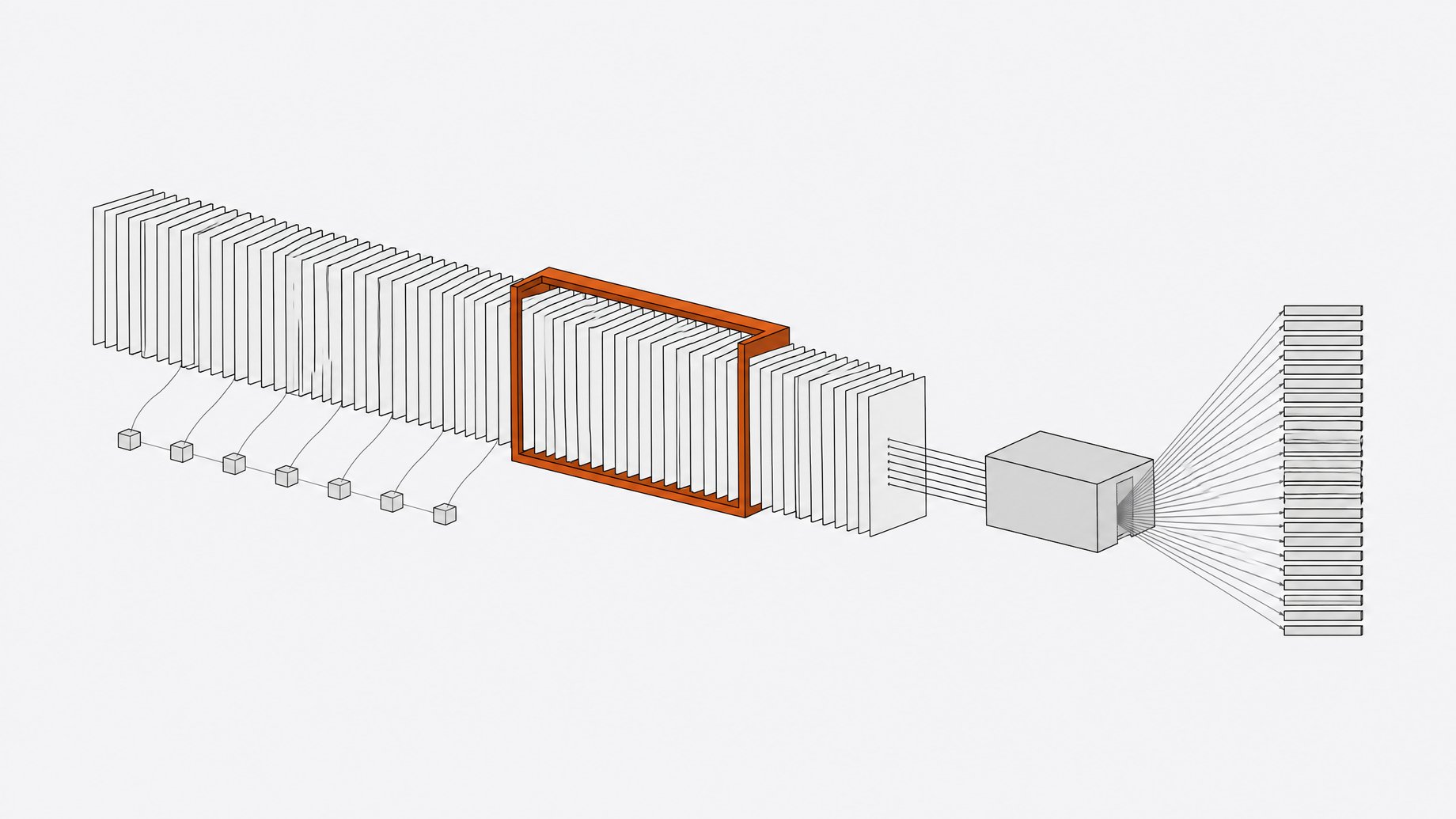
SR-SWA is the core idea in Unlimited OCR 2. Instead of attending to every earlier page at once, the model keeps a small fixed set of references and looks at those plus what it is currently reading. The name suggests a sliding-window attention variant with fixed reference points, though the sources I have do not detail the exact design, so I will not guess at internals.
The creator's analogy is a student copying notes from a huge stack of pages. With full attention, every new word means rereading everything. With SR-SWA, the student keeps only the few spots that matter right now and ignores the rest. The principle: look at less, but look at the right thing.
Why do speed and memory stay almost flat?
Full attention gets more expensive as the context grows, because each new token compares against everything before it. If the model only attends to a fixed-size set of references, the per-token work stops growing with document length. That is why the project describes speed and memory as almost flat even on very long documents.
This is also why the authors frame the model as moving from long-horizon to unlimited-horizon parsing. Document length stops being the bottleneck. "Unlimited" is a design claim about cost scaling, not a guarantee of accuracy on every document, as the failure cases below show.
What does it take to run Unlimited OCR 2 locally?
In one hands-on demo, the creator installed prerequisites, downloaded the model, and ran a short Python script that loads an image and returns OCR output. Watching GPU memory, the model needed around 8.3 GB of VRAM in full precision. An SGLang server is also an option for serving it locally, with the same script talking to it.
Output can be rendered as an HTML page showing the source image next to the parsed result. The model returns text, tables, formulas, and headings, and one demo turned a handwritten physics sheet into LaTeX covering special relativity, the photoelectric effect, and blackbody radiation.
Where does Unlimited OCR 2 still fail?
The same demos exposed clear limits.
- Multilingual text. On an image with English, Urdu, and Indonesian, the model handled the English lines and then looped on the Urdu sentence. It appears to be an English and Chinese model, not a broad multilingual one.
- Ornate old print. On an 1883 newspaper, it read the body text in 1.9 seconds but skipped the decorative masthead, misread the year as 1893, and turned a price of three pence into something like 10 pounds.
- Tables and long outputs. An invoice mostly came out well, but one last line went missing, possibly from a context cutoff or the creator's formatting script. Empty table rows were also flagged as a trouble spot.
- Small cosmetic errors. In a printed math solution, the first fraction lost its fraction bar, though the numbers were correct.
On clean printed English, results were strong. A printed math problem parsed in about 2 seconds with each step correct, and the creator reported no problems on a document of 50-plus pages with plain text.
Is Unlimited OCR 2 worth trying?
If you parse long, clean, English or Chinese documents such as reports, filings, or manuals, the benchmark story makes it worth testing. The flat memory behavior matters most when other models stall or collapse at page counts in the hundreds. If your documents mix scripts, include handwriting, or use ornamental typefaces, expect errors and keep a verification step, especially for numbers like dates and prices.
One caution on the benchmarks: they come from the author's own GitHub repo page, and the sources here include no independent replication. Run your own sample of real documents before committing.
Frequently Asked Questions
What score does Unlimited OCR 2 get on the 100-page test?
It scores around 77 out of 100. Most of the models it was compared against fall under 30 on the same test. The earlier Unlimited OCR scored zero.
How much VRAM does Unlimited OCR 2 need?
In one local demo, the model used about 8.3 GB of VRAM in full precision. That figure came from a single run on one image, so your usage may vary with settings and serving method.
Does Unlimited OCR 2 support languages other than English?
It appears limited. A test with English, Urdu, and Indonesian text produced correct English and then a loop on the Urdu sentence. The demonstrations suggest English and Chinese are the supported languages.
What does SR-SWA stand for and what does it do?
The sources do not expand the acronym. It is the attention method that keeps a small fixed set of references instead of attending to every page, which keeps speed and memory nearly constant as documents grow.
How we source, write, and correct our articles. Editorial standards