How Accurate Is Phonon 2? 5.21% WER in a 164MB ASR Model
Phonon 2 averages 5.21% WER on Open ASR leaderboard English sets in 164MB, 15x smaller than Parakeet. See where it holds up and where it fails.

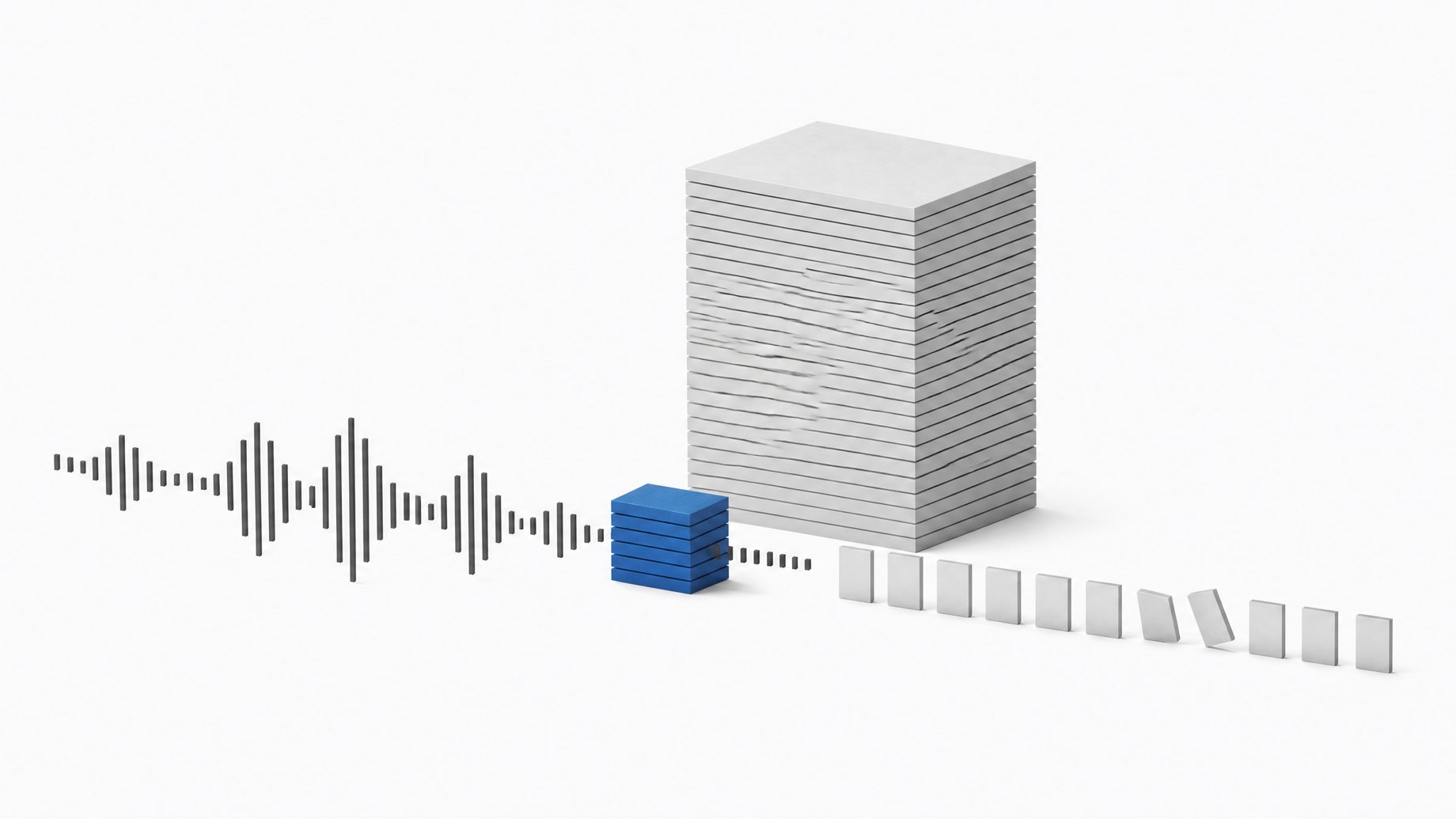
How accurate is Phonon 2 compared with larger speech recognition models?
Phonon 2, from Fermion Research, reports an average word error rate (WER) of 5.21% across the seven English datasets on the Open ASR leaderboard, according to its model card. It is built on Nvidia's Parakeet but squeezed into a 164 MB download, about 15 times smaller. It runs on a plain CPU. Informal tests show strong English results, including on rough audio. It is English only, and multilingual output is weak.
TL;DR
- Phonon 2's model card reports a 5.21% average WER across the seven English sets of the Open ASR leaderboard.
- The model is a compressed derivative of Nvidia's Parakeet, with a 164 MB download roughly 15x smaller than the original.
- It runs on CPU only, with no GPU required, and a hands-on test showed a warm run finishing in about 14 seconds for a short clip.
- In informal tests, it handled clean, narrative, noisy and emotional audio with few or no visible errors.
- Multilingual performance is poor. A reviewer who tried several European languages, Arabic, Hindi, Urdu, Indonesian and Malay found it did not work well.
- Check the license before any commercial use. The terms were not covered in the source material.
What does a 5.21% word error rate mean?
WER counts the substitutions, deletions and insertions in a transcript, divided by the number of words in the reference. A 5.21% WER means roughly one word in twenty is wrong. The Open ASR leaderboard scores models across several English datasets and averages the results, so a single number hides variation. A model can post a low average while doing worse on a particular accent, recording condition or speaking style.
The 5.21% figure comes from the model's own card. Treat it as a vendor-reported number until you reproduce it on your own data. The size is the notable part. Low-single-digit and mid-single-digit WERs usually come from much larger models, and a 164 MB file is small enough to ship inside an application.
How does Phonon 2 relate to Parakeet?
Phonon 2 is built on Nvidia's Parakeet model. The reported result is a download about 15 times smaller than Parakeet's. The source material does not detail the compression method, the parameter count or the quantization format, so those specifics are not covered here. The model card is the place to look for them.
What matters for builders is the tradeoff. You give up some range (the model is English only) and gain a footprint that fits on commodity hardware.
What happened in hands-on accuracy tests?
A reviewer ran Phonon 2 on a CPU-only Ubuntu machine and tried a series of English clips. These were informal listening checks, not scored benchmarks, so no WER was computed for them. Still, they show how the model behaves outside a leaderboard.
| Test | Audio type | Observed result |
|---|---|---|
| Short clip | Clean, single sentence | Matched the audio word for word |
| 18-second clip | Longer clean passage | Judged "pretty good" |
| Narrative line | Descriptive prose with unusual wording | Transcribed correctly |
| Polychrome passage | Harder text with an uncommon name | Transcribed correctly |
| 25-second custom recording | Poor audio quality | Judged to do well |
| "You've hit me four times now" | Short, hard, unclear start | Transcribed correctly |
| Emotional announcement | Expressive, shaky speech | Quality judged "really good" |
The useful signal is in the last four rows. Clean read speech is the easy case on any leaderboard. A model that holds up on a muffled recording, an unclear opening and emotional delivery is showing some real-world tolerance. A handful of clips is still a small sample, and nothing here replaces testing on your own recordings.
How fast is it, and what does it need to run?
The setup was short. The reviewer installed PyTorch for CPU, then installed the Phonon CLI and its dependencies, and added the CLI to the path. A GPU and CUDA build of the same setup also exists. The CLI lists the models available from Fermion, and Phonon 2 is one of them.
Timing from the short test clip:
- First run: about 50 seconds. That run downloaded the model, checked its checksum and compiled the CPU runtime.
- Second run: about 14 seconds, using the cached model.
Most of that 14 seconds was engine startup, not decoding. The reviewer noted that the model loads in 10 to 14 seconds. CPU load stayed low and nothing touched the GPU.
The model can also be served through an OpenAI-compatible endpoint. In the demo it ran locally on port 8000, with a health check reporting status OK. After the initial load, a transcription request returned very quickly. That compatibility matters if you already have code written against the OpenAI audio API, since you may be able to point it at a local server instead.
Where does Phonon 2 fail?
Language coverage is the clear limit. Phonon 2 is English only, and the reviewer's multilingual tests confirmed it. Results were poor for Arabic, Hindi, Urdu, Indonesian and Malay. For some European languages it got words right here and there, but not reliably. The reviewer described the model as fine-tuned and made for English.
Other gaps are not tested in the source material:
- Heavy accents and code-switching were not examined.
- Long-form audio, such as hour-long recordings, was not tested.
- Overlapping speakers and diarization were not covered.
- Timestamps and punctuation quality were not discussed.
- Per-dataset WERs behind the 5.21% average were not provided in the source material.
If your workload involves any of these, run your own evaluation before committing.
Is Phonon 2 worth considering?
It depends on the job. For English transcription on laptops, edge devices, CPU-only servers or privacy-sensitive setups where audio should stay local, a 164 MB model with a reported 5.21% average WER is attractive. The small footprint cuts download time, storage and hardware cost.
It is a poor fit for multilingual products, or where you need a documented guarantee on a specific domain such as medical or legal speech. In those cases a larger or multilingual model is the safer choice.
One practical step comes first. Read the license. The reviewer specifically flagged checking it for commercial use, and the source material does not state the terms.
How should you test it on your own audio?
A reasonable approach:
- Collect 30 to 50 representative clips, including your worst-quality ones.
- Write reference transcripts by hand.
- Run Phonon 2 and your current model on the same clips.
- Compute WER with a standard tool and normalize text the same way for both.
- Compare error types, not only the total. Names and numbers often matter more than function words.
Also measure end-to-end latency on your target hardware, including model load time, since startup dominated the short-clip timing above.
Frequently Asked Questions
What is Phonon 2's word error rate?
Its model card reports an average WER of 5.21% across the seven English datasets on the Open ASR leaderboard. That is a developer-reported figure. Your own audio may produce different results.
Does Phonon 2 need a GPU?
No. It runs on a CPU, and the reviewer ran it with the CPU build of PyTorch while the GPU sat idle. A GPU and CUDA version of the setup also exists if you want it.
Does Phonon 2 support languages other than English?
Not in any useful way. It is built for English. Tests on several European languages, Arabic, Hindi, Urdu, Indonesian and Malay gave weak results, with occasional correct words in some European languages.
Can I use Phonon 2 through an API?
Yes. It can be served locally behind an OpenAI-compatible endpoint, shown running on port 8000 with a health check. That lets existing OpenAI-style transcription code talk to a local model.
Is Phonon 2 free for commercial use?
The source material does not say. Check the license on the model's page before using it in a commercial product.
How we source, write, and correct our articles. Editorial standards