How Does Medical Billing Work and How Is Candid Automating It?
How US medical billing works, from claims and ICD-10 codes to denials, and how Candid Health uses automation and AI to fix revenue cycle management.

Why is medical billing so complicated?
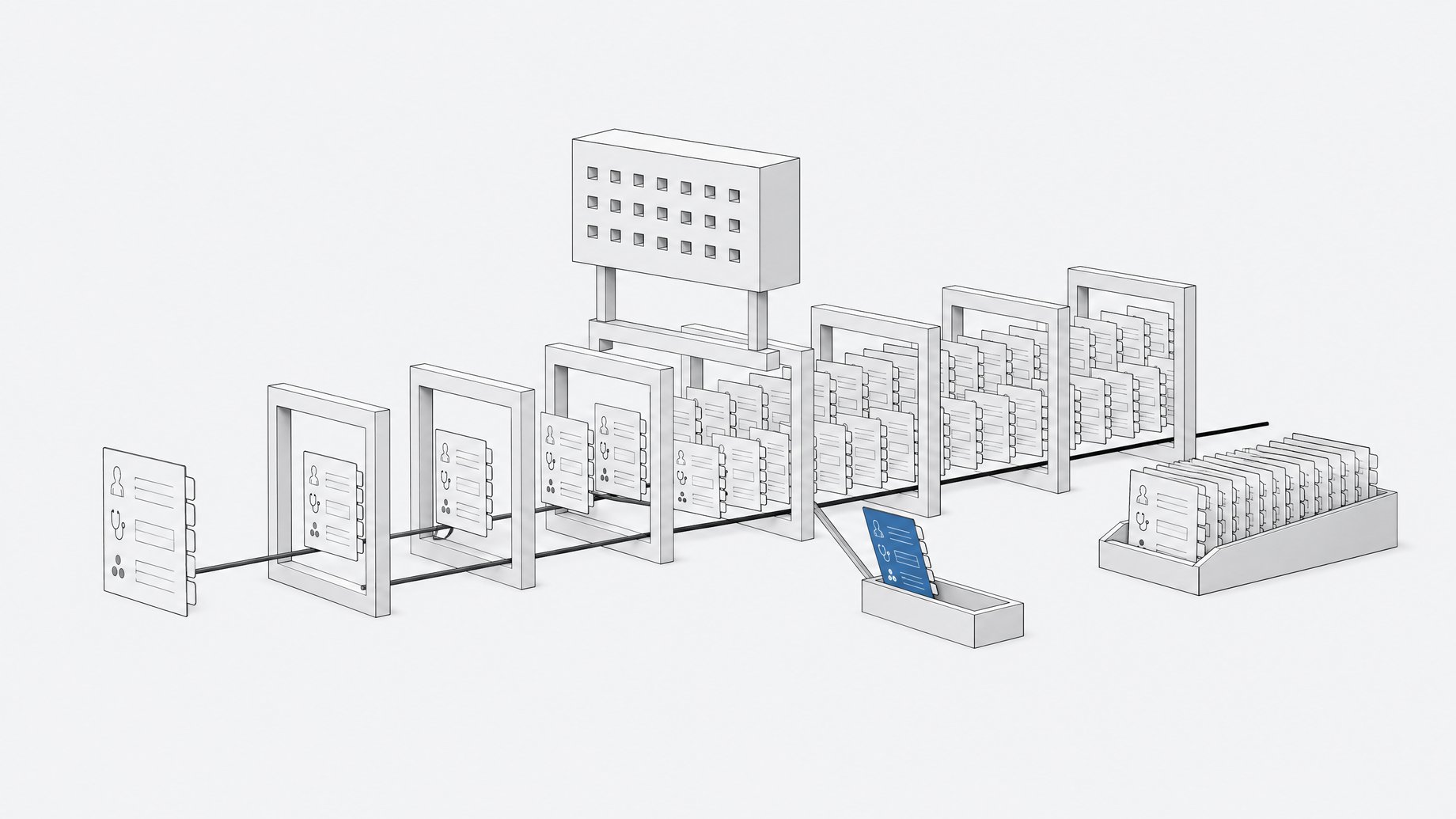
Medical billing is complicated because a provider may see patients from hundreds, or up to a thousand, different insurance companies, and each payer has its own rules for how a claim must be submitted. The same therapy visit can require a differently formatted claim for each payer. Coverage rules, benefit structures and network status vary too. Candid Health, a company founded by Nick Perry, is rebuilding the billing stack around automation and AI to handle this.
TL;DR
- US medical billing is estimated at $200 to $300 billion a year, according to Candid CEO Nick Perry, and almost every estimate lands in that range.
- A claim carries patient and insurance metadata plus ICD-10 diagnosis codes and CPT service codes, and the payer checks each piece before paying.
- Payment can take about a week and a half at best and five to six weeks on the slow end, and some cases stretch to six months once billing backlogs are included.
- Denials are hard to fix because payer responses are vague, so staff often play detective and call the payer.
- Candid's thesis is to submit claims correctly the first time by reverse engineering each payer's rules and building them into the platform.
- Candid entered through digital health companies that wanted something like "a Stripe for medical billing," then expanded into the wider outpatient market.
How does a medical claim go from visit to payment?
The patient usually pays a copay at the front desk. The visit is then typed up into a claim and submitted to the insurer. The insurer applies the patient's benefits and decides what the patient still owes, whether that is a deductible or co-insurance. Co-insurance is a percentage split. On a $100 visit with 20% co-insurance, the insurer pays $80 and the patient pays $20.
So the patient often learns the full amount owed anywhere from two weeks to six months after the visit. Meanwhile the insurer pays the provider whatever it decides to pay.
Most claims go in electronically (Perry puts it at about 95%), but he suggests thinking of a claim as a paper form. Much of it is metadata: who the patient is, who the provider is, where the service happened, and the insurance details. A smaller part describes what actually happened in the visit.
What do ICD-10 and CPT codes do?
Those two code sets describe the clinical content of the claim.
| Code set | What it records |
|---|---|
| ICD-10 | The diseases or conditions the patient presented with |
| CPT | The services provided against those conditions |
The front desk captures the insurance card, name and date of birth. The visit itself produces the ICD-10 and CPT codes. Both end up on the claim, and the whole thing goes to the payer.
What happens inside the insurer?
Adjudication runs in stages, and a claim can fail at each one.
- Is this our patient? If the insurer says no, that is a rejection.
- Apply the benefit. If benefits exist, the insurer applies them and pays accordingly.
- In network or out of network? Small data errors matter here. Perry says a comma in the wrong place in an address can, in some cases, cause a claim to be adjudicated out of network. That changes what the patient owes, and with high-deductible out-of-network plans the patient may pay far more in cash.
- Is the service covered at all? Some services simply have no benefit under a given plan.
Coverage is not standardized. Perry notes there is some regulation, but it is not universal or comprehensive. Employer plans add another layer. Many large companies run self-funded plans, meaning the employer decides what gets covered. The insurer then has to adjudicate across many different benefit structures and produce a copay, co-insurance, deductible and a payment to the doctor.
How long does it take to get paid?
Timing depends heavily on the payer and on the provider's own backlog. Perry says the fastest payers can finish in about a week and a half. That is the best case, and it is not what most providers see.
Delays pile up on the provider side. Coding may not happen right away, claims sit in queues, and much of the work is manual clicking. A claim can take three weeks just to be submitted. After the payer adjudicates it, it lands in another queue for someone at the provider to process. That is how some payments arrive six months later. Even a provider that responds within 24 to 48 hours is looking at roughly five or six weeks on the slow end.
What happens when a claim is rejected or denied?
Rejections and denials set off what Perry calls detective work, and he names it as a core reason revenue cycle management (RCM) is so expensive and time-consuming. Payers send back CARC codes, which are vague and high level. You can look them up online, but they often do not say exactly why a claim failed. So staff frequently have to call the payer and wait on hold.
Once the cause is clear, the fix depends on the problem:
- No active insurance: contact the patient for updated coverage.
- Denied for no benefit: decide whether to appeal. An appeal might argue that the payer's medical necessity policy should cover the service, or that the payer skipped a step.
- Accept the denial: sometimes the provider chooses not to fight it.
Why does billing cost $200 to $300 billion?
Perry says the estimates depend on who does the math, but nearly all fall between $200 and $300 billion for medical billing. The cost comes from the factors above: thousands of payer-specific rules, manual queues, opaque denials, and phone-based investigation. Every one of those steps takes staff time, which is the workforce side that companies like Stepful address by training healthcare workers with AI tutors.
Perry splits the market roughly 50/50:
- Inpatient: health systems and hospitals. A few vendors dominate billing and records here, including Epic, Cerner and Meditech.
- Outpatient and ambulatory: primary care, mental health and similar settings. Hundreds of EMRs and billing companies compete. The market is fragmented largely because of the number of medical specialties, with generalist EMRs and specialist vendors that dominate their own niches.
How is Candid Health automating RCM?
Candid describes itself as having rebuilt the whole billing stack providers use to bill insurance, with automation and AI as the foundation. Its core idea is to submit claims correctly the first time. That means reverse engineering each payer's rules and pulling them into the platform, so the claim is already formatted for that specific payer.
The reasoning ties back to the problem. If a therapist's identical visits need different claims for different payers, then tracking those rules by hand does not scale. Encoding the rules once and applying them automatically does.
Perry also explains why the company narrowed its scope early on. Candid did not build scheduling. It did not build patient billing either, since many customers already used Stripe or similar tools it could connect to. That let the team concentrate on the first interaction with the insurer, which Perry says everything else stems from. Over time it expanded toward a more fully featured product.
Why did Candid start with digital health?
Perry's argument is that incumbents in medical billing are protected by feature breadth. Before AI agents, software features acted as a moat, and a vendor that checked enough boxes was hard to replace. He says that is why there has not been a big new billing company in about 30 years.
Candid's way in was the digital health wave. The company was in the last Y Combinator batch before COVID, and telemedicine took off as laws required insurers to cover it. Digital health companies wanted something like a Stripe for medical billing, and they became Candid's target market. Perry jokes that it worked like paid R&D. They were great customers, but not a large enough market on their own. The plan was to build the product core there, then expand into outpatient and ambulatory care as features caught up.
Frequently Asked Questions
What is revenue cycle management (RCM)?
RCM is the process providers use to get paid for care, from collecting insurance details and submitting claims to handling denials and patient balances. Candid focuses on automating the claim submission and follow-up portion of that process.
What is the difference between a rejection and a denial?
A rejection happens early, when the insurer says it cannot match the claim to one of its patients. A denial comes after adjudication, for example when the service has no benefit under the plan. Providers can appeal a denial, but they may also accept it.
Why can a small typo change what a patient owes?
Perry says issues like a misplaced comma in an address can cause a claim to be adjudicated out of network. Out-of-network benefits differ sharply from in-network ones, and with high-deductible out-of-network plans the patient may pay much more out of pocket.
How much of the US medical billing market is outpatient?
Perry estimates the market is about half inpatient and half outpatient or ambulatory care. The outpatient side is far more fragmented, with hundreds of EMRs and billing companies, while the inpatient side is dominated by a few vendors.
How we source, write, and correct our articles. Editorial standards