AI SaaS vs. Building Internal Software: Which Costs Less?
Compare AI SaaS with building internal tools. See cost data, real company savings, and the $2,000 a month threshold where building starts to win.

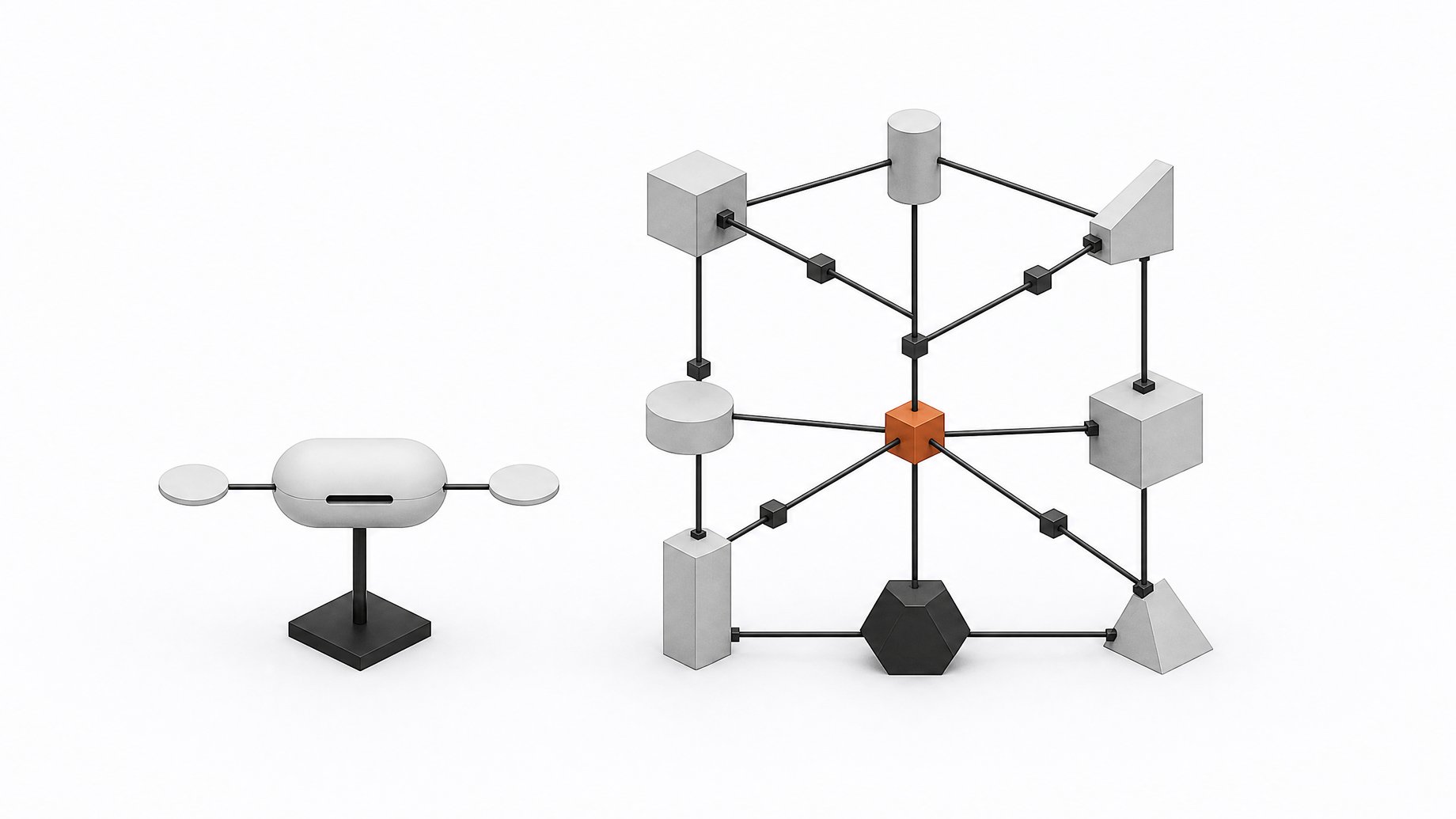
Is AI SaaS or building internal software cheaper?
AI SaaS vs. building internal software is no longer a close call for a growing slice of your subscription stack. If the tool you're paying for is mostly a UI wrapped around OpenAI's or Anthropic's API, you can build and own that same layer faster and cheaper than you can procure, onboard, and renew it. The question isn't whether this is possible. It's which line items on your SaaS bill qualify.
TL;DR
- Many AI SaaS products are thin, since an investigation found that 73% of 200 funded AI startups were making direct, unmodified calls to OpenAI or Anthropic.
- Inference prices for a fixed level of model performance have fallen between 9x and 900x per year, so the compute behind an "AI SaaS" product keeps getting cheaper for anyone who calls the API directly.
- A survey of Retool builders found that 35% of organizations have replaced at least one SaaS tool with a custom AI-built internal tool.
- Companies like ClickUp, Harmonic, Atonom, and Klarna have already made public, dollar-specific replacements of paid SaaS with internal tools.
- Investors noticed too, as roughly $830 billion in software and services stock value was wiped out in six trading days in early February 2026.
- The rough breakeven for tech companies with existing engineering talent sits around $2,000 a month in SaaS spend, above which building increasingly wins.
- Buying still wins for systems of record, deterministic audited logic, and tools that need a dedicated team forever.
What does "AI SaaS vs. building internal software" actually mean right now?
For most of the SaaS era, build-vs-buy was a lopsided bet. Buying got you a working product today. Building got you a multi-month engineering project with uncertain ROI. That math held because software was expensive and slow to write.
Two things broke it. AI coding agents collapsed the time to build a functional internal tool from weeks to hours. And the inference costs underlying most "AI-powered" SaaS products kept falling even as the subscription prices built on top of them did not. When the cost of building drops faster than the cost of renting, the decision flips. That's happening fastest to seat-priced AI tools, because so many of them are thinner than they look.
Are 73% of funded AI startups really just repackaged API calls?
An investigation that monitored network traffic and decompiled code across 200 funded AI startups found that 73% were making direct, unmodified calls to OpenAI or Anthropic behind a custom interface, not running proprietary models or infrastructure despite marketing claims to investors and customers. OpenAI dominated the traffic, Claude was everywhere, and the gap between the pitch deck and the decompiled code was, in the investigator's words, staggering.
This isn't a fringe accusation anymore. Even people defending AI startups concede the point. Forbes noted that "a new UI slapped onto an API that just about anyone could call was always fragile," and that businesses with no differentiation beyond that UI "deserve to be swallowed" once the market notices. That's the useful part of the wrapper critique for a buyer: if the vendor's moat is a login page and a markup, you don't need their moat. You need their API key, which you already have.
How did the economics flip with cheaper inference and faster builds?
Two cost curves crossed, and most procurement teams haven't caught up.
On the input side, inference prices for a fixed level of model performance have fallen somewhere between 9x and 900x per year depending on the benchmark, with the steepest declines in the most recent measured year. The compute underneath an "AI SaaS" product keeps getting cheaper for everyone who can call the API directly, including you.
On the labor side, tools like Bolt, Replit, Cursor, and Lovable let people who aren't traditional engineers ship working internal tools in hours. Netlify CEO Mathias Biilmann put it plainly: "When you have millions of new people who can build software, the barrier goes down. What a single internal developer can build inside a company increases dramatically." We've tracked the same shift in coding-model capability on the internal-tools side; it's the same force behind what Claude Sonnet 5.5 did to internal tool economics.
A 2026 survey of 817 Retool builders quantifies how far this has already gone: 35% of organizations have replaced at least one SaaS tool with a custom AI-built internal tool, and 78% expect to build more in 2026. Workflow automation and internal admin tools are the categories most exposed. The same survey found 60% of builders had shipped something outside official IT oversight in the past year, with "faster than IT" and "existing SaaS insufficient" as the top reasons. That's shadow AI showing up as a build-vs-buy signal, not just a governance problem.
Who's already doing it?
This isn't theoretical. The dollar figures are public and specific.
- ClickUp built six internal AI tools connected to Salesforce, Zendesk, and Snowflake, cutting roughly $200,000 a year in automation software spend.
- Harmonic rebuilt a $20,000-a-year third-party tool inside Retool after slow vendor support, and now runs 33 internally built apps.
- Atonom, an AI startup, replaced a $40,000-a-year Salesforce contract with a custom CRM built in Lovable. The replacement costs about $1,200 a year including hosting, and a non-engineer built the first version in hours.
- Klarna shut down roughly 1,200 SaaS tools and providers, including Salesforce, consolidating fragmented SaaS data into internally built AI systems, and separately reported saving about $2 million after cutting Salesforce loose.
None of these are academic exercises. These are production replacements for tools that were, in several cases, charging five figures a year for functionality that turned out to be a CRUD app and a prompt.
Did the market notice first?
If this were just a few blog posts and conference anecdotes, it would be easy to dismiss. Public markets priced it in instead. In early February 2026, fear that AI agents would displace traditional enterprise applications wiped out roughly $830 billion in software and services stock value in six trading days, with the S&P 500 software and services index falling nearly 13% over that stretch. Investors weren't betting that SaaS disappears. They were betting that the seat-priced markup on commodity functionality stops being defensible, the same thesis applied at index scale.
When does buying still beat building?
Build-everything is its own trap, and the data supports a bounded disruption, not a wipeout. Gartner estimates up to $234 billion in enterprise application spend, about 20% of enterprise SaaS spend, is exposed to "agentic arbitrage" by 2030, and that 35% of point-product SaaS tools will be replaced or absorbed by agentic platforms over that window. That leaves most SaaS spend, including deep systems of record, compliance-heavy deterministic software, and tools that require dedicated long-term vendor ownership, as a reasonable buy.
A few categories still favor renting:
- Systems of record with regulatory weight. Core accounting, payroll, and compliance platforms carry liability you don't want to self-insure by building in-house.
- Deterministic, audited logic. If a wrong answer has legal consequences, a probabilistic AI wrapper is the wrong architecture regardless of who built it.
- Tools that need a dedicated team forever. If nobody internally wants to own upgrades, security patches, and support tickets for the next five years, you're not saving money, you're deferring a cost.
If you're weighing a specific category rather than a general philosophy, our category-by-category guide to self-hosted SaaS alternatives is a better starting point than this piece's broader argument.
What's the threshold for building instead of buying?
The rough breakeven for tech companies with existing engineering talent sits around $2,000 a month in SaaS spend. Above that line, the math increasingly favors building, especially as coding agents keep improving.
Use this quick filter before a renewal:
- Is the vendor's core value an API call? If you could reproduce 80% of the product's output by hitting OpenAI or Anthropic directly, you're paying a markup, not buying a moat.
- Does your team already have the skill to maintain it? Reallocating existing engineering time costs far less than it looks like on paper, which is why tech-forward teams build sooner than non-technical ones.
- Is the spend above roughly $2,000 a month? Below that line, procurement friction and maintenance risk usually outweigh the savings. Above it, they usually don't.
- Is the category workflow automation or internal admin? These are the two categories Retool's survey flagged as most exposed to in-house replacement right now.
This isn't a free lunch. SaaS spend per employee hit $4,830 in 2025, up 21.9% year over year, the first increase in three years, driven largely by AI adoption and vendor price increases. That number keeps climbing for every tool you don't bring in-house, which is its own argument for running the filter above on every renewal, not just the obvious wrapper products.
| Upfront Cost | Time to Deploy | Customization & Control | Ongoing Maintenance Burden | Fit for Regulated/Audited Use | |
|---|---|---|---|---|---|
| Buy (seat-priced SaaS)systems of record and compliance-heavy workflows | Low | Low | Low | Low | High |
| RecommendedBuild (internal AI tool)workflow automation and internal admin tools that are thin API wrappers | Medium | Medium | High | Medium | Low |
Why own the wrapper instead of renting it?
The uncomfortable version of this argument is simple. If a SaaS product's entire value is a thin layer over a model you can call yourself, paying a recurring seat fee for it is renting something you could own outright. That was always true in theory. It's now true in practice, because the two costs that used to make renting rational, build time and inference price, have both collapsed. We've made versions of this case before, from how Fable 5.1 shifted the math on niche tools to why AI software factories are starting to beat SaaS outright. The pattern keeps repeating because the underlying economics keep moving the same direction.
Not every SaaS tool is a wrapper, and not every wrapper is worth replacing this quarter. But the next time a vendor sends a renewal with a price hike attached, ask yourself what model is actually doing the work. If the answer is "the same one you already have an API key for," you don't have a vendor problem. You have a build problem you've been outsourcing at a markup.
Frequently Asked Questions
How do I tell if a SaaS tool is just an AI wrapper?
Check what model is actually doing the work. If the product's core output could be reproduced by calling OpenAI's or Anthropic's API directly with a well-written prompt, and the vendor isn't running proprietary infrastructure, you're likely paying a markup on commodity access rather than buying real differentiation. One investigation found this true of 73% of 200 funded AI startups examined.
At what spend level does building beat buying a SaaS tool?
For companies with existing engineering talent, the rough breakeven sits around $2,000 a month in SaaS fees. Above that, reallocating already-employed engineers' time to build and maintain the tool tends to cost less than the subscription, especially with AI coding agents cutting build time to hours instead of weeks.
Which SaaS categories are most likely to be replaced by internal AI tools?
Workflow automation and internal admin tools top the list, according to a 2026 survey of enterprise builders. Deeply regulated systems of record, deterministic compliance software, and tools requiring dedicated long-term ownership remain better suited to buying.
Is the shift from SaaS to internal AI tools actually happening at scale, or is it just talk?
It's measurable. A 2026 Retool survey found 35% of organizations have already replaced at least one SaaS tool with a custom AI-built alternative, and public markets wiped out roughly $830 billion in software stock value in six trading days in February 2026 on fears of exactly this disruption.
Does this mean SaaS is going away entirely?
No. Gartner estimates about 20% of enterprise application spend, roughly $234 billion, is exposed to agentic AI disruption by 2030, and 35% of point-product SaaS tools will be replaced or absorbed. That leaves the majority of enterprise SaaS spend, particularly systems of record and compliance-critical software, as a reasonable buy.
How we source, write, and correct our articles. Editorial standards