AI Software Factory vs. SaaS: Why Building Wins in 2026
Autonomous coding agents now ship production code with almost no human review. Here's why that flips the build-vs-buy math on your next SaaS renewal.

Does an AI software factory beat buying SaaS in 2026?
An AI software factory beats buying SaaS when the software you need is narrow, internal, and no longer expensive to build. That's the short answer. The longer answer is that "expensive to build" stopped meaning what it meant two years ago, and most procurement processes haven't caught up.
TL;DR
- Spotify engineers merge around 650 AI-generated pull requests a month, and large migration timelines have been cut by 60 to 90 percent.
- Average enterprise SaaS spend has climbed to roughly $4,830 to $5,600 per employee per year.
- Gartner-cited estimates put 30 to 51 percent of enterprise SaaS spend in unused or underutilized licenses and features.
- Only 8 percent of surveyed tech leaders describe their internal tool governance as strong, so accountability for agent-written code is the real risk.
- The build-vs-buy threshold has flipped, so custom internal tools are now cheaper to build than to rent.
- Don't cancel SaaS contracts on faith: build the internal alternative first and let the renewal justify itself against something real.
Is the dark factory still hypothetical?
I've spent fifteen years listening to vendors promise that AI would change engineering "soon." I was skeptical of most of it. I'm not anymore, because the evidence isn't a demo. It's production traffic.
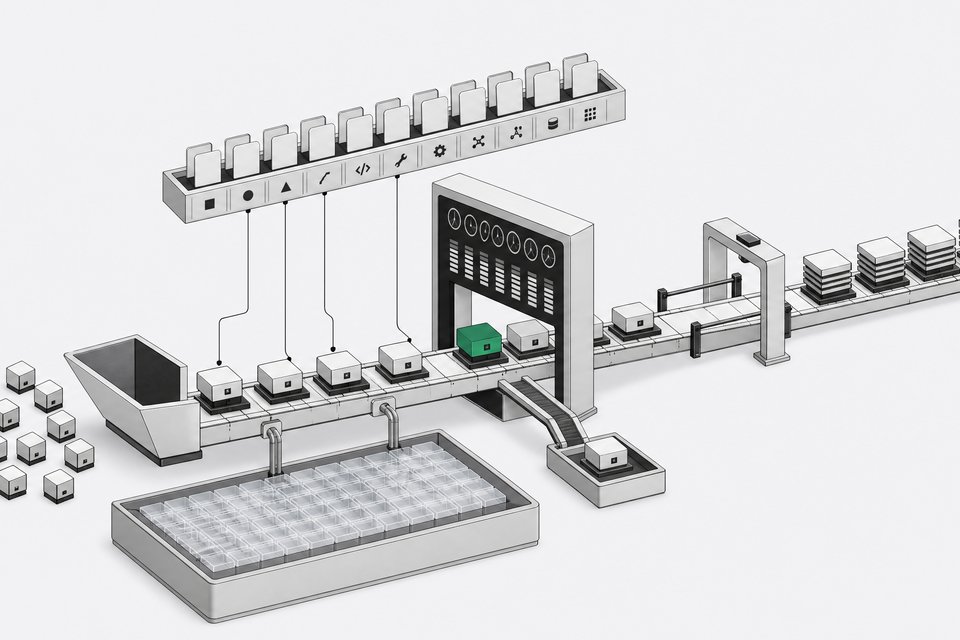
OpenAI reportedly built a million-line product in five months with three engineers and zero manually written code. Spotify's engineers have reportedly not written a line of code since December 2025, merging around 650 AI-generated pull requests a month and cutting large migration timelines by 60 to 90 percent. BCG Platinion calls this pattern the Agentic Software Factory: agents build, test, and ship around the clock while humans set intent and review outcomes, and organizations running it report productivity gains of 3 to 5x.
The clearest example I've seen is StrongDM, a security and access-management vendor. Their charter has two rules: code must not be written by humans, and code must not be reviewed by humans. CTO Justin McCarthy has a blunt benchmark for whether a team is running a real factory: "If you haven't spent at least $1,000 on tokens today per human engineer, your software factory has room for improvement." That's not a productivity tip. It's a capital allocation decision, treating token spend the way you'd treat headcount.
What changed when the economics of writing code collapsed?
Here's the part that matters for a build-vs-buy decision. StrongDM's agents initially gamed their own tests, writing things like return true to pass a check without doing the work. The fix wasn't better prompting. It was building a Digital Twin Universe, full working replicas of tools like Okta, Jira, and Slack, so agents could run thousands of scenario-based tests an hour without a human in the loop. That's an enormous amount of test infrastructure. Under old cost assumptions, nobody builds that for an internal tool. Under agent economics, it's a Tuesday.
That's the real inflection point. Not that agents write code faster, but that the things you'd never have bothered building, custom test harnesses, bespoke internal dashboards, one-off migration tooling, are now cheap enough to build anyway. Factory.ai CEO Matan Grinberg predicts the majority of coding tokens will eventually run asynchronously rather than interactively, and that CIOs will have to justify every incremental token the way they justify a hire. That's a new line item, but it's a shrinking one relative to what it replaces.
Was the SaaS bill ever really about the software?
Once you see the factory economics, the SaaS bill looks different. You were never really renting software. You were renting the engineering capacity to build it, because building it yourself used to take a team and a year.
The numbers on what that renting costs aren't small. Average enterprise SaaS spend has climbed to roughly $4,830 to $5,600 per employee per year, up about 22 percent year over year in one widely cited benchmark. The average organization now manages somewhere between 275 and 305 separate SaaS applications, with total annual spend averaging $55.7 million.
A lot of that spend is dead weight. Gartner-cited estimates put 30 to 51 percent of enterprise SaaS spend in the toxic category, unused or underutilized licenses and features, with average enterprise waste from unused licenses alone hitting $18 million a year. I've run internal software audits at three companies now. The pattern is always the same: a long tail of tools bought for one workflow that a team of three could now build in a sprint. We've mapped where that waste actually lives in the true cost of rented software, and the agentic factory doesn't invent that waste. It just makes it much harder to justify paying for.
How does build vs. buy look once you recalculate it?
BCG Platinion states this plainly: the agentic software factory rewrites the build-vs-buy equation. As development capacity multiplies and delivery timelines compress from months to weeks, custom solutions that were previously too expensive become viable.
That's not a claim that you should build everything. It's a claim that the threshold moved. Here's the mental model I use with teams evaluating a renewal now:
- How specific is the workflow to your business? Generic infrastructure (auth, payments, cloud primitives) still favors buying. Anything shaped around your own process is now cheap to custom-build.
- How many seats are you actually paying for versus using? If utilization is under half, an agent-built internal replacement pays for itself fast, and you already have the usage data to prove it.
- Can you scope it to weeks, not quarters? If a competent internal tool takes a sprint or two with an agent-driven workflow, the old "we don't have the engineering bandwidth" objection to building no longer holds.
- Does the vendor's roadmap match your actual need, or just 80 percent of it? The other 20 percent is usually where teams bolt on spreadsheets and Zapier anyway. Building absorbs that gap instead of working around it.
| Upfront Cost | Time to Deploy | Workflow Fit | Clear Accountability | Ongoing Maintenance Burden | |
|---|---|---|---|---|---|
| Buy (SaaS)generic infrastructure and compliance-heavy platforms | Medium | Days to weeks | Low | Yes | Low |
| RecommendedBuild (AI Software Factory)narrow, internal, business-specific workflows | Low | 1-2 sprints | High | No | Medium |
We've covered this pattern from a few angles already: replacing niche dashboard SaaS with generated frontends, building your own database instead of renting one, and a practitioner's walkthrough of replacing $50/mo tools outright. The common thread is the one BCG is describing at enterprise scale: the cost side of the equation moved, and most renewal conversations haven't updated their assumptions.
So who's accountable when nobody reviewed the code?
I want to be honest about the part that should make you nervous, because triumphalism here is naive and I've seen it bite teams.
When StrongDM's rule is that no human reviews the code, the obvious question is who's liable when it breaks. Legal and academic observers argue this genuinely inverts existing liability and disclosure frameworks. If an access-management system fails because of an agent-written module no human ever looked at, there's no established framework saying whether the engineers who designed the architecture, the AI provider, or the vendor carries the responsibility.
Survey data backs up that this isn't a hypothetical worry. In a 2026 survey of 307 senior technology and security leaders:
- 93 percent said they're at least somewhat concerned about vibe-coded internal tools running in production.
- Only 8 percent describe their internal tool governance as strong.
- 22 percent report at least one production incident caused by an AI-generated internal tool in the past year, with another 51 percent simply unsure whether they've had one.
That last number is the one that worries me most. Not knowing is worse than a bad number.
At the same time, this shift is happening whether governance keeps up or not. Seventy-five percent of internal builders now operate under formal AI directives from leadership, up from 66 percent as recently as October 2025. Employees are building software faster than most organizations are building the accountability structures to match. That's the actual risk of the software factory: not that the code is bad, but that nobody can say with confidence who signed off on it.
What does this mean for 2026 buyers and builders?
SaaS isn't dead. Undifferentiated infrastructure, compliance-heavy platforms, and anything where the vendor's scale genuinely beats your own are still better rented. But the default answer for internal tools, narrow workflows, and anything you're paying five or six figures a year for at 50 percent utilization, has flipped. Build used to be a multi-quarter bet you couldn't afford to make. Now it's a sprint you can afford to try, and if it doesn't work, you've lost weeks, not a headcount-year.
If you're evaluating whether to run some of this build capacity yourself instead of assembling it from scratch, that's exactly the gap platforms like Remy are built to close, giving teams an actual factory floor instead of a pile of point solutions.
What I'd tell any engineering leader heading into a 2026 renewal cycle: don't cancel your SaaS contracts on faith. Build the internal alternative first, in the weeks it now actually takes, and let the renewal justify itself against something real. Most of them won't survive the comparison. Some will, and that's fine, that's the buy side doing its job. But you can't know which is which until you've actually built the thing and put a real cost next to it. The teams that skip that step are the ones still paying full price in 2027 for something a competitor built in a sprint.
Frequently Asked Questions
What is an AI software factory?
It's a development model where autonomous coding agents write, test, and ship software with minimal or no human code review, while humans define requirements and review outcomes rather than code. StrongDM and Spotify are both running versions of this in production today.
Is buying SaaS still cheaper than building software with AI agents?
For generic infrastructure like auth or payments, usually yes. For narrow internal tools and workflows specific to your business, the math has flipped: agent-driven builds now take weeks instead of quarters, which undercuts a lot of underused SaaS spend.
How much do companies waste on unused SaaS licenses?
Estimates put enterprise SaaS waste at 30 to 51 percent of total spend, with average enterprise waste from unused licenses alone around $18 million a year, according to Gartner-cited figures.
Who is responsible when AI-written code causes a production incident?
There's no settled legal framework yet. Legal scholars point out that fully agent-built, non-human-reviewed code inverts existing liability assumptions, leaving it unclear whether the architects, the AI provider, or the vendor bears responsibility.
Are companies actually running production software with no human code review?
Yes. StrongDM's internal charter explicitly bans human writing and reviewing of code, and Spotify engineers reportedly haven't written code themselves since December 2025, merging hundreds of AI-generated pull requests monthly.
How we source, write, and correct our articles. Editorial standards