What Is an Enterprise LLM Gateway? Best Options for Sensitive Data
Compare Portkey, Kong, LiteLLM, Cloudflare, and AWS Bedrock on PII redaction, compliance certifications, and data residency to stop shadow AI data leaks.


What is an enterprise LLM gateway, and which options best protect sensitive data?
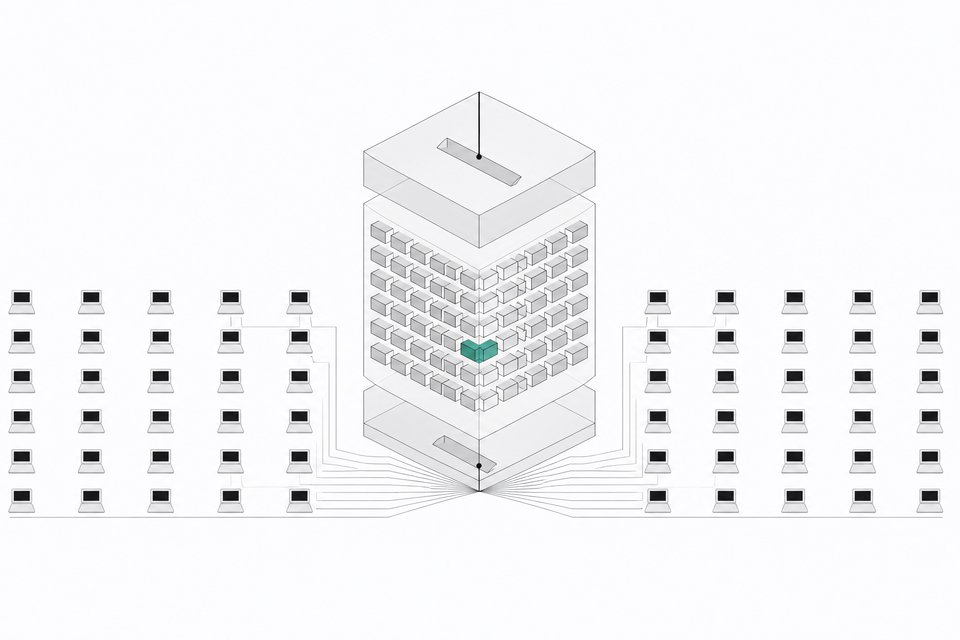
An enterprise LLM gateway is a policy layer that sits between every employee and every model provider (OpenAI, Anthropic, Google, Bedrock) so every prompt and every response passes through redaction, logging, and access rules before it ever leaves the corporate network. That's the fix the market has converged on. The enterprise AI gateway category is projected to grow from roughly $1.33 billion in 2026 to $11.32 billion by 2035.
TL;DR
- About 35% of corporate data put into AI tools is classified as sensitive (34.8% by April 2025), and 39.7% of all AI tool interactions now expose sensitive data.
- Shadow AI was a factor in 20% of data breaches, adding about $670,000 to the average breach cost.
- Enterprise LLM gateways safely route, redact, and log AI requests instead of relying on bans that don't work.
- Banning generative AI typically drives usage into personal, unmanaged accounts that IT cannot monitor.
- The five gateways differ on compliance and data control: for example, Cloudflare AI Gateway has no data residency controls, and Kong's and LiteLLM's sensitive-data features sit behind paid licenses.
- A gateway enforces policy but doesn't write it, so regulated enterprises still need data classification, zero-data-retention terms, training, and AI-specific incident response.
Is the real insider threat espionage or copy-paste?
Apple sued OpenAI and two former employees in 2026, alleging a coordinated effort to funnel confidential hardware trade secrets out the door. The complaint notes more than 400 former Apple employees now work at OpenAI. xAI filed a separate suit against OpenAI over trade-secret theft by former staff. Those cases are dramatic, well-lawyered, and genuinely existential for the companies involved.
They are also not the exposure most enterprises actually have. The far more common leak doesn't need a poached engineer or a conspiracy. It needs one employee, a deadline, and a free ChatGPT tab. Seventy-seven percent of employees who use AI tools have pasted company data into them, and 82% of that activity runs through personal or unmanaged accounts IT cannot see at all. This is the same ungoverned surface area covered in our look at how employees are quietly disabling corporate AI tools and building their own: the tooling is invisible by design, not by accident.
How bad is shadow AI data leakage, really?
The trend line is the real story, not any single data point. The share of corporate data employees put into AI tools that's classified as sensitive rose from 10.7% in 2023 to 27.4% in 2024 to 34.8% by April 2025. Cyberhaven's later telemetry pushes that further: 39.7% of all AI tool interactions now expose sensitive data. Employees average 46 paste operations a day. Personal accounts alone generate roughly 15 of those daily, at least four of which contain something sensitive.
And it isn't just text in a chat window. Roughly 40% of files uploaded into GenAI tools contain PII or PCI data. IBM's 2025 Cost of a Data Breach Report puts a dollar figure on the consequence: shadow AI was a factor in 20% of breaches among studied organizations, adding about $670,000 to the average breach cost. Ninety-seven percent of organizations that had an AI-related security incident admitted they lacked proper AI access controls. That last number is the one worth sitting with. This isn't a sophistication problem. It's an absence-of-controls problem.
What does an enterprise LLM gateway actually do?
An LLM gateway isn't a firewall rule that blocks chat.openai.com. It's an API-layer proxy that every model call, from an employee's browser extension, an internal app, or an agent, has to pass through on the way to the model provider. The core functions are consistent across vendors:
- Virtual keys and routing. Employees and apps authenticate against the gateway, not against OpenAI or Anthropic directly, so no one is holding a raw API key that can be copied into a personal account.
- PII and secret redaction. The gateway strips or masks sensitive fields, names, account numbers, source code, credentials, before the request reaches an external model.
- Prompt and response guardrails. Both the outbound request and the inbound model response get scanned for policy violations, not just the prompt.
- Audit logging. Every request is logged with who sent it, what model handled it, and what it contained. That's the forensic trail missing in 97% of the breached organizations IBM studied.
- Budget and rate controls. Spend caps and usage limits per team or app, which doubles as a side door into catching unauthorized or runaway usage.
The distinction that matters: blocking tries to stop the behavior. A gateway assumes the behavior will happen and makes it safe when it does.
Which enterprise LLM gateways are best for sensitive data?
Five products come up repeatedly when security teams evaluate this category. They split cleanly on compliance posture, deployment model, and how far redaction actually reaches.
- Portkey (now Prisma AIRS AI Gateway, after Palo Alto Networks' 2026 acquisition). SOC 2, GDPR, ISO 27001, and HIPAA compliant out of the box, with automatic PII redaction and FIPS-compliant self-hosted images for regulated enterprises. The acquisition itself is a signal: a major security platform decided this layer was worth buying rather than building.
- Kong AI Gateway. Built on Kong's existing API gateway, with a dedicated plugin that masks sensitive data before it leaves the network, plus prompt and response guardrail plugins. The catch: the core is Apache 2.0 open source, but the advanced AI plugins require a Konnect or Gateway Enterprise license. The sensitive-data features aren't in the free tier.
- LiteLLM. The open-source gateway is MIT-licensed and fully self-hostable, so prompts and responses never leave your own environment by default. The Enterprise tier is SOC 2 Type II audited and adds SSO/SCIM, audit logs, and PII-masking integrations with Microsoft Presidio and Lakera's prompt-injection detection, but those integrations sit behind the paid license, not the free core.
- Cloudflare AI Gateway. Guardrails evaluate both prompts and responses in real time for harmful content and data loss prevention. The gap: as of 2026, Cloudflare's own community forum confirms AI Gateway has no data residency or regional-processing controls, which rules it out for workloads with jurisdictional requirements.
- AWS Bedrock (with Guardrails). Not marketed as a standalone gateway, but it functions as one for AWS-native shops. A single AWS Business Associate Agreement covers every Bedrock-accessible model (Claude, Llama, Titan, Mistral) without negotiating a separate BAA per vendor, which is the main reason regulated enterprises route traffic through it.
The pattern across all five: the vendor that controls your traffic also controls what compliance certs apply, and self-hosting generally buys more control at the cost of more operational overhead. None of this works if the AI usage it's meant to govern stays underground. The enforcement model has to assume agents and ad hoc automations are already running, which is the same lesson covered in the playbook for managing AI agents before they manage you.
Why does banning AI outright backfire?
Samsung banned ChatGPT and other generative AI tools for staff in 2023 after employees pasted confidential semiconductor source code and internal meeting notes into the chatbot on at least three separate occasions in about 20 days. It's the canonical cautionary tale, and it's usually told backward. The ban didn't stop the leaking. It stopped Samsung's visibility into it.
LayerX's data backs that up directly: 82% of sensitive-data pastes already happen on personal, unmanaged accounts. A prohibition policy doesn't eliminate that number, it just confirms it. Employees under deadline pressure don't stop using the tool that makes them faster. They stop using the version IT can see. That dynamic is exactly what we've documented in how shadow AI has quietly spread across employee laptops and wearables: block the sanctioned tool hard enough and workers route around it, taking the data with them. A gateway flips that incentive. It makes the sanctioned path the fast, invisible-to-the-user path, so there's no reason to leave it.
What do regulated industries need beyond the gateway?
A gateway is necessary infrastructure, not a complete program. OWASP's 2025 Top 10 for LLM Applications elevated "Sensitive Information Disclosure" to the #2 risk, up from #6 the prior cycle. That's industry consensus that uncontrolled prompts and outputs covering PII, financial data, health records, and confidential business data are now a top-tier application risk, not an edge case.
IBM's finding that 97% of breached organizations with an AI incident lacked proper access controls points at governance, not tooling. A gateway enforces policy. It doesn't write the policy. Regulated enterprises still need:
- A documented data-classification scheme that tells the gateway what counts as sensitive in the first place.
- Contractual zero-data-retention agreements with model providers where eligible. Both OpenAI and Anthropic offer this for approved enterprise and API customers, though it must be separately negotiated and doesn't cover consumer tiers.
- Training that explains why the gateway path is faster and safer, not just mandated.
- Incident response procedures specific to AI-related exposure, since standard breach playbooks rarely account for a model provider as a third party.
The underlying logic is the same one that runs through most of what this publication writes about: owning the enforcement layer that touches your data, rather than renting trust from whichever vendor happens to host the model. The gateway is one piece of a wider shift away from assuming SaaS defaults will protect you.
| Deployment Model | Compliance Posture | Redaction Depth | Cost Model | |
|---|---|---|---|---|
| Portkey (Prisma AIRS AI Gateway)regulated enterprises wanting compliance out of the box | Hosted or self-hosted (FIPS images) | SOC 2, GDPR, ISO 27001, HIPAA built in | High | Commercial platform |
| Kong AI Gatewayshops already standardized on Kong's API gateway | Self-hosted, Apache 2.0 core | Advanced AI plugins gated behind Konnect/Enterprise license | Medium | Open core + enterprise license for AI plugins |
| LiteLLMteams wanting fully self-hosted, auditable infrastructure | Self-hosted, MIT-licensed core | SOC 2 Type II audited on the paid Enterprise tier | High | Free core + paid Enterprise tier for PII masking, SSO, audit logs |
| Cloudflare AI Gatewayteams already on Cloudflare's network without jurisdictional constraints | Hosted on Cloudflare's network | No data residency or regional-processing controls | Medium | Usage-based |
How do you choose an enterprise LLM gateway?
Strip away the marketing and the choice comes down to five questions:
- Self-host or hosted? Self-hosting (LiteLLM's open-source core, Kong's base) keeps data in your environment but adds operational load. Hosted (Portkey, Cloudflare) trades that overhead for faster deployment and someone else's uptime commitment.
- Which compliance certs do you actually need? HIPAA, SOC 2, and ISO 27001 are not interchangeable, and not every gateway holds all three. Match the cert to the regulation you're actually under, not the one that sounds most impressive.
- How deep is the redaction, really? "PII redaction" ranges from basic regex pattern-matching to integrated detection engines like Presidio. Ask for the specifics before you assume parity across vendors.
- Can you get zero-data-retention terms from the underlying model provider? This is a separate negotiation from the gateway contract and gates whether your data is ever stored on the model side at all.
- What's the latency and cost tax? Every redaction pass and guardrail check adds milliseconds and, often, a per-request fee on top of the model's own API cost. For high-volume workloads, that tax compounds fast.
The espionage lawsuits will keep making headlines. They involve named executives, discovery filings, and nine-figure trade secrets. The copy-paste problem won't make headlines, because it's happening in a browser tab on a laptop with no name attached. It's also the one actually costing your company money right now, and it's the one a gateway can fix starting with the next prompt an employee sends.
Frequently Asked Questions
What is an enterprise LLM gateway?
It's a policy-enforcement proxy that sits between employees or applications and AI model providers like OpenAI, Anthropic, or Google. Every prompt and response passes through it for authentication, PII/secret redaction, guardrail checks, and audit logging before reaching the model.
How is an LLM gateway different from just blocking ChatGPT at the network level?
Blocking tries to stop AI usage outright, which research shows pushes it to personal, unmanaged accounts IT can't see — 82% of sensitive-data pastes already happen that way. A gateway assumes employees will use AI and makes the sanctioned path safe, fast, and visible instead.
Which enterprise LLM gateways support HIPAA or SOC 2 compliance?
Portkey (now Prisma AIRS AI Gateway) is SOC 2, GDPR, ISO 27001, and HIPAA compliant. LiteLLM's Enterprise tier is SOC 2 Type II audited. AWS Bedrock covers HIPAA for any Bedrock-accessible model under a single Business Associate Agreement. Cloudflare AI Gateway currently lacks data residency controls, which matters for regulated workloads.
Does a gateway alone stop shadow AI data leaks?
No. IBM found 97% of organizations with an AI-related security incident lacked proper AI access controls, which points at governance and policy gaps, not just missing tooling. A gateway needs to be paired with data classification, training, and incident response procedures specific to AI exposure.
What is zero data retention and do all AI providers offer it?
Zero data retention (ZDR) is a contractual arrangement where a model provider doesn't store prompts or outputs after processing a request, except for abuse monitoring. OpenAI and Anthropic both offer it for approved enterprise and API customers, but it must be separately requested and doesn't apply to consumer-tier accounts.
How we source, write, and correct our articles. Editorial standards