What Is an AI Software Factory? Definition and SaaS Impact
An AI software factory uses agents to run the dev lifecycle with human gates. Learn how it works and how it affects SaaS renewals and build-vs-buy decisions.

What is an AI software factory?
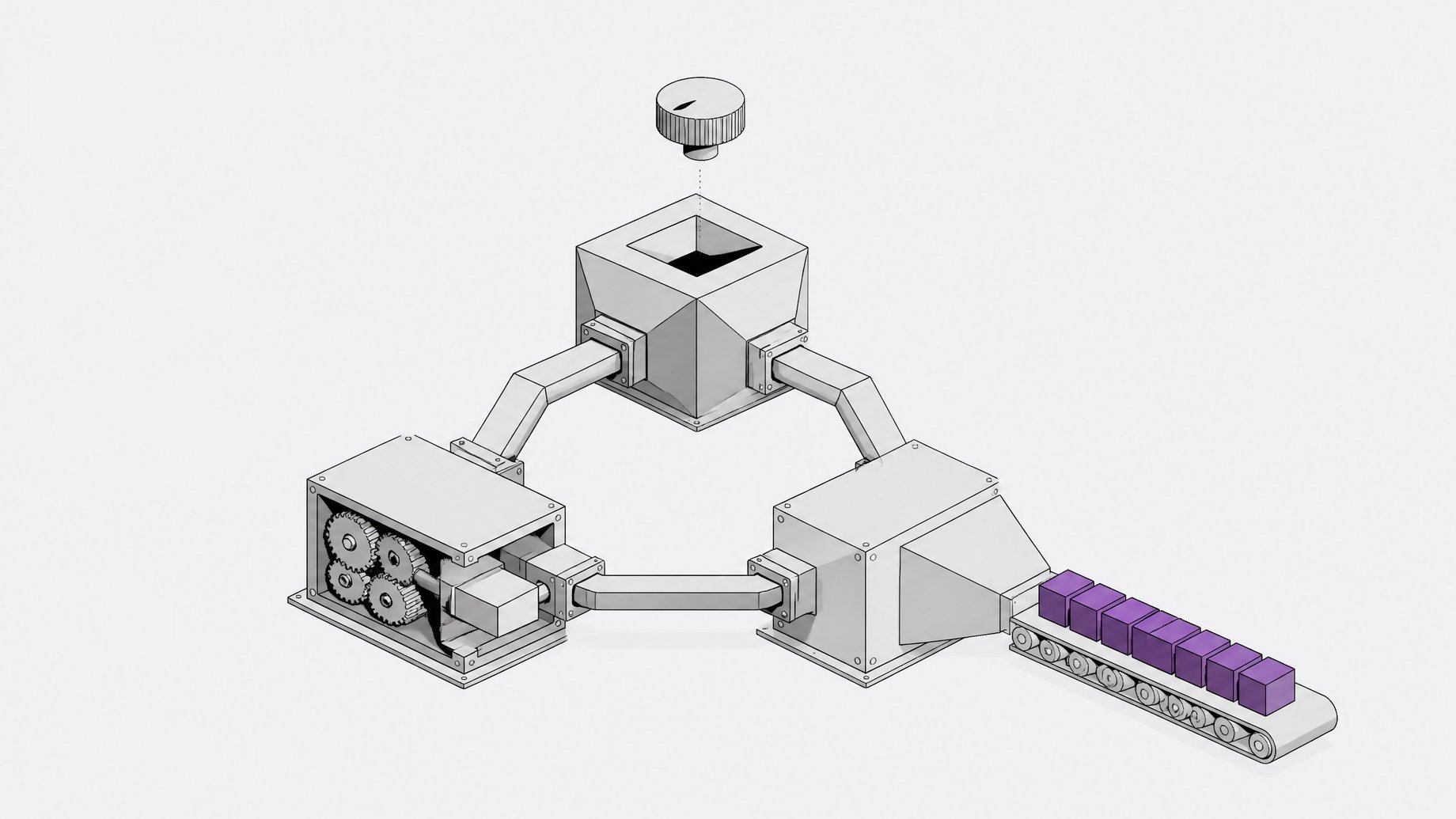
An AI software factory is an organizational system in which AI agents handle the discrete stages of the software development lifecycle (triage, coding, testing, review, deployment, monitoring), while humans retain control at two gates: setting the specification and approving the merge. It is not a coding assistant. It is the pipeline that sits around the assistant, turning a stream of requests into shipped, maintained software on a predictable cadence.
The phrase gets confused with something unrelated. Nvidia uses "AI factory" to describe a data center built to manufacture intelligence at scale, a hardware story about GPUs and throughput. The AI software factory is a different claim entirely: it's about who builds your internal tools, and what that does to the price you're willing to pay someone else to build them for you.
TL;DR
- AI agents collapse implementation times, which makes custom internal tools cheaper to build than to rent as SaaS over the long term.
- Organizations waste an average of $19.8 million per year on unused or underutilized SaaS licenses.
- 35% of companies have already replaced at least one SaaS tool with custom-built software, according to Retool's survey.
- Systems of record remain SaaS strongholds, especially where deep domain knowledge, strict oversight, or regulated data is involved.
- Commodity workflow tools such as dashboards, internal portals, and approval workflows are the category moving in-house.
- Before your next renewal, treat the factory as a build option in the negotiation and compare agent-assisted build cost against multi-year subscription fees.
What changes when you go from copilots to a factory?
Copilot and Cursor made individual developers faster at writing code. That's real, but it doesn't change who owns the build-versus-buy decision. A software factory changes that decision by changing what a project costs.
Factory.ai, the company that popularized the term with its "Factory 2.0" framing, describes the loop like this: signals come in from the outside world, get triaged into planned changes, and those changes are built, tested, reviewed, secured, shipped, and monitored, largely by agents, inside guardrails a human has already drawn. Augment Code frames the same shift from the delivery side: the bottleneck used to be writing code, and now it's verifying code, because agents can produce pull requests faster than any organization can review them. Cortex's version makes the organizational point directly: engineers move up a level, from writing software to designing and operating the system that writes it.
Developer Martin Alderson's observation shows what that does to timelines: implementation time collapses even though the thinking time behind a project barely changes. A project that used to take a month now takes about a week, and smaller teams mean less coordination overhead, not more. That's the detail that matters for a build-vs-buy call: the old argument for renting software was never that SaaS worked better, it was that building and maintaining your own version cost too much. Cut that cost by an order of magnitude, as our coverage of why building wins in 2026 argues, and the rest of the SaaS pricing model has to be re-examined, not just tolerated.
Why does agentic coding break the SaaS cost equation?
SaaS pricing has always rested on a trade. You pay a premium for a multi-tenant product built for thousands of customers, and you accept a lot of feature waste, because building your own version was slower and riskier than paying the subscription. That trade made sense when a month-long internal tool genuinely took a month, needed a dedicated engineer, and came with the coordination tax of a team.
Agentic coding collapses the build side of that trade without touching the buy side at all. Globant's framing of this shift is careful on purpose: SaaS doesn't disappear, but it stops being the automatic default and becomes a deliberate, workflow-by-workflow choice, with the earliest proof points showing up in bounded internal tools rather than core financial systems. AlixPartners goes further, arguing that AI agents are starting to replace the logic and presentation layers that SaaS vendors have monetized for two decades, which is why vendors are already shifting from seat licenses toward outcome- and usage-based pricing. Either way, the premium you pay for a generic product stops being a fixed cost of doing business. It becomes a number you can compare against an actual build estimate, which is exactly the math behind building internal tools with AI instead of renewing.
Which Companies Are Already Building Instead of Buying?
This isn't theoretical. A few concrete examples:
- Blackstone rewrote its internal developer portal, a project that previously took two years to build, in four months using an agentic platform.
- Factory's own CTO, Eno Reyes, says the company has started building things internally it would historically have bought, including its customer support workflow and legal tooling, and replaced a third-party analytics app with an internal build. He calls much of this "small utilities or micro-SaaS" territory.
- Software factories are already running in production at NVIDIA, EY, Adobe, Palo Alto Networks, Adyen, Blackstone, Wipro, and Comarch.
- Retool's 2026 survey of 817 customers and builders found that 35% of companies have already replaced at least one SaaS tool with custom-built software, and 78% expect to build more custom internal tools in 2026. Workflow automation, internal admin tools, BI dashboards, and CRM or sales tools were the categories most often replaced. The two reasons builders gave: saving on subscription fees, and getting software that actually fits their workflow.
- Just over half of builders told Retool they'd already built at least one piece of software with AI, mostly using ChatGPT, Gemini, or Claude.
Martin Alderson's observation ties the pattern together. He's seen SaaS vendors send their usual annual price increase, and teams that would have accepted it a year ago are now asking whether they could just build the thing themselves. A year ago that was a hypothetical with a fast no. Now it's a real option people put real effort into.
How Much Is SaaS Actually Costing You Right Now?
The case for reconsidering SaaS doesn't rest only on how cheap building got. It also rests on how much the current subscription stack already wastes.
- The average organization wastes $19.8 million per year on unused or underutilized SaaS licenses, a figure that rises to $80.6 million at enterprises with more than 10,001 employees.
- Organizations leave an average of 36% of their SaaS licenses unused against recommended utilization levels.
- Gartner estimates that up to $234 billion of enterprise application software spend, roughly 20% of enterprise SaaS spend, is at risk through 2030 from what it calls "agentic arbitrage," where AI agents complete cross-system tasks and bypass the software interface entirely.
Gartner's George Brocklehurst frames this as a shift rather than a collapse. Total software spending still grows roughly 12% through 2030 on his numbers, but the money moves away from seat-based dashboards toward outcome-based, agent-delivered services. "This is less an apocalypse and more of a metamorphosis," he says. That distinction matters. It tells you where the money is going, not just where it's leaving from.
Where does buying SaaS still win?
An honest version of this argument has to admit where the factory doesn't change the calculus. Bain's 2025 Technology Report maps SaaS workflows across a spectrum based on how automatable the user task is and how deeply AI can penetrate the workflow. Only the workflows in the "battleground" quadrant, high automation potential plus high AI penetration, such as Tier-1 support, invoice processing, or time-entry approval, are genuinely at risk of being cannibalized. Workflows that require deep domain knowledge, strict oversight, or regulated data remain what Bain calls "core strongholds" for incumbent SaaS.
JLL's industry analysis makes a similar point from the vendor side: "'AI removes the need for SaaS' is not the position any serious analyst holds." Build-vs-buy is a workflow-by-workflow spectrum, not a binary. Their research found that AI initiatives delivered with an external vendor or partner succeed roughly twice as often as those built entirely in-house, and Gartner expects more than 40% of agentic AI projects to be cancelled by the end of 2027 on cost, value, or control grounds. CIO.com reporting adds a practical warning: some companies have already swapped a road-tested CRM for a homegrown AI-built app, and experts caution that doing so shifts the full burden of maintenance, security, and support onto the company that built it. Systems of record, regulated data, and genuinely deep product moats aren't where the factory argument should be pointed.
Where Does the Factory Actually Make Buying Obsolete?
The line that matters isn't AI versus SaaS. It's commodity internal tooling and workflow glue versus systems of record. Dashboards, internal portals, approval workflows, reporting layers, lightweight CRMs built for one team's specific process: these are exactly the categories Retool found companies already replacing, and exactly the kind of "micro-SaaS" Factory's own CTO describes building in-house. They're also, not coincidentally, the categories where the SaaS premium was always hardest to justify. You were paying for a product built for everyone's workflow instead of yours, which is exactly why AI-generated dashboards are starting to replace niche SaaS products first.
What's new is that the line is moving fast, and it's moving in one direction. The factory isn't a capability reserved for engineering-heavy companies anymore. Below that moving line, a new SaaS purchase for a commodity workflow tool is increasingly a bet that your team can't build what it needs, and that bet gets worse every quarter the factory improves.
| Upfront cost | Time to deploy | Ongoing maintenance burden | Fit to your workflow | Risk of project cancellation or failure | |
|---|---|---|---|---|---|
| RecommendedBuild with an AI software factoryCommodity internal tools, dashboards, workflow glue | Engineering time only (days-weeks) | Days to weeks | High | High | High |
| Buy (SaaS subscription)Systems of record, regulated data, deep product moats | Recurring seat/usage fees | Fast if already selected, but renews indefinitely | Low | Low | Low |
What should you ask before your next SaaS renewal?
Treat the factory as a build option in the negotiation, not just a line item to approve or cut. Before signing the next renewal for a workflow tool, dashboard, or internal admin product, ask three things:
- Is this a system of record or a workflow convenience? If it's the latter, the factory argument applies directly.
- How much of the license are you actually using? Organizations leave over a third of licenses idle on average, so the renewal price you're negotiating against may already be inflated by waste you haven't audited.
- What would four weeks of agent-assisted build time actually cost, compared to the next three years of subscription fees? That's the comparison Blackstone, Factory, and the 35% of companies in Retool's survey have already run.
The SaaS vendor sending you the renewal quote isn't wrong that their product works. They're betting you still believe building the alternative is harder than it is. For a shrinking, but no longer small, set of tools, that bet is losing.
Frequently Asked Questions
What is an AI software factory, in plain terms?
It's an organizational setup where AI agents handle most of the software development lifecycle, triage, coding, testing, review, deployment, and monitoring, while people set the specification up front and approve the final merge. It's a system, not a single coding tool.
Is an AI software factory the same thing as Nvidia's 'AI factory'?
No. Nvidia's term describes a data center built to manufacture intelligence at scale, which is a hardware and infrastructure story. An AI software factory is an organizational model for building and shipping software, and the two terms are unrelated despite the shared phrase.
Does an AI software factory mean companies should stop buying SaaS entirely?
No. The strongest case for building applies to commodity internal tools and workflow glue, like dashboards, internal portals, and approval workflows. Systems of record, regulated data, and products with deep domain moats generally remain better bought than built, according to Bain's and JLL's analyses.
How much are companies actually saving by building instead of buying?
The clearest public data point is Blackstone's internal developer portal, which took four months to rebuild with an agentic platform versus the two years the original build required. Retool's 2026 survey also found 35% of companies have already replaced at least one SaaS tool with something they built.
What's the biggest risk of building internal software instead of buying it?
You take on the full maintenance, security, and support burden that a SaaS vendor otherwise carries. JLL's research found AI initiatives delivered with an external vendor succeed roughly twice as often as those built entirely in-house, which is a real argument for caution, not just enthusiasm.
How we source, write, and correct our articles. Editorial standards