Building Dashboards with AI: How Frontier Frontend Models Kill Niche SaaS
AI tools like v0, Bolt, and Lovable now build internal dashboards in minutes. Here is when that replaces niche SaaS, and when it does not.

Can AI frontend models replace niche SaaS dashboards?
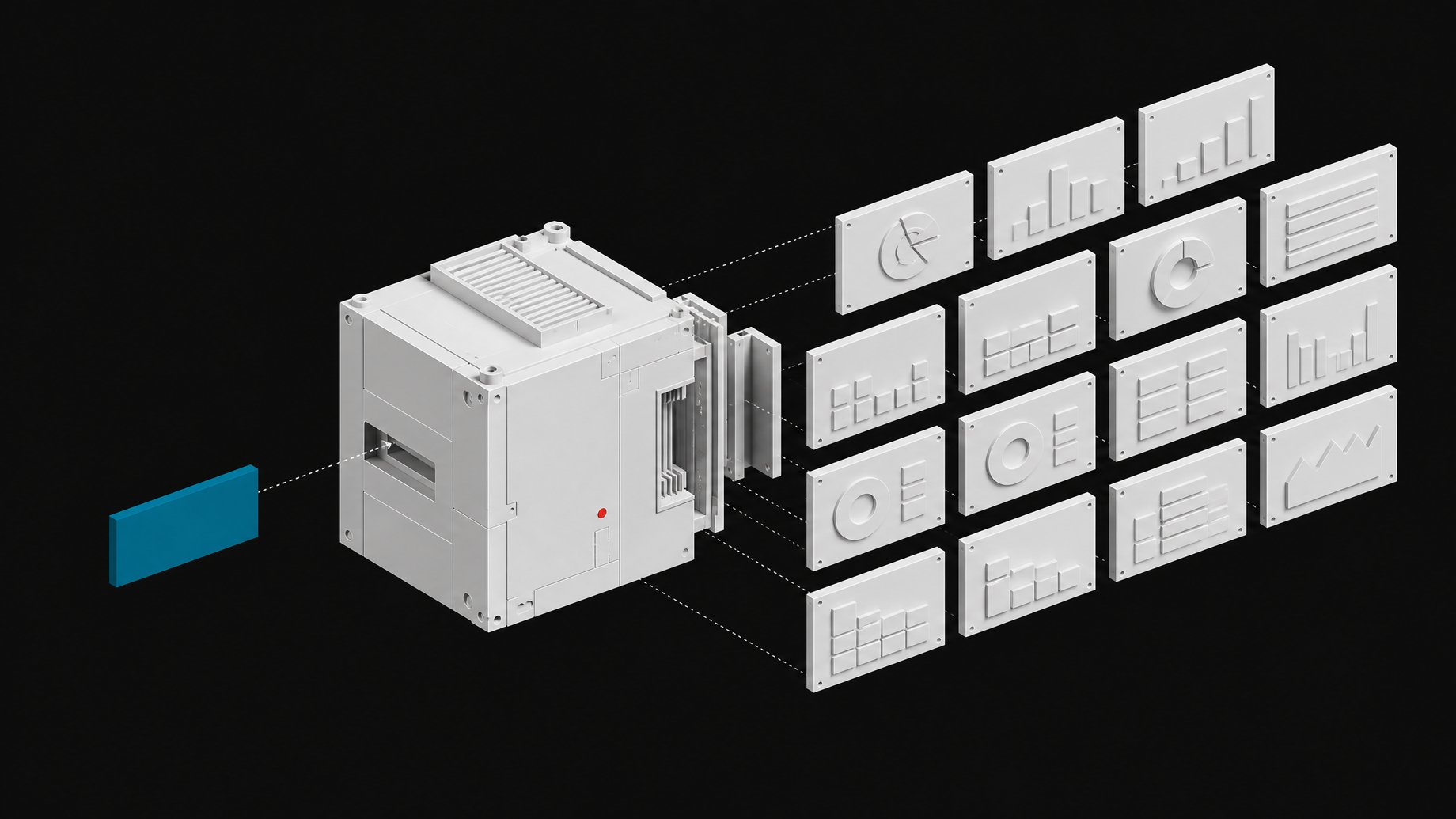
AI frontend generation for internal tools means using models like v0, Bolt, and Lovable to describe a dashboard in plain English and get working, deployable UI in minutes, often for free or a few dollars in credits. For a large slice of niche SaaS, that kills the case for subscribing at all. If the tool is basically a chart, a table, and a form wired to data you already own, you can now build it faster than you can get through a vendor's sales call.
I spent years greenlighting or blocking tools like this from the security side. My answer used to be "buy it, we don't have engineering time." That answer is aging fast.
TL;DR
- Tools like v0, Bolt, and Lovable let you describe a dashboard in plain English and get working, deployable UI in minutes.
- Frontier code-generation models now go from a plain-language prompt straight to working React and Tailwind, wired to a database, in one pass.
- Most niche B2B dashboard tools sell a UI, a couple of API integrations, and a hosted login, so the interface is the product.
- For a single internal dashboard, the AI-generated route can cost close to nothing compared with $150 to $500 a month for a niche SaaS tool.
- AI builders hit a complexity ceiling (the "70% problem"), so permissioning, audit trails, and multi-tenant billing usually still need a real codebase.
- Self-built dashboards create a governance gap, so treat them like software you own, with version control, access notes, and a responsible owner.
Why did this change now, not five years ago?
Low-code builders have promised "build your own internal tools" for a decade. Retool, Appsmith, and similar platforms made progress, but they still required someone who understood the platform's abstractions, and they still charged per seat. Retool's standard pricing runs $50 to $65 per builder per month plus $15 to $18 per internal viewer, on top of the time spent learning the tool.
What changed is the model underneath the builder. Frontier code-generation models are now good enough to go from a plain-language prompt straight to working React and Tailwind, wired to a database, in one pass. Tools like v0, Bolt.new, and Lovable all sit on this shift, and most route to the same underlying model family, Claude Sonnet, with Gemini or OpenAI models used for specific tasks. The distance between "I want a dashboard" and "I have a dashboard" collapsed from a sprint to a coffee break.
That is not a small optimization. It is a different category of tool. A low-code platform asks you to learn its way of thinking. A frontend model asks you to describe what you want.
What is a niche SaaS subscription actually paying for?
Most niche B2B dashboard tools are not selling a hard technical problem. They are selling three things: a UI, a couple of API integrations, and a hosted place to log in. Take a KPI dashboard tool like Databox. Its paid tiers run from about $64 a month for a single user up to $499 a month for its Growth plan, and it caps how many data sources you get before charging more per source. The actual functionality, pulling numbers from a few APIs and rendering them as charts and cards, is now something a frontend model can produce from a two-paragraph prompt.
This is the same argument this publication has made about the zero-marginal cost AI era breaking SaaS economics in general. Dashboards are simply the most visible, most reproducible example of it. The interface is the product. And the interface is exactly what these models are best at.
What does the build vs buy math look like concretely?
Here is a rough comparison for a single internal dashboard covering, say, sales pipeline and support ticket volume for a 50-person company.
- Niche SaaS route: $150 to $500 a month for a hosted dashboard tool, plus setup time to connect integrations, plus an annual renewal negotiation.
- AI-generated route: A few hours of prompting in a tool like Lovable or Bolt to get a working dashboard against your existing data, hosted on infrastructure you already pay for, at a one-time cost that is close to zero if you are inside a free tier.
The gap does not close because the AI-built version is worse. It closes because most internal dashboards do not need the extra layer of vendor abstraction, support tickets, and renewal cycles that a SaaS subscription bundles in.
Where does this actually break down?
I do not want to oversell it. Two honest caveats matter here.
First, the "70% problem." Developer Addy Osmani, who has tested v0, Bolt, and Lovable extensively, notes that all three tools hit a complexity ceiling: they get you to a working prototype fast, but past a certain point you need to eject into a real codebase and edit by hand. A simple metrics dashboard rarely hits that ceiling. A tool with complex permissioning, audit trails, or multi-tenant billing usually does.
Second, someone still owns it. When an employee spins up a dashboard in an afternoon, IT did not approve it, security did not review it, and nobody documented what data it touches. That is the same governance gap this publication covered in the "Free Claude" problem. The tools got easier before the accountability did.
Are shadow tools already the norm?
This is not a hypothetical risk. Shadow IT already accounts for an estimated 30 to 40% of large company IT spending, according to Gartner. Enterprises run 270 to 364 SaaS applications on average, with more than half unsanctioned by IT. Employees were already building and buying their own tools before AI made it trivial. Frontier frontend models do not create this behavior. They make it ten times faster and remove the last excuse, "I'm not technical enough," that used to slow it down.
What should you actually do with this?
If you are deciding whether to renew a niche dashboard tool this quarter, ask one question first: is the value it provides mostly the interface, or mostly something harder underneath, like a proprietary dataset, a compliance certification, or a workflow engine you cannot reproduce? If it is mostly the interface, prompt your way to a replacement before you sign the renewal.
If you do build it yourself, treat it like software you own, not a Slack hack. Put it in version control. Note who has access to it and what data it touches. Decide who is responsible when it breaks. This is the same discipline covered in build vs buy in the agent era: the build option only wins if you are honest about the ongoing ownership cost, not just the build time.
Platforms like Remy exist for exactly this middle ground: giving teams a way to spin up and govern internally built tools without quietly turning every department into its own unaccountable IT shop.
How we source, write, and correct our articles. Editorial standards