Did OpenAI Disprove the Exponential Time Hypothesis?
OpenAI says its model disproved the Exponential Time Hypothesis. Here is what ETH is, how it relates to P vs NP, and what the claim does and doesn't mean.

Did OpenAI disprove the Exponential Time Hypothesis?
OpenAI says yes. In a recent blog post it reported that one of its models proved the Exponential Time Hypothesis (ETH) is false. ETH is a long-standing conjecture that certain hard logic problems need exponential time to solve. The claim does not mean P equals NP. OpenAI president Greg Brockman said P still probably does not equal NP. The work is being shepherded by outside researchers, and it still needs community vetting.
TL;DR
- OpenAI claims a model disproved the Exponential Time Hypothesis, a belief about computational hardness that has stood for roughly 30 years.
- ETH is closely related to P vs NP, but disproving ETH does not prove P equals NP. Greg Brockman said P probably still does not equal NP.
- The work is shepherded by Russell Impagliazzo, Ramamohan Paturi and Ryan Williams, and OpenAI says it is not taking credit for the discovery.
- Impagliazzo and Paturi are the people behind ETH, so the people who created the hypothesis are now handling its refutation.
- The same post reportedly includes a sub-result on pure Yang-Mills theory, which does not qualify for the Millennium Prize.
- Hundreds of papers use ETH as an assumption, so a confirmed refutation would ripple through conditional hardness results.
What is the Exponential Time Hypothesis?
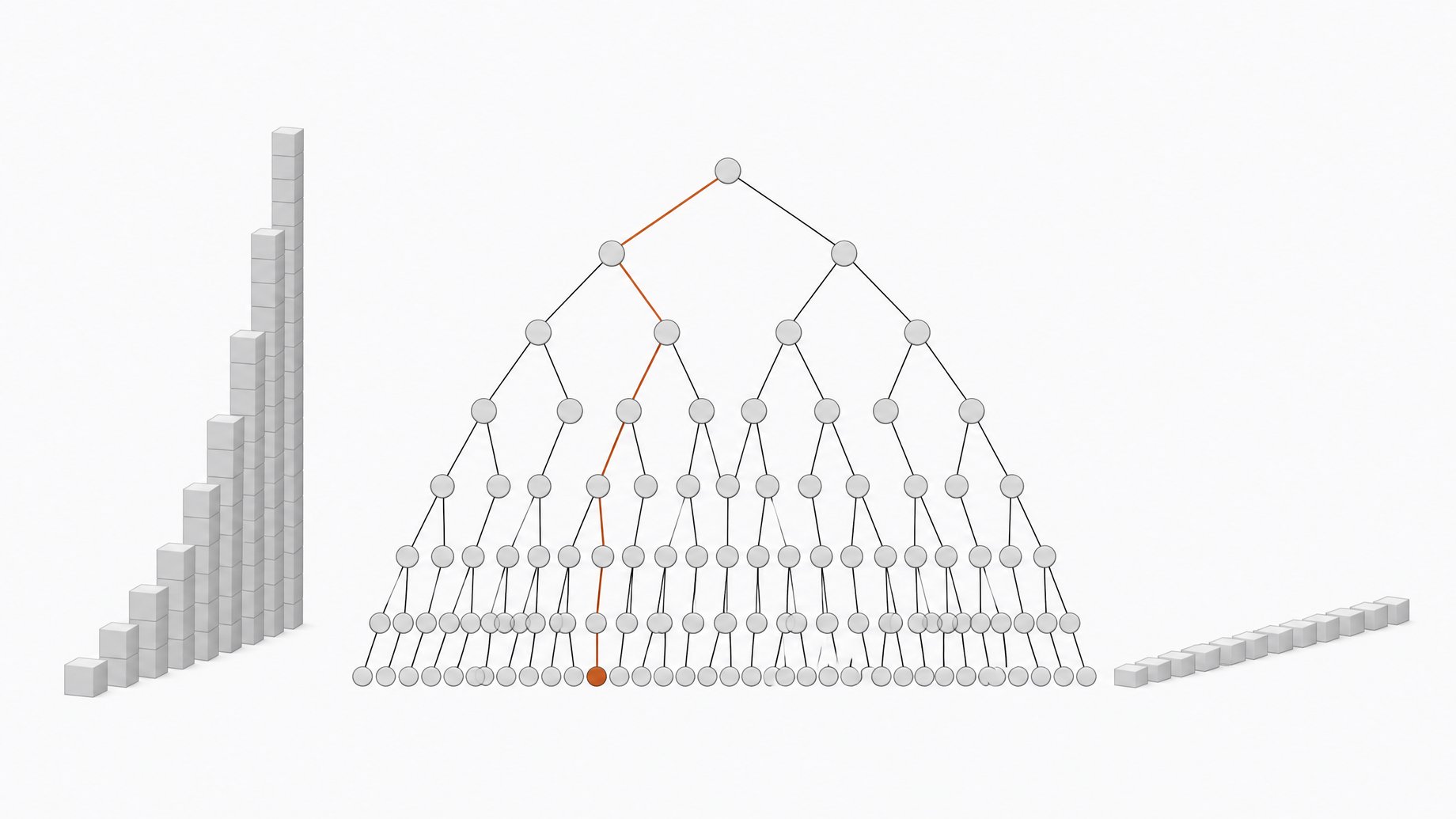
ETH says that a certain kind of constraint puzzle cannot be solved quickly as it grows. Picture a huge checklist of variables with rules like "if A is true, then B must be false, and therefore C must be true." You need an assignment that satisfies every rule at once. ETH says the work needed grows exponentially with the number of variables. Eventually even a supercomputer would need more time than the universe has left.
In the formal version (general background, not spelled out in the source material), the problem is 3-SAT, and ETH says no algorithm solves it in subexponential time.
Exponential growth is easy to feel with a combination lock. One dial with ten digits takes at most 10 tries. Two dials take 100. Ten dials take 10 billion. Each added dial multiplies the work.
ETH has been widely believed and used in hundreds of papers. Researchers assume it to derive conditional hardness results in graph theory, computational biology, databases, computational geometry and other fields. The pattern is "if ETH is true, then this problem is also hard." That is why one hypothesis carries so much weight.
What is P vs NP, in plain terms?
P vs NP asks whether every problem whose answer is easy to check is also easy to solve.
- P covers problems that can be solved in a manageable amount of time, where more input means more work but not an explosion.
- NP covers problems where a proposed answer can be checked quickly.
A Sudoku is the standard example. Checking a finished grid takes moments. Solving a hard one from scratch takes far longer. Shift scheduling works the same way. You can verify a proposed schedule against everyone's constraints fast, but building one is harder.
Everything in P is also in NP, because anything you can solve quickly you can check quickly. The open question is the reverse. If P equals NP, every easy-to-check problem has a shortcut to a solution. Most researchers believe it does not.
It is one of the seven Millennium Prize Problems, and it remains unsolved. The Poincaré conjecture was resolved by a human in the early 2000s, and the prize was declined. Navier-Stokes is listed as an active problem, with OpenAI's proof undergoing review.
Does disproving ETH mean P equals NP?
No. ETH is a stronger statement than P not equal to NP. If ETH is true, then P does not equal NP. The reverse does not hold.
Suppose ETH is false. Then some hard problems may be solvable in subexponential time. That is faster than brute force, but it is still not polynomial time. A subexponential algorithm could exist while P still differs from NP.
So the result, if it holds, would break a widely used assumption without answering the million-dollar question. Brockman made the same point publicly: P probably still does not equal NP.
The cryptography worry (credit card numbers and most internet encryption would be broken if P equals NP) applies to P = NP, not to this claim. The source material does not describe the actual algorithm or its running time, so nobody should infer practical attacks on encryption from it.
Who is shepherding the work?
OpenAI says it will not take credit for these discoveries. It is asking researchers in the field to shepherd them, so those experts get the credit. For ETH, the names are Russell Impagliazzo, Ramamohan Paturi and Ryan Williams. A different lab, Recursive, makes its own claim about AI doing research with its Eureka machine.
Impagliazzo and Paturi are the people behind ETH. They formulated it and built work on top of it. Roughly 30 years later, they are helping vet a claim that their own hypothesis is false.
This is a notable change in how OpenAI presents results. The approach looks like a response to the backlash earlier AI math announcements received, though the details of that backlash are beyond what the source covers.
What about the Yang-Mills result?
The same post reportedly includes a proof of the existence of pure Yang-Mills theory. OpenAI describes it as a byproduct. The model was working on a different problem, a kind of side quest, and produced this along the way.
This is a sub-result of the quantum Yang-Mills problem, one of the Clay Mathematics Institute's Millennium Prize Problems. It is not the full problem and does not qualify for the prize. Yang-Mills remains listed as unsolved.
How have people reacted?
The reaction in the source material is mostly attention and caution rather than detailed expert verdicts.
- ETH began trending, which the speaker found funny because the discussion was not about Ethereum.
- Brockman moved quickly to reassure people that the result does not break the world's assumptions about P vs NP.
- Scott Aaronson, a leading complexity theorist, appeared on a podcast shortly before the release. He said physicists he talks to watch AI nervously because it had not yet come for their field. That interview predated the announcement and did not respond to it.
Formal assessments from complexity theorists will matter more than commentary. The source material does not include them, so treat the result as claimed and under review.
Is the result settled?
Not yet. A claimed refutation of a 30-year-old hypothesis needs careful checking. The signals so far are encouraging: the leading experts on ETH are attached to the work, and OpenAI is deferring credit to them. Still, the details of the algorithm and proof are not in the material reviewed here.
Watch for a published write-up, independent verification, and statements from the three shepherds. If the proof holds, the downstream effect would be re-examining the many "conditional on ETH" hardness results. That is real consequence even without any change to P vs NP.
Frequently Asked Questions
What does ETH stand for in this context?
It stands for the Exponential Time Hypothesis, a computer science conjecture about the difficulty of constraint satisfaction problems. It has nothing to do with Ethereum, though the shared abbreviation caused some confusion when it began trending.
Would disproving ETH break encryption?
Nothing in the source material says so. Disproving ETH would show that some hard problems are easier than believed, but possibly still not solvable in polynomial time. Breaking most internet cryptography is associated with P equals NP, which this claim does not establish.
Who created the Exponential Time Hypothesis?
Russell Impagliazzo and Ramamohan Paturi are credited as the people behind it. They, along with Ryan Williams, are now shepherding OpenAI's claimed refutation.
Did OpenAI solve a Millennium Prize Problem?
No. The Yang-Mills piece is a sub-result and does not qualify for the prize. ETH is not a Millennium Prize Problem, and P vs NP remains unsolved. Navier-Stokes is listed as an active problem, with OpenAI's proof undergoing review.
How we source, write, and correct our articles. Editorial standards