Open-Source ERP vs SaaS ERP: Which Costs Less for Manufacturers?
Compare open-source ERP (Odoo, ERPNext) with SaaS ERP (SAP, NetSuite) on pricing, 3-year TCO, customization, lock-in, and when SaaS still wins.

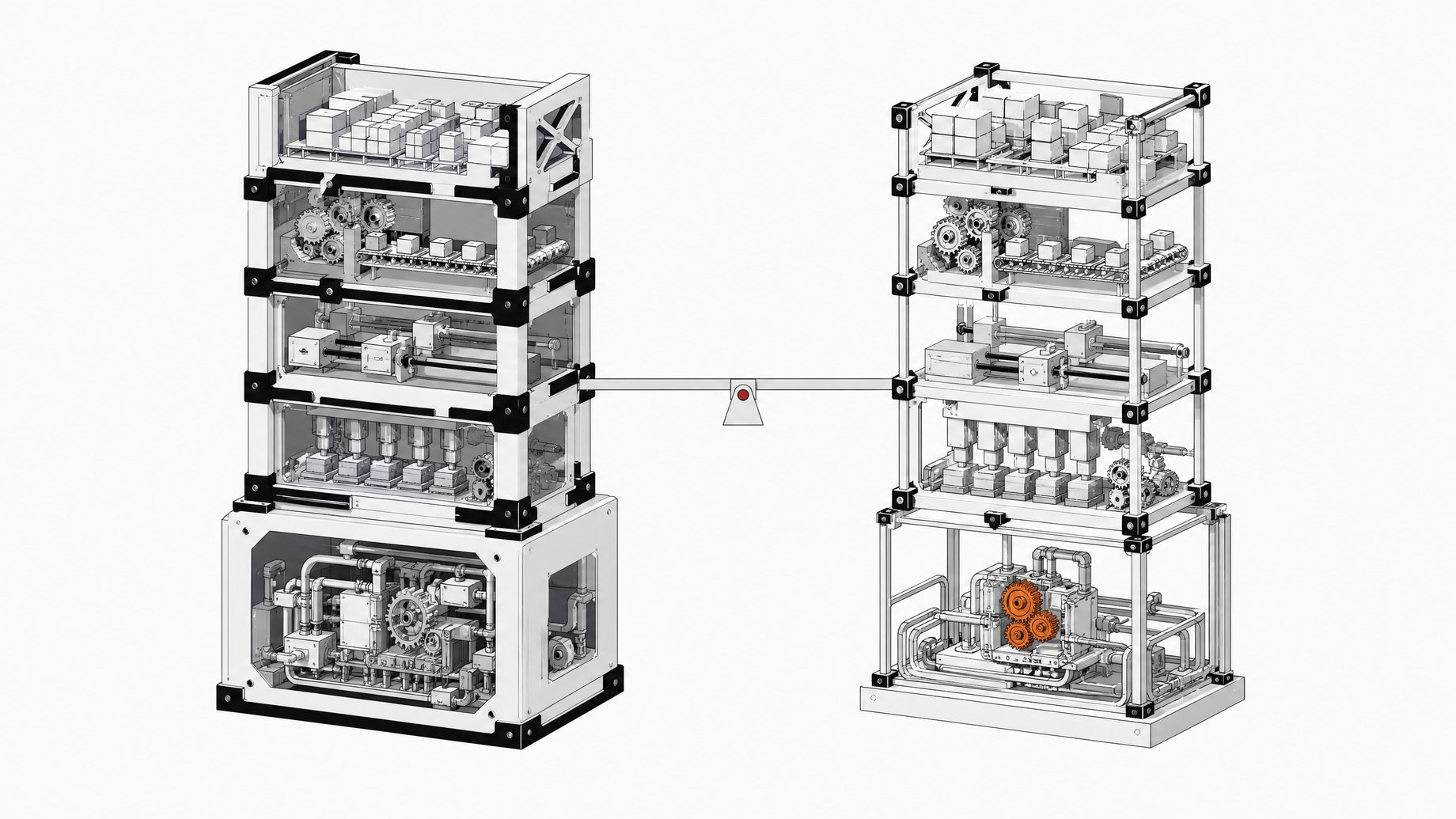
Does open-source ERP or SaaS ERP cost less for manufacturers?
Open-source ERP costs 70 to 95% less to run than SaaS ERP like SAP or NetSuite at the same headcount, and the manufacturing depth gap that used to justify the SaaS premium has closed. That's the short version. The long version explains why this flipped, and why it matters most for the mid-market manufacturers who used to assume "real ERP" meant a six-figure SAP contract.
TL;DR
- Open-source ERP costs 70 to 95% less to run than SaaS ERP at the same headcount, and the manufacturing depth gap has closed.
- A server handling 50 Odoo users costs $30 to $80 a month, while the same 50 users on SaaS ERP runs $2,500 to $10,000 a month.
- In a documented UAE case, a three-year SAP Business One TCO of around AED 700,000 compared with about AED 72,000 for ERPNext.
- AI coding agents cut custom Odoo module work from 4 to 8 hours down to 30 to 60 minutes, which weakens the old "who implements it" objection.
- Per-seat pricing is structurally wasteful, and the average enterprise wastes about $19.8 million a year on unused SaaS licenses.
- SaaS still wins for very small teams, companies with no compliance mandate or customization need, and buyers who need speed over cost.
How much does SaaS ERP actually cost?
Most SaaS ERP platforms charge per user, per month, and the number climbs with every module you add. Typical pricing runs $50 to $200 per user per month, which puts a 50-person deployment at $2,500 to $10,000 a month before implementation costs even enter the picture. SAP S/4HANA Public Cloud starts around $180 per user per month on its own, and that's the entry tier.
Then there's the implementation itself. Panorama Consulting's 2025 ERP Report surveyed 172 organizations that implemented ERP between January 2024 and January 2025, and found a median project cost of $450,000. More than half of buyers stayed on budget. For the ones who didn't, the most common cause was needing additional technology nobody scoped for at the start. That's the SaaS ERP pattern: a subscription that looks manageable on the sales deck, plus an implementation bill that grows every time the standard package doesn't fit how your factory floor actually runs.
What does open-source ERP actually mean today?
If your mental model of open-source ERP is a clunky 2010-era tool that needed three consultants to configure, update it. The category has consolidated around two mature platforms.
- Odoo is the largest by user count, with more than 13 million users, roughly 7,000 new clients added every month, and a €5 billion (about $5.26 billion) valuation after a November 2024 funding round. It grows around 40% a year without needing primary capital, which tells you the revenue is real, not subsidized.
- ERPNext, built on the Frappe framework, has more than 39,500 stars and 12,900 forks on GitHub, and is used by 15,000 to 30,000-plus companies across 150 countries. It has been open source since 2009 and charges no per-user license fee at all.
Both ship manufacturing modules with material tracking, capacity planning, and multi-level bills of materials out of the box. The market backs this up: the global open-source ERP market is valued at $5.31 billion in 2026 and is projected to reach $8.42 billion by 2031, growing at a 9.66% CAGR, with manufacturing the single largest end-use industry at 26.74% of 2025 revenue. This isn't a hobbyist niche. It's the category manufacturers are actually choosing.
How do open-source ERP and SaaS ERP compare directly?
Strip away the marketing and the differences come down to a handful of structural facts:
- Cost at scale. A server handling 50 Odoo users costs $30 to $80 a month. The same 50 users on SaaS ERP runs $2,500 to $10,000 a month, and the gap doesn't shrink as you add users, it widens.
- Licensing model. SaaS ERP charges per seat. ERPNext charges nothing per user; you pay for hosting only, starting at $5 a month on Frappe Cloud or free if you self-host under AGPL-3.0.
- Customization depth. SaaS vendors gate custom fields, workflows, and integrations behind higher tiers or professional services. Open-source code is yours to modify directly.
- Data ownership. Self-hosted Odoo or ERPNext keeps your production, inventory, and financial data on infrastructure you control. SaaS keeps it on the vendor's infrastructure, under the vendor's terms.
- Update control. SaaS vendors push updates on their schedule, sometimes breaking custom workflows. Self-hosted deployments upgrade when you decide to.
- Vendor lock-in. SaaS ERP ties your operational data to a contract renewal cycle. Open-source ERP means you can switch hosting providers, or bring hosting in-house, without touching the underlying software.
None of this is theoretical. It shows up directly in the numbers below.
What are the real numbers on SAP vs. ERPNext and Odoo TCO?
A 50-employee manufacturing and trading company in the UAE evaluating SAP Business One faced an implementation cost of AED 350,000 to 600,000, with a three-year total cost of ownership around AED 700,000 once maintenance is included. The same company running ERPNext over the same three years came in around AED 72,000, a documented AED 628,000 difference, roughly $171,000, for comparable functional coverage.
Independent benchmark data from ERP Research, which tracks more than 24,000 implementations, puts typical total contract value for ERPNext at $0 to $30,000 and Odoo at $10,000 to $80,000. SAP S/4HANA Public Cloud sits at $150,000 to $600,000 for comparable company sizes, and SAP S/4HANA Private Cloud runs $500,000 to $5 million or more. Mordor Intelligence's market analysis confirms the pattern at the category level: open-source community editions eliminate license fees and cut five-year total cost of ownership by 30 to 50% versus proprietary suites. Three independent sources, three different methodologies, one conclusion.
Where does SaaS still win?
None of this means self-hosted ERP is right for everyone. A fair comparison has to admit where the rented option is actually the better call.
- Very small teams. Under roughly 15 to 20 users, the absolute dollar savings from self-hosting are small enough that the DevOps time may not be worth it, even though the percentage savings still look good on paper.
- No compliance mandate. If you don't have a regulatory reason to control where your data physically lives, someone else patching servers has real value.
- Zero customization need. If your business genuinely fits an out-of-the-box SaaS workflow, you're not paying for flexibility you won't use.
- Speed over cost. If you need something running next week and don't have anyone who can own infrastructure, a SaaS contract buys time. Just budget for the fact that this time isn't free forever.
The honest framing here matches the build vs. buy logic covered in Build vs. Buy in 2026: The Open-Source Infrastructure Boom: the math has shifted decisively toward owning, but "decisively" isn't "universally."
How are AI coding agents closing the old objection?
For years, the real argument against open-source ERP wasn't cost. It was implementation risk: who configures the modules, who writes the customizations, who keeps the server patched. That objection is weakening fast.
AI coding agents like Claude Code and Cursor can now generate a working Odoo module, complete with data models, views, security rules, and business logic, from a single prompt. What used to take a developer 4 to 8 hours of manual work now takes 30 to 60 minutes, a documented 3 to 5x velocity multiplier per developer. That directly attacks the "who implements it" objection that used to make SaaS feel safer by comparison.
The DevOps side has narrowed too. Standing up a self-hosted instance still takes real work, spinning up a server, locking down the network, but managed self-hosting platforms now automate most of it. Teams that have already put an AI agent in charge of routine ops, whether through a custom script or a hosted platform, are finding they can own the infrastructure without owning the toil. The same pattern shows up in the broader shift toward self-hosted alternatives to SaaS across entire categories, not just ERP.
What is the hidden SaaS tax of waste, shadow IT, and lock-in?
The per-seat pricing that makes SaaS ERP expensive also makes it structurally wasteful. The average enterprise uses only 54% of the SaaS licenses it pays for, wasting about $19.8 million a year on unused seats against average annual SaaS spend of $55.7 million. ERP seats, tied to named users across finance, ops, and shop floor roles that turn over constantly, are exactly the kind of license that goes stale and keeps getting billed.
Lock-in compounds the problem. SAP has raised on-premise support fees by 5% and pushed customers toward its RISE cloud bundling, a pattern that leaves buyers with less pricing leverage the longer they stay. Open-source ERP is structurally immune to this specific squeeze: you own the source code, so switching hosting providers or bringing hosting in-house is a technical decision, not a renegotiation.
How do you choose between open-source ERP and SaaS ERP?
Before committing either way, run through this:
| Cost at Scale | Per-Seat Fees | Customization Depth | Data Control | In-House Setup Effort | Best For | |
|---|---|---|---|---|---|---|
| RecommendedOpen-source ERP (Odoo/ERPNext, self-hosted)Cost-conscious teams with any DevOps capacity | Low | No | High | High | Medium | Mid-market manufacturers, cost control, data ownership |
| SaaS ERP (SAP, NetSuite)Teams needing zero infrastructure ownership | High | Yes | Low | Low | Low | Very small teams, no compliance mandate, speed over cost |
- Count your users. Above 20-30 users, the per-seat SaaS math starts compounding fast enough that self-hosting pays for itself within the first year.
- Check your compliance exposure. If data residency or audit control matters, self-hosted ERP gives you direct answers instead of vendor assurances.
- Map your customization needs. If your manufacturing process doesn't fit a standard workflow, budget for professional services under SaaS or AI-assisted development under open source, then compare.
- Assess in-house technical capacity. You need someone, or an AI-assisted workflow, who can own server maintenance and upgrades. That bar is lower than it used to be, but it isn't zero.
- Test your AI-tooling readiness. If your team already uses Claude Code, Cursor, or similar agents for internal tooling, the implementation gap that used to favor SaaS has mostly closed.
The direction of travel is clear. Open-source ERP used to be the risky choice for buyers trying to save money. The evidence from 2025 and 2026 says it's now the economically rational default, and SaaS is the choice you make when you have a specific reason to pay the premium, not the other way around.
Frequently Asked Questions
Is open-source ERP actually cheaper than SaaS ERP like SAP or NetSuite?
Yes, by a wide margin at any meaningful headcount. A server running 50 self-hosted Odoo users costs $30 to $80 a month versus $2,500 to $10,000 a month for the same users on SaaS ERP, and a documented UAE case put ERPNext's three-year TCO at roughly $171,000 less than SAP Business One for a 50-person company.
Can open-source ERP handle real manufacturing operations, or is it just for finance and CRM?
Both Odoo and ERPNext ship with manufacturing modules covering material consumption tracking, capacity planning, subcontracting, and bill-of-materials management. Manufacturing is the largest end-use industry in the open-source ERP market, accounting for 26.74% of 2025 revenue, which reflects real adoption rather than a limited use case.
Who implements and maintains a self-hosted ERP if I don't have a big IT team?
This used to be the strongest argument against open-source ERP, but AI coding agents like Claude Code and Cursor can now generate a working Odoo module, including data models, views, and business logic, from a single prompt in 30 to 60 minutes versus 4 to 8 hours of manual development. Managed self-hosting platforms also automate most of the server provisioning and maintenance work that used to require a dedicated DevOps hire.
When does SaaS ERP still make more sense than self-hosting?
SaaS is the better call for very small teams under roughly 15 to 20 users where absolute savings are small, for companies with no compliance-driven need to control data location, for businesses that fit an out-of-the-box workflow with zero customization, and for teams that need something running immediately and lack anyone who can own infrastructure, even temporarily.
What's the real difference between Odoo and ERPNext for a manufacturing business?
Odoo has a larger user base, over 13 million users and a $5.26 billion valuation, with a broader app ecosystem and typical total contract values of $10,000 to $80,000. ERPNext, built on the Frappe framework, charges no per-user fee at all and typically runs $0 to $30,000 in total contract value, making it the lower-cost option for teams comfortable with more direct customization.
How we source, write, and correct our articles. Editorial standards