The Hidden Costs of Cloud Data Centers: Who Really Pays for 'the Cloud'
Electric bills, water tables, bot traffic, and egress fees: who actually pays for the cloud. A data-backed look at cloud computing's externalized costs.

Who really pays for the hidden costs of cloud data centers?
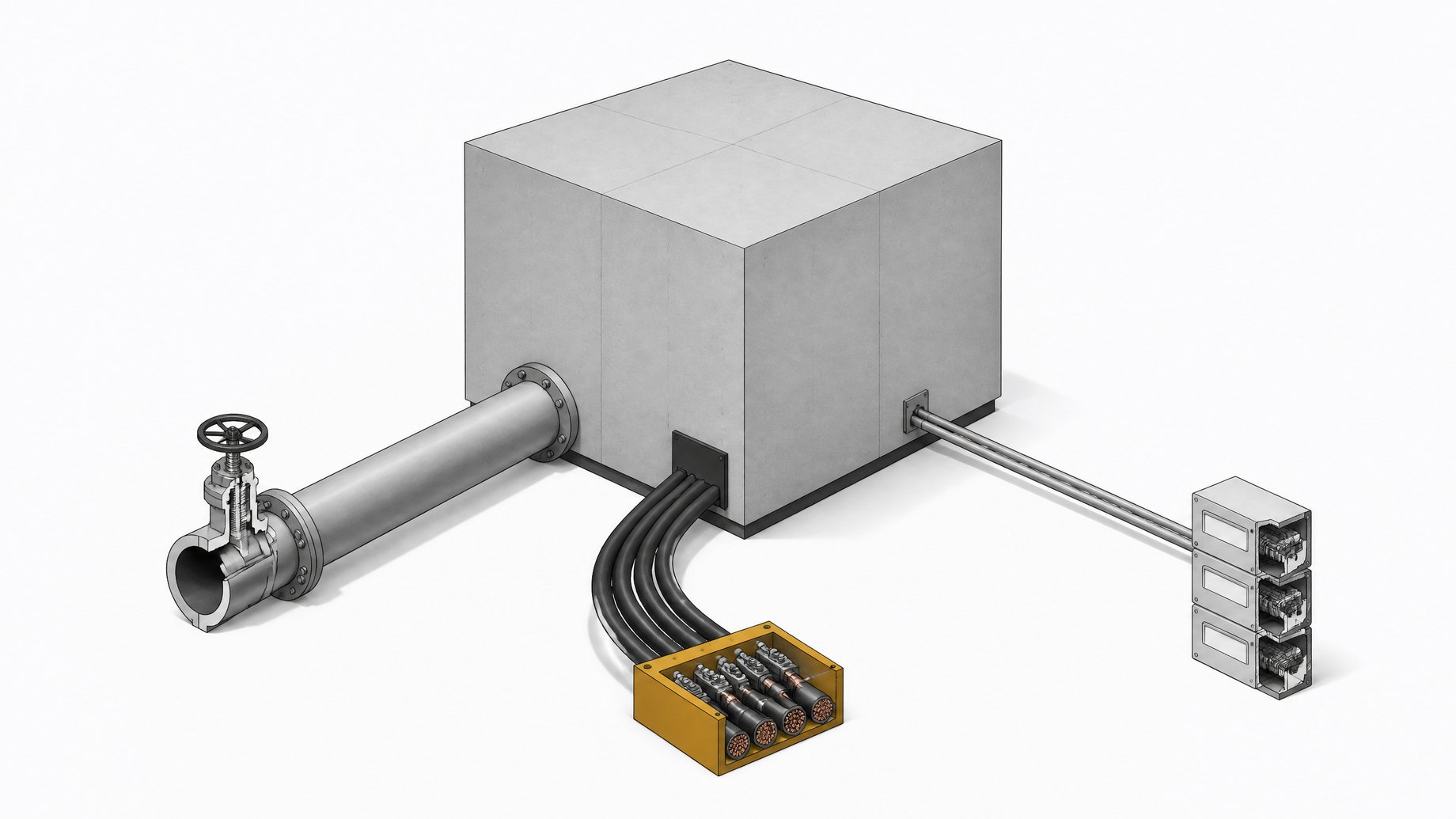
The hidden costs of cloud data centers show up as higher electric bills for people who never signed up for AI, water shortages in drought-prone towns, and inflated cloud invoices driven by bot traffic instead of real customers. Those costs are real, they're growing fast, and almost none of them appear on the bill a company actually pays for its cloud subscription. They land on neighbors, on the power grid, on watersheds, and eventually on anyone running a website that bots decide to scrape.
"The cloud" is a marketing word for a physical industry: concrete pads, steel racks, chillers, transmission lines, diesel backup generators, water intake pipes. Typing a few lines of code and getting infinite compute depends on all of that physical infrastructure existing somewhere, and somebody is paying for the somewhere. This piece is about who.
TL;DR
- Data center power demand is driving up regional capacity prices, so household ratepayers cover grid costs even if they never use an AI tool.
- Hyperscale data centers consume billions of gallons of water a year for cooling, and many sit in water-stressed regions where local communities feel the strain.
- Diesel backup generators and data center electricity generation create public health costs that show up in hospital visits and insurance claims, not on cloud invoices.
- Automated bots now generate more than half of web traffic, creating uncompensated bandwidth costs for the site owners being scraped.
- Egress fees and overprovisioning mean bot-driven waste gets billed back through cloud invoices as real money.
- Moving workloads from rented cloud to owned hardware removes the externalized capacity markups that public cloud pricing passes on to every tenant.
How much electricity do data centers actually use?
US data centers burned through about 176 terawatt-hours of electricity in 2023, roughly 4.4% of total US electricity consumption. The Lawrence Berkeley National Laboratory projects that figure could reach somewhere between 6.7% and 12% of total US electricity by 2028, as AI training and inference demand accelerates.
That is not a rounding error. It's a structural shift in how the US grid gets used, concentrated in a handful of regions rather than spread evenly across the country.
Who pays when a data center plugs into the grid?
The PJM Interconnection, the largest regional grid in the US, covers 13 states and Washington, DC, including "Data Center Alley" in Northern Virginia. Its most recent capacity auction saw revenue jump by $7.3 billion, an 82% increase, to roughly $16.1 billion, and the grid's own market monitor named data center load the primary driver.
Capacity prices in PJM rose almost tenfold, from $28.92 per megawatt-day in the 2024/25 auction to $329.17 per megawatt-day for 2026/27. The Institute for Energy Economics and Financial Analysis estimates that increase added about $9.3 billion in costs onto PJM ratepayers in a single year, costs that show up on household and business electric bills regardless of whether those households use a single AI tool.
In some regions near data center clusters, wholesale electricity prices have climbed as much as 267% over five years, and those increases pass straight through to residential customers who see none of the upside. This is the clearest version of an externalized cost: a company rents cloud compute, a data center expands to meet that demand, the grid operator raises capacity prices to cover the strain, and a retiree three towns over opens an electric bill that's suddenly much higher than last year's.
How much water and land do data centers consume?
Electricity isn't the only resource data centers consume at scale. Cooling the servers inside them takes enormous amounts of water. A single large hyperscale data center can use up to 5 million gallons a day, comparable to the daily water use of a city of 50,000 people.
The disclosed numbers from the biggest cloud providers back that up. Google's global data center operations consumed about 6.4 billion gallons of water in 2023, up from 4.3 billion gallons in 2021, with 95% of that going directly to cooling. Microsoft disclosed roughly 10.9 billion gallons consumed in a recent year, a 34% increase year over year, almost entirely for data center cooling.
The local impact can be severe. A Meta data center in Newton County, Georgia, that opened in 2018 uses about 500,000 gallons of water a day, roughly 10% of the entire county's water consumption, and the company has sought permits for new facilities that could more than double that figure. Roughly two-thirds of US data centers built since 2022 sit in water-stressed regions, and a Business Insider investigation found 40% of mapped data centers located in areas of high or extremely high water stress.
That same Business Insider analysis estimated the annual public health cost from data center-related electricity generation at between $5.7 billion and $9.2 billion nationally, with diesel backup generators alone contributing a separate $385 million annual public health burden and nearly 20,000 asthma symptom cases a year. None of that appears on a cloud invoice. It appears in hospital visits and insurance claims in the communities nearest the facilities.
The land costs are just as concrete. Data center campuses in Virginia and Georgia have cleared forest and converted farmland to make room for new buildings, prompting organized pushback from residents and new legal and legislative scrutiny across Southern states. A data center doesn't just need power and water. It needs acreage, and that acreage used to be a forest, a farm, or a floodplain.
Do bots really outnumber humans on the web now?
The second hidden cost of cloud dependency has nothing to do with electricity or water. It's traffic that was never human in the first place.
In 2024, automated bot traffic surpassed human traffic on the web for the first time in a decade. Bots accounted for 51% of all internet traffic, with "bad bots" alone making up 37%. Much of that growth comes from AI companies deploying crawlers to scrape content for training data and real-time retrieval.
The Wikimedia Foundation offers a concrete case study. Since January 2024, bandwidth used for downloading multimedia content on Wikimedia projects grew by 50%, even as traffic from actual human readers declined about 8%. Roughly 65% of the most resource-expensive traffic hitting Wikimedia's data centers now comes from bots, not people. Fastly's own threat research found that in the second quarter of 2025, AI crawlers accounted for almost 80% of all AI bot traffic, meaning a small number of AI companies are responsible for most of the uncompensated scraping load that site owners now absorb.
The Electronic Frontier Foundation has documented the same pattern across the open web: operators everywhere report a drastic increase in automated traffic, most of it attributed to AI companies, and when that scraping isn't done thoughtfully it drives up hosting costs, degrades performance, and can take sites offline entirely.
Why does bot traffic become a cloud bill problem?
Here's the mechanical link between bot traffic and your cloud invoice: every request a bot makes, whether it results in a sale, a page view, or any value at all, consumes bandwidth and compute that cloud providers bill for.
Cloud egress, the fee for moving data out of a cloud provider's network, is one of the most underweighted line items in a typical cloud bill. Gartner has found that most customers spend 10% to 15% of their total cloud bill on egress charges alone. Other analyses put the baseline closer to 6-12%, with AWS, Azure, and GCP charging somewhere between $0.08 and $0.12 per gigabyte, and AWS's NAT Gateway processing fee pushing the effective rate above $0.13 per gigabyte once you account for how traffic actually routes through a typical cloud architecture.
Akamai has reported that AI bot traffic surged 300% in a single year, and on some sites now consumes between 30% and 50% of total bandwidth. None of that bandwidth converts into a sale, a signup, or an ad impression. It's pure cost, billed by the gigabyte, generated by a crawler with no commercial relationship to the site it's hitting. Combine that with the overprovisioning most teams build into cloud architecture to survive traffic spikes that never fully materialize, and you get a bill shaped by load that was never a customer in the first place. This same dynamic, data-center power costs and bot-driven waste getting repackaged and passed down the chain, is a big part of why SaaS prices have risen well above general inflation over the past two years.
What does owning infrastructure actually buy you?
The clearest real-world test of what happens when a company stops renting cloud infrastructure and starts owning it comes from 37signals, the maker of Basecamp and HEY. In 2022 the company's cloud compute bill ran at a $3.2 million annual rate. After moving that workload onto owned Dell hardware in 2023, the run rate dropped to about $1.3 million. Combined with an eventual exit from cloud storage, 37signals projects total savings from the move will exceed $10 million over five years.
That gap illustrates the thesis: public cloud pricing bakes in costs that have nothing to do with your actual workload, including the grid strain, the water use, and the bot traffic covered above, then passes a share of that externalized cost back to every tenant as margin. Owned infrastructure removes the externalities. There's no middleman absorbing someone else's power bill, water bill, or scraping problem and marking it up. It also makes costs predictable in a way variable cloud billing structurally can't, since there's no egress surprise, no auto-scaling spike from a bot swarm, and no capacity-market pass-through buried three layers deep in the invoice.
This is also where the economics of renting versus owning compute really diverge: once you cross a predictable usage threshold, the math increasingly favors owned hardware over rented API tokens, the same logic that pushed 37signals off AWS. Tools built for teams that want to run their own software stack rather than lease it, like Remy, exist precisely because this calculation keeps tilting toward ownership as cloud externalities get bigger and harder to ignore.
| Upfront Cost | Cost Predictability | Exposure to Grid/Water/Bot Externalities | Maintenance Burden | Scaling Flexibility | |
|---|---|---|---|---|---|
| Rented Cloud InfrastructureUnpredictable or bursty workloads | Low | Low | High | Low | High |
| RecommendedOwned InfrastructurePredictable, sustained workloads at scale | High (upfront hardware purchase) | High | Low | High | Low |
What are the hidden costs of cloud data centers?
The hidden costs of cloud data centers break down into four categories that rarely appear on any single invoice:
- Grid costs, passed to ordinary ratepayers through capacity auction increases, not to the companies renting the compute.
- Water and land costs, borne by local communities and watersheds, often in drought-stressed regions far from the headquarters of the companies using the compute.
- Bot-driven bandwidth costs, borne by any site or service that gets scraped, with no commercial transaction to offset the expense.
- Egress and overprovisioning markups, embedded in cloud pricing itself and billed back to every tenant regardless of whether their own usage caused the strain.
Together, these costs are the real price of "the cloud." They explain why a growing number of technically sophisticated teams are deciding that owning the hardware under their own workloads, where the costs are visible, bounded, and theirs alone, beats renting a system where someone else's bot traffic and someone else's grid strain show up on your bill.
Frequently Asked Questions
What percentage of US electricity do data centers use?
US data centers consumed about 176 terawatt-hours in 2023, roughly 4.4% of total US electricity. The Lawrence Berkeley National Laboratory projects that could rise to between 6.7% and 12% by 2028 as AI demand grows.
Do data centers really raise regular people's electric bills?
Yes. In the PJM grid, which covers 13 states including Northern Virginia's data center cluster, data center demand drove capacity auction revenue up by $7.3 billion in one year, and the Institute for Energy Economics and Financial Analysis estimates that added roughly $9.3 billion in costs onto ratepayers who have no direct relationship to AI or cloud services.
How much water do AI data centers use?
A large hyperscale data center can use up to 5 million gallons of water a day, comparable to a city of 50,000 people. Google reported 6.4 billion gallons of water use globally in 2023, and Microsoft reported 10.9 billion gallons in a recent year, a 34% year-over-year increase.
Why does bot traffic increase cloud computing costs?
Bots now make up more than half of all internet traffic, and AI crawlers alone account for most AI-related bot traffic. Every bot request consumes bandwidth that cloud providers bill for as egress, with no sale or signup to offset the cost, which is why sites like Wikimedia have seen bandwidth usage jump 50% even as human traffic declined.
Is owning your own servers actually cheaper than cloud hosting?
For predictable, high-volume workloads, often yes. 37signals cut its cloud compute bill from a $3.2 million annual run rate to about $1.3 million after moving off AWS, and projects total savings from its cloud exit will exceed $10 million over five years.
How we source, write, and correct our articles. Editorial standards