5 Self-Hosted Alternatives to Enterprise SaaS That Actually Save Money
Encrypted mail, chat, file sync, secrets, and Zero Trust VPN: five self-hosted alternatives to enterprise SaaS, with real cost comparisons.


What are the best self-hosted alternatives to enterprise SaaS that actually save money?
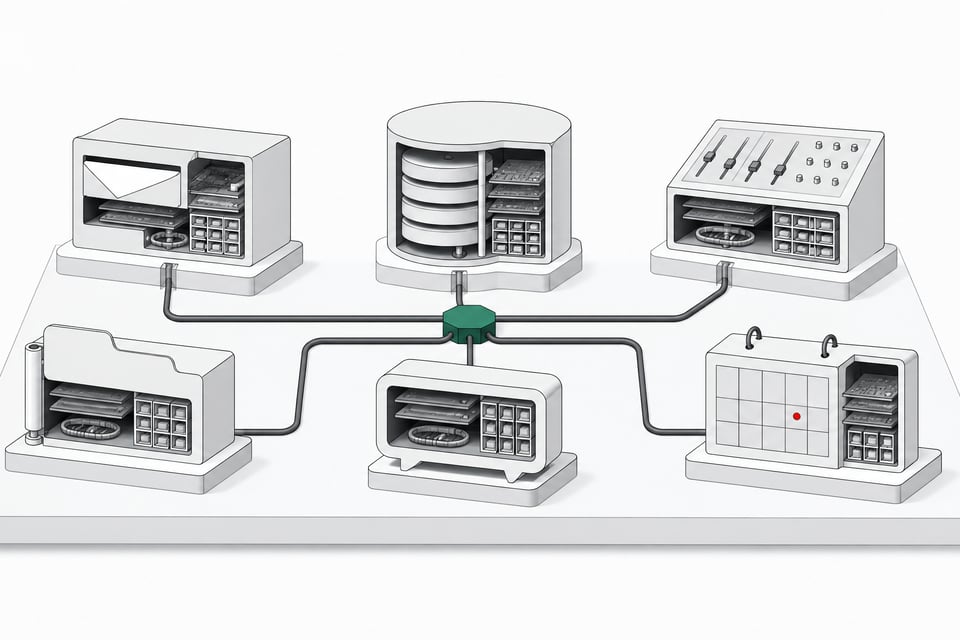
Self-hosted alternatives to enterprise SaaS now exist for nearly every line item in a typical stack: encrypted mail and docs, team chat, file sync, password management, and Zero Trust VPN. Five open-source suites cover this ground today: AurionMail Suite, Mattermost, Nextcloud, Vaultwarden, and Headscale or NetBird. Each one trades a per-seat subscription for a VPS bill that barely moves as you add users.
That trade works because of a pricing mismatch. Seat-based SaaS pricing keeps climbing. Tailscale moved to seat billing in 2026, and Slack Enterprise Grid ran $32 per user per month during its own beta pricing period. Meanwhile a capable VPS still costs $5 to $40 a month, flat, regardless of headcount. Here are five suites worth evaluating, plus the real ops cost that comes with each.
TL;DR
- Self-hosted alternatives swap climbing per-seat SaaS pricing for a flat, predictable VPS bill that barely moves as you add users.
- Mattermost's own analysis found customers saving over 60% versus Slack Enterprise Grid, with savings growing at larger user counts.
- Vaultwarden replaces per-seat password managers with a flat $5 monthly VPS that can run the whole company's vault.
- Open-source tools like Headscale and NetBird eliminate per-seat Zero Trust VPN fees by letting you own the coordination plane.
- Self-hosting saves money on licenses, but the ops time moves from a SaaS invoice line item to someone's calendar.
Can AurionMail Suite give you one password for encrypted mail and docs?
AurionMail Suite is an open-source orchestrator, licensed AGPLv3, that bridges CryptPad, the Stalwart JMAP mail server, Bulwark Webmail, and Ory Hydra into one login. The pitch: a single master password unlocks encrypted email and document collaboration, positioned explicitly as a fully open-source alternative to Proton's proprietary backend.
It's not flawless, and the maintainer doesn't pretend otherwise. A security critique on the project's Hacker News launch thread flagged a static per-user auth salt, no reproducible or signed client builds, and PGP's lack of forward secrecy. The maintainer's response reframed the model as "client-side encryption with a trusted operator" rather than absolute zero-knowledge. That's a meaningfully weaker claim than "zero-knowledge." Any team evaluating AurionMail for compliance-sensitive mail should read that thread, not just the landing page.
Is Mattermost the Slack replacement enterprises actually run?
Mattermost isn't a hobby Slack clone. Its own total-cost-of-ownership analysis found customers saving over 60% versus Slack Enterprise Grid, with savings growing at larger user counts thanks to economies of scale in self-hosted licensing and infrastructure. Slack Enterprise Grid pricing during its public beta ran $32 per user per month; Mattermost's self-hosted model doesn't scale that linearly.
This is the suite with the most enterprise and government adoption of the five, which matters if your buying committee wants proof that self-hosted chat survives a security review, not just a weekend hack.
Why is Nextcloud cheaper than Google Workspace?
Google Workspace runs $6 to $18 per user per month. Nextcloud, self-hosted, is free software; the remaining cost is infrastructure and maintenance, not licensing. It's the default choice for enterprises, educational institutions, and government agencies bound by data residency requirements, because you control exactly where the files and metadata sit.
That sovereignty angle is the real differentiator over a straight cost comparison. If your org already has audit or residency obligations, Nextcloud removes a whole category of vendor-risk conversation, not just a monthly invoice.
How does Vaultwarden handle password management without per-seat vault fees?
Bitwarden Enterprise runs about $6 per user per month; 1Password Business runs roughly $8 to $9. Vaultwarden, a lightweight Rust reimplementation of the Bitwarden server, can be self-hosted for the cost of a small VPS, as little as $5 a month total, not per seat.
The gap compounds with headcount because SaaS vault pricing is per-seat and Vaultwarden's isn't. A 50-person team paying $6/user/month for Bitwarden Enterprise is spending $300/month on something a $5 VPS can run for the whole company. This is one of the clearest wins on this list, and it pairs well with the ownership thinking covered in Bricked Hardware and Missing Git Tags: Why Software Ownership Matters.
Can Headscale or NetBird give you self-hosted Zero Trust networking?
Tailscale's 2026 pricing restructure moved business plans to seat-based billing: Standard at $8/seat/month, Premium at $18/seat/month. At 100 users that's $800 to $1,800 a month, recurring, forever, growing with every hire.
Two open-source projects let you keep Tailscale's WireGuard-based model while owning the coordination plane:
- Headscale is a BSD-3-Clause reimplementation of Tailscale's control server. Official Tailscale clients connect to infrastructure you fully own, with no per-seat licensing. The tradeoff is CLI-only administration and no built-in multi-tenancy.
- NetBird goes further and self-hosts the entire coordination stack, including the management service, signal server, and relay routing, not just the control server. It's AGPLv3/BSD licensed and raised a $10 million Series A in January 2026 to build out as a European open-source alternative to legacy VPN vendors.
| Licensing model | Self-hosted scope | Admin complexity | Multi-tenancy support | |
|---|---|---|---|---|
| Tailscale (SaaS)teams that want zero ops burden | Per-seat, $8-$18/user/mo | Fully hosted by vendor | Low | Yes |
| Headscaleteams wanting Tailscale's client with an owned control server | BSD-3-Clause, free | Control server only | Medium | No |
| RecommendedNetBirdteams wanting the entire coordination stack self-hosted | AGPLv3/BSD, free | Full stack: management, signal, relay | High | Yes |
Either one turns a linear, per-seat networking cost into a fixed infrastructure cost, the same shift covered in The API Trap: How Cloud Bugs and Usage Fees Are Forcing a Return to Self-Hosting.
How does total cost of ownership compare with total cost of ops?
Every number above looks good in isolation. Stack them and the pattern holds: SaaS pricing scales with headcount, self-hosted infrastructure mostly doesn't. A 60% savings on chat. A $0 licensing line on file sync. A $5/month vault instead of a per-seat fee. A fixed VPN control plane instead of $800 to $1,800 a month in Tailscale seats.
None of this is free in the way "free software" implies. Someone has to patch the mail server, rotate the Vaultwarden backups, and keep the Headscale node online. The workflow-automation world offers a useful comparator: one team moved off an $800/month Zapier bill onto self-hosted n8n and cut automation software spend by more than 90%, down to near-zero plus cheap hosting. The software cost really does drop that far. The ops time doesn't disappear, it just moves from a line item on a SaaS invoice to a line item on someone's calendar.
How do you decide what to self-host first?
Don't self-host everything at once. Work through your SaaS invoice in order of leverage:
- Rank your per-seat line items by total monthly spend, not unit price. A $6/user password manager across 200 seats outranks an $18/user tool used by five people.
- Start with tools that have one-click Docker installs and active communities. Vaultwarden and Nextcloud both qualify; a half-day of setup covers most teams.
- Pilot the highest-savings swap on a non-critical team first. Run Mattermost or Headscale alongside the incumbent for a month before you cut over.
- Keep specialized, deeply integrated SaaS where the ops burden outweighs the savings. Not every tool is worth owning; some are worth renting precisely because the vendor absorbs complexity you don't want.
- Track the swap against actual invoices, not vendor list prices. Enterprise SaaS contracts often include discounts your team never sees reflected in the sticker price used in public comparisons.
If you're already tracking which SaaS renewals are worth fighting and which are worth replacing, a tool like Remy can help keep that decision from living in someone's spreadsheet forever.
The honest version of this pitch isn't "self-host everything and save 90%." It's narrower and more useful: five categories of enterprise SaaS now have mature, boring, well-adopted open-source replacements, and the per-seat math on all five favors ownership once you cross a modest headcount. Below that threshold, the ops time probably isn't worth it. Above it, the subscription is the expensive option.
Frequently Asked Questions
What are the best self-hosted alternatives to enterprise SaaS tools?
For encrypted mail and docs, AurionMail Suite. For team chat, Mattermost. For file sync and calendar, Nextcloud. For password management, Vaultwarden. For Zero Trust VPN, Headscale or NetBird. All five are open-source and run on standard VPS infrastructure.
Is self-hosting actually cheaper than paying for SaaS?
Usually, once you clear a modest headcount. Mattermost customers report over 60% savings versus Slack Enterprise Grid, and Vaultwarden can replace a per-seat password manager for the cost of a $5/month VPS. The savings scale with users; the ops time mostly doesn't.
What's the catch with self-hosting SaaS replacements?
Ops time. Someone has to patch, back up, and monitor the servers. Software cost drops close to zero in some cases, like the Zapier-to-n8n migration that cut automation spend over 90%, but the labor cost doesn't vanish, it just shifts from a vendor invoice to your team's calendar.
Is Vaultwarden as secure as Bitwarden or 1Password?
Vaultwarden is a community-maintained Rust reimplementation of the Bitwarden server, not an official Bitwarden product. It's widely used and actively maintained, but you're trusting a third-party implementation instead of the vendor's own infrastructure.
Why did Tailscale move to seat-based pricing in 2026?
Tailscale shifted its business plans from usage-based to seat-based billing, with Standard at $8/seat/month and Premium at $18/seat/month. At 100 users that's $800 to $1,800 a month, which is a big part of why self-hosted alternatives like Headscale and NetBird have gained traction.
How we source, write, and correct our articles. Editorial standards