Open Source AI vs SaaS AI: The Privacy Case for Owning Your Models
Court orders, training opt-outs, and leaks at OpenAI, Anthropic, and xAI show renting AI exposes your data. Here's the case for running open weights yourself.

Is open source AI or SaaS AI better for keeping company data private?
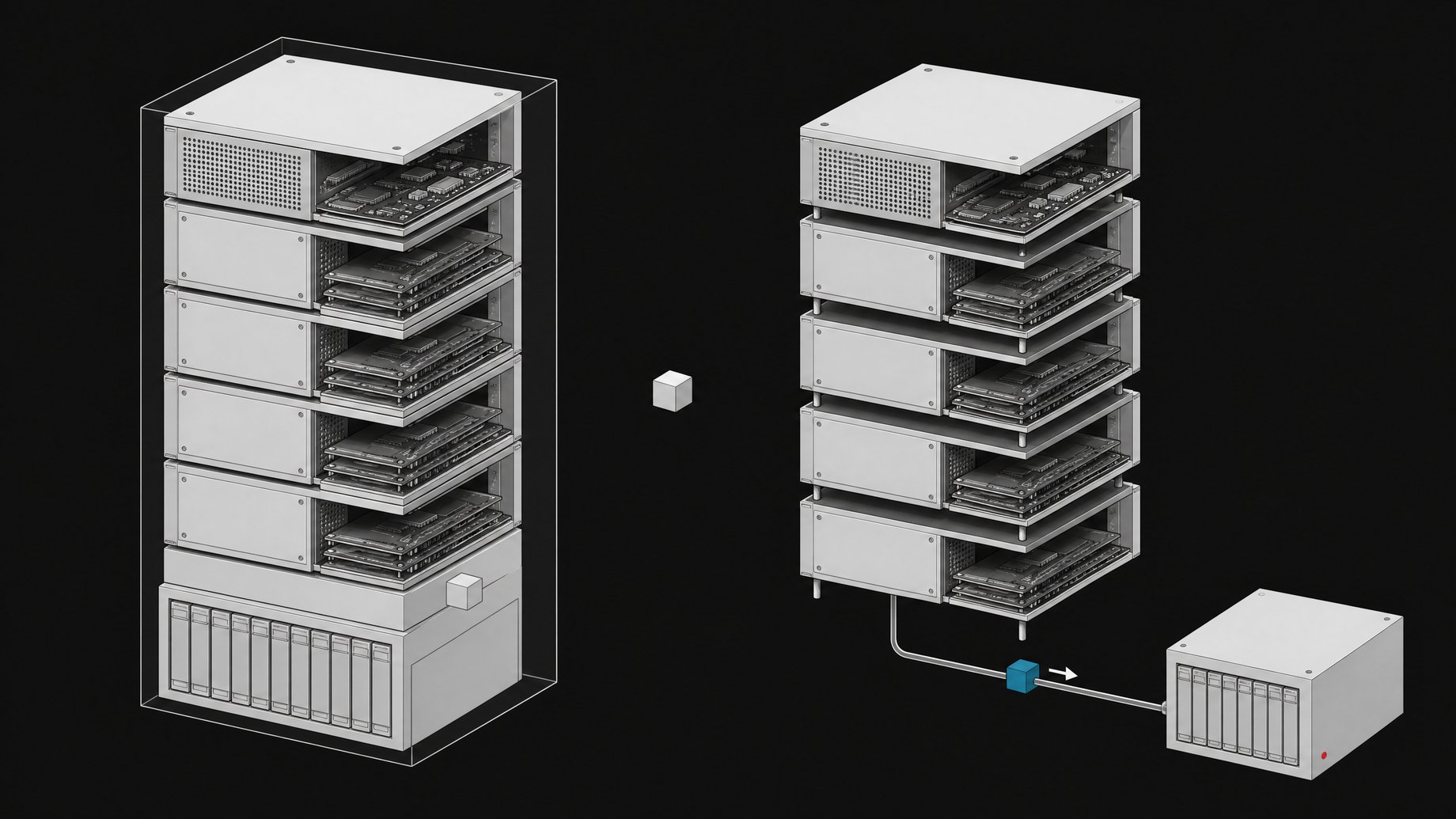
Open-weight AI run on infrastructure you control keeps your data under your legal and technical custody. SaaS AI, no matter what the vendor's privacy page promises, puts your prompts, code, and customer data inside someone else's systems, subject to someone else's lawyers, engineers, and terms of service. That difference used to be theoretical. It isn't anymore.
TL;DR
- A court ordered OpenAI to preserve roughly 20 million ChatGPT conversation logs, including chats users had deleted, overriding the company's own retention policy.
- All six leading U.S. frontier AI developers studied by Stanford use consumer chat data to train their models by default.
- About 40% of enterprise AI interactions involve sensitive data, often through personal accounts that bypass company controls.
- Running an open-weight model on your own infrastructure means no third party holds your data, so there is no vendor to subpoena or opt out of.
- Small open-weight models on a single consumer GPU can break even against API costs in as little as 0.3 to 3 months.
- Despite the privacy risks, enterprise open-weight usage fell from 19% in 2024 to 11% in 2025 as closed models improved faster.
Is Your Data Actually Private When You Use ChatGPT, Claude, or Grok?
Every company evaluating ChatGPT, Claude, or Grok for internal use eventually asks some version of: is this data actually private? Based on the last two years of court filings, regulatory fines, and leaked chat logs, the honest answer is no. Not reliably. Not in the way "private" means when you own the system.
This isn't a knock on any single vendor. It's a pattern that spans OpenAI, Anthropic, and xAI, three companies with different products and different cultures, running into the same underlying problem: when you rent intelligence, you also rent exposure.
Exhibit A: Can Courts Force an AI Vendor to Hand Over Your Chats?
OpenAI tells users that deleted ChatGPT conversations and Temporary Chats are automatically removed from its systems within 30 days. That's a real policy. It's also not a guarantee, because a federal judge can suspend it with a signature.
In the New York Times' copyright litigation against OpenAI, a court ordered the company to preserve and segregate roughly 20 million ChatGPT conversation logs, including chats users had deleted, as evidence. The preservation order overrode OpenAI's own retention policy outright. It stayed in force until September 26, 2025, when the obligation was finally lifted.
Sit with that timeline. For months, millions of conversations that users were told would disappear instead sat in indefinite legal hold, because a third party in an unrelated lawsuit asked for them. Your 30-day deletion promise is only as durable as the next subpoena. That's not a privacy policy. It's a privacy policy with an asterisk nobody reads.
Exhibit B: Does "Default On" Training Turn Your Prompts Into the Model's Memory?
Deletion timelines aside, the bigger question is what happens to your data while it's still live. A Stanford HAI and Stanford Law study examined the privacy policies of six leading U.S. frontier AI developers, Amazon, Anthropic, Google, Meta, Microsoft, and OpenAI, and found that all six use consumer chat data to train and improve their models by default. Some retain that data indefinitely. Four of the six appear to include children's chat data in training.
Anthropic, often positioned as the privacy-conscious alternative, made the same move in August 2025. The company changed its consumer terms of service so Claude conversations, including code, are used for model training by default unless the user actively opts out before a hard deadline. That's a shift from opt-in to opt-out, and the practical difference is real: opt-out policies depend on users noticing a terms-of-service email and acting before a cutoff date. Most won't.
Six out of six frontier developers, training on chat data by default, isn't an anomaly. It's the business model.
Exhibit C: What Happens When the SaaS Layer Leaks?
Policy risk is one thing. Operational risk is another, and it's arguably worse because it doesn't require a lawsuit or a terms-of-service change. It just takes an engineering mistake or an employee pasting the wrong thing.
Three documented incidents make the point:
- Samsung, 2023. Within about 20 days of lifting an internal ban on generative AI tools, Samsung employees leaked confidential data into ChatGPT in three separate incidents, including proprietary semiconductor source code and the minutes of an internal meeting. Samsung responded by banning generative AI tools company-wide.
- Grok, 2025. A flawed "share" feature on xAI's Grok chatbot caused more than 370,000 private conversations to become publicly searchable on Google, Bing, and DuckDuckGo, exposing medical details, passwords, and other sensitive personal and business information. Users had no reason to expect their chats were indexable. Many found out from reporters.
- Shadow AI, ongoing. Cyberhaven's analysis of enterprise AI usage found that 39.7% of all AI tool interactions now involve sensitive data, with employees pasting sensitive information into AI tools roughly once every three days on average. A large share of that activity runs through personal accounts that bypass single sign-on, logging, and retention controls entirely, so the company has no visibility and no record of what left the building.
Two of these are vendor-side failures. One is employee behavior that no SaaS contract was ever going to prevent. Together they show the leak surface isn't a single weak point you can patch. It's structural, and it shows up on both sides of the API call.
Exhibit D: Have Regulators Already Ruled SaaS AI's Data Practices Unlawful?
This isn't only a privacy advocate's complaint anymore. Italy's data protection authority, the Garante, fined OpenAI €15 million in December 2024 for processing personal data to train ChatGPT without an adequate legal basis, and for failing to meet GDPR information obligations to users. OpenAI was also required to run a six-month public information campaign as part of the penalty.
A sovereign regulator didn't speculate that a frontier SaaS AI vendor's data handling was risky. It investigated and found concrete violations. That's a different category of evidence than a leaked chat log or an uncomfortable terms-of-service clause. It's a finding of fact from a government body with subpoena power.
What Does Running the Model Yourself Actually Buy You?
Here's the alternative, stated plainly. If you run an open-weight model on infrastructure you control, your prompts and your customers' data never leave your network. There's no vendor training pipeline to opt out of, because there's no vendor in the loop. There's no third party for a court to subpoena, because the only party holding the data is you. There's no shared "share" feature with a bug in it, because you built the retrieval layer, or didn't build one at all.
This isn't a hypothetical, cost-free trade. Running your own models requires real infrastructure decisions, and the economics have to work before the privacy argument even gets a hearing. They do work, more often than people assume. A Carnegie Mellon cost-benefit analysis of 54 on-premise LLM deployment scenarios found that small open-weight models running on a single roughly $2,000 consumer GPU can break even against commercial API costs in as little as 0.3 to 3 months. Medium-scale deployments on $15,000 to $30,000 of hardware break even in roughly 2 to 34 months, depending on which commercial model you're comparing against. That's not hyperscaler math. That's a budget a mid-sized engineering team can approve without a board meeting.
If you want the detailed playbook for sizing that infrastructure and running the break-even numbers for your own workload, How to Self-Host Your Company's AI Stack walks through it. The short version: the economic objection to self-hosting is weaker than most procurement teams assume, and the privacy case stands on its own regardless.
Why Haven't Most Enterprises Switched Yet?
An honest piece doesn't pretend the market has already made this choice. It hasn't. Menlo Ventures' 2025 enterprise survey found that open-weight model usage actually fell, from 19% of enterprise LLM usage in 2024 to 11% in 2025, as closed frontier models from Anthropic, OpenAI, and Google improved faster than open alternatives. The same report found that 76% of enterprise AI use cases in 2025 were purchased rather than built internally, up from roughly a 50/50 split the year before.
Those two numbers tell you where the current incentive points. Capability is winning the argument against ownership, at least for now, and the market is renting more, not less. That mirrors a broader quiet shift inside enterprises moving sensitive production workloads off the cloud even as the public usage numbers still favor renting. The gap between "open models are catching up fast enough to run your production workloads" and "closed frontier models are still clearly better" is a real tension this piece won't wave away. For a lot of use cases, the capability delta still justifies the rent.
| Data Custody | Vendor Trains on Your Data by Default | Third-Party Subpoena Exposure | Setup Cost | Frontier Capability | |
|---|---|---|---|---|---|
| RecommendedSelf-Hosted Open-Weight Modelssensitive workloads: code, customer data, anything legal would question | High | No | Low | $2,000–$30,000 in hardware | Medium |
| SaaS AI (ChatGPT, Claude, Grok)general-purpose tasks that need frontier capability and no setup | Low | Yes | High | $0 upfront | High |
But capability and privacy are different variables, and enterprises are increasingly unwilling to let one override the other for sensitive workloads. The same survey data that shows buying winning on raw usage also shows data sovereignty and governance climbing the list of enterprise AI concerns, which is exactly the pressure that turns a cost-benefit analysis into a procurement requirement. You don't need every workload on open weights. You need your sensitive ones there, and the court orders, leaks, and fines above are a good checklist for identifying which workloads qualify.
What Is the Business Case for Owning Your Models?
Treating AI like ordinary SaaS was reasonable when the privacy risk looked hypothetical, when "we might train on your data" and "a court might someday subpoena your logs" were disclosures nobody expected to matter. They mattered. A federal court compelled retention of 20 million logs. A European regulator fined a frontier vendor €15 million for unlawful data processing. Six for six frontier developers train on your chats by default. Hundreds of thousands of private conversations ended up indexed on Google.
That's not a string of bad luck. It's what renting intelligence looks like at scale, across every major vendor, regardless of how carefully each one writes its privacy policy. The fix for a governance team isn't to find the vendor with the best-worded terms of service. It's to stop putting the sensitive workload in someone else's custody in the first place. For code, customer records, and anything that would make legal nervous in a deposition, owning the model where that work happens is no longer a hobbyist preference. It's a governance requirement, and the infrastructure to meet it is cheaper than most finance teams have been told. Platforms like Remy exist precisely to make that ownership path practical for teams that don't want to run a GPU cluster to get there.
If you're deciding where to draw that line in your own stack, run the break-even math before the next contract renewal, not after the next leak.
Frequently Asked Questions
Is open-source AI more private than SaaS AI like ChatGPT or Claude?
It can be, but only if you run the open-weight model on infrastructure you control. The privacy benefit comes from data custody, not the license. An open-weight model called through a third-party API offers the same exposure as any SaaS AI product.
Can a company be forced to hand over AI chat logs in a lawsuit?
Yes. A federal court ordered OpenAI to preserve roughly 20 million ChatGPT conversation logs, including deleted chats, as evidence in litigation, overriding the company's own 30-day deletion policy. The obligation lasted months before it was lifted in September 2025.
Do AI companies train on your prompts by default?
A Stanford study of six leading U.S. frontier AI developers, including OpenAI, Anthropic, Google, Amazon, Meta, and Microsoft, found all six use consumer chat data to train their models by default. Anthropic switched Claude to an opt-out model in August 2025, meaning conversations are used for training unless a user actively opts out.
Is it expensive to self-host an open-weight AI model instead of using an API?
Not necessarily. A Carnegie Mellon cost-benefit analysis found small open-weight models running on a single roughly $2,000 consumer GPU can break even against commercial API costs in as little as 0.3 to 3 months, depending on usage volume.
Have regulators found AI vendors' data practices to be illegal?
Yes. Italy's Garante fined OpenAI €15 million in December 2024 for processing personal data to train ChatGPT without an adequate legal basis and for failing to meet GDPR disclosure requirements to users.
How we source, write, and correct our articles. Editorial standards