Local AI vs Cloud LLM for Enterprise: Why the Real Shift Is Happening Quietly
GPT-6 Astra owns the headlines, but enterprise inference is quietly shifting local. Here's the cost, governance, and workload math behind the move.


Should enterprises choose local AI or a cloud LLM?
For enterprise AI, local usually wins on cost and control once a workload is stable and high-volume. Cloud frontier APIs still win for open-ended chat and cutting-edge reasoning. The data backs both halves of that sentence, and 2026 is the year the split became obvious.
The loudest launch is rarely the one that changes your budget. That's exactly what's happening right now.
TL;DR
- On-premises and edge inference grew to 55% of enterprise AI workloads in 2026, so most enterprise inference now happens outside a vendor's cloud.
- Small open-source deployments can break even in as little as 0.3 months against a premium cloud API, though large-scale deployments can take up to 69.3 months.
- Shadow AI breaches add an average of $670,000 to incident costs and frequently leak PII.
- Running models on hardware you own and a network you control shrinks the shadow-AI attack surface to something your security team can audit.
- Open-source models are losing ground for general chatbots but winning for structured tasks that are repetitive and suited to a smaller model you own.
- The right choice is made workload by workload: local for stable, high-volume or sensitive work, and cloud for novel reasoning and open-ended chat.
What is the GPT-6 Astra hype cycle really about?
On September 3, OpenAI shipped GPT-6 Astra, a cloud-only frontier model rolled out through ChatGPT, the OpenAI API, Azure, and AWS Bedrock. The benchmark numbers are genuinely wild. Astra reportedly saturates FrontierMath Tier 4 at a 98% score and claims a 99.9% score on ARC-AGI-3. Nine hours after launch it had already pulled in 36 million views and 164,000 likes, OpenAI's biggest LLM launch to date.
That's a real achievement, and it's also, from an enterprise IT perspective, almost beside the point. Every one of those benchmark wins runs on infrastructure you don't control, with data that has to leave your building to get an answer. That tradeoff was fine when AI was a novelty. It's a much harder sell now that AI touches production systems, regulated data, and real budgets.
How much has local AI actually grown inside enterprises?
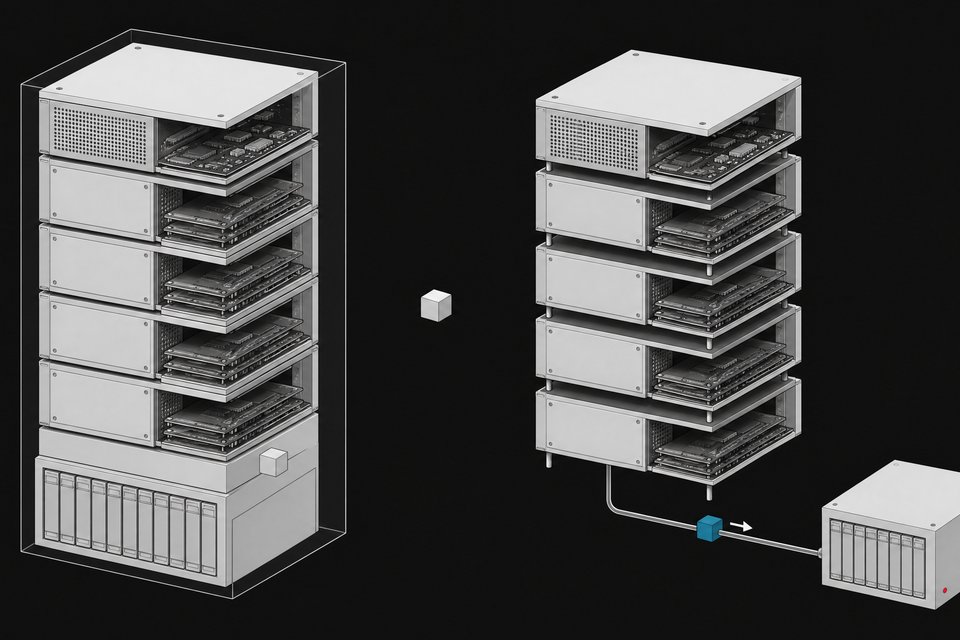
While the internet was watching Astra demos, on-premises and edge inference grew from 12% of enterprise AI workloads in 2023 to 55% in 2026, a 4.6x jump in three years. On-premise deployments now hold roughly 51 to 60 percent of the overall LLM deployment market. That's not a niche trend. That's a majority of enterprise inference happening somewhere other than a vendor's cloud.
This migration lines up with a pattern we've tracked across this publication's ownership coverage: teams start on a rented API because it's the fastest way to ship, then move the workload in-house once volume and requirements stabilize. Our self-hosting playbook walks through exactly how that transition happens in practice, and it maps closely to what these deployment numbers show at scale.
Is local AI actually cheaper than a cloud API?
Yes, and by more than most people assume. DreamFactory's analysis puts locally run open-weight models at roughly 18x cheaper per million tokens than premium commercial APIs. That's a headline number, but the more rigorous version comes from a peer-reviewed Carnegie Mellon cost-benefit study across 54 deployment scenarios. The CMU researchers found:
- Small open-source deployments — a 32B-parameter model on a single consumer GPU around $2,000 — can break even against a premium API like Claude Opus in as little as 0.3 months.
- Medium-scale deployments break even in a wider range, roughly 2.3 to 34 months, depending on volume and hardware choice.
- Large-scale deployments can take up to 69.3 months to break even against the cheapest commercial providers, which means for some workloads renting still makes sense.
That spread is the whole story in one list. Small and medium workloads pay for themselves fast. Enormous, low-volume, or rarely-used large models often don't. Anyone telling you "just self-host everything" is skipping the second half of that math. We go deeper on where the actual break-even lines sit in our real break-even math piece, and it's worth running your own numbers before committing hardware budget.
What governance problem can't cloud AI fix?
Cost is the argument that gets a project approved. Governance is the argument that gets a project mandated. IBM's 2025 Cost of a Data Breach Report found 13% of organizations reported a breach of an AI model or application, and 97% of those breached organizations lacked proper AI access controls. One in five organizations reported a breach tied specifically to shadow AI, adding an average of $670,000 to breach costs, and those incidents leaked PII in 65% of cases and intellectual property in 40%.
Unauthorized AI tool use isn't a fringe behavior, either. PagerDuty's 2026 survey found two-thirds of office professionals have used unauthorized AI tools at work, even though 72% believe they understand their company's AI policy. That gap between "I think I'm following the rules" and "I'm running ChatGPT on customer data in a browser tab" is where breach costs come from.
This is why so much of the local-AI shift is really a governance decision wearing a cost-savings costume. If the model runs on hardware you own, inside a network you control, you've collapsed the shadow-AI attack surface down to something your security team can actually audit. No cloud subscription tier fixes that. It's the same reasoning behind the broader software ownership renaissance we've tracked elsewhere, and it's why "where does the data physically go" has become as important a procurement question as "how good is the model."
Is every local deployment a chatbot?
Some of the clearest ROI is happening in narrow, task-specific models that were never trying to compete with GPT-6 Astra in the first place. Google Research's TimesFM is a good example: an open-weight, decoder-only time-series forecasting model, Apache-2.0 licensed through version 2.5, designed to run via BigQuery, Vertex Model Garden, or a laptop GPU. A retailer forecasting demand or a finance team modeling cash flow doesn't need a frontier reasoning model. It needs a fast, accurate, boring model that never sends proprietary numbers to a third party.
That's the nuance missing from most "local vs cloud" arguments. Enterprises aren't choosing local models because they want a worse version of ChatGPT running on their own servers. They're choosing local models because most production AI work isn't chat at all. It's structured, repetitive, and perfectly suited to a smaller model you fully own.
So why hasn't open-source 'caught up'?
Because at the chatbot layer, it's actually losing ground, and pretending otherwise would be dishonest. Menlo Ventures' mid-2025 survey of 150 enterprise and startup technical leaders found open-source model usage in production AI workloads declined, from 19% to 13%, over six months, as teams consolidated around a handful of high-performing closed frontier models for chat and agent use cases. Menlo's own read is that open-source models continue to trail frontier closed models in performance by nine to twelve months.
Both things are true at once. Open-weight models are losing ground at the general-purpose chatbot layer, where frontier reasoning quality is the differentiator and OpenAI, Anthropic, and Google keep raising the bar. And open-weight models are gaining ground at the infrastructure layer, where the question isn't "which model is smartest" but "which model can I run on hardware I own, at a cost that scales with my business instead of my token count." Those are different battles. Astra is winning the first one loudly. Local models are winning the second one quietly, and the second one is where most enterprise AI spend actually lives.
How should you actually decide between local and cloud?
The decision isn't local versus cloud as a religion. It's workload by workload:
- High-volume, stable workloads (classification, extraction, forecasting, internal search) are prime candidates for local hosting. The CMU break-even math favors them, sometimes within weeks.
- Regulated or sensitive data (PII, financial records, health data, source code) push hard toward local, given the breach-cost premium tied to shadow AI and weak access controls.
- Latency-sensitive operations benefit from local inference, which can cut response times dramatically compared with round-tripping to a cloud API.
- Novel reasoning, open-ended chat, and frontier research tasks still make sense to rent. Closed models keep a real performance edge here, and the volume rarely justifies dedicated hardware.
- Anything you're not sure about yet should start on a rented API and graduate to local once volume and compliance requirements are clear. That's the natural progression this whole migration is following, and it's the same path we lay out in our practical guide to running AI workloads locally.
| Cost at High Volume | Data Control | Time to Start | Frontier Reasoning Quality | Best-Fit Workload | |
|---|---|---|---|---|---|
| Local / On-Premstable, high-volume, sensitive workloads | Low | High | Low | Medium | Classification, extraction, forecasting |
| RecommendedCloud Frontier APIopen-ended chat and novel reasoning | High | Low | High | High | Open-ended chat, research, agents |
None of this requires ignoring GPT-6 Astra. It's a genuinely capable model and it will keep winning benchmark headlines. But benchmarks answer a different question than the one most CIOs are actually asking, which is closer to what a tool like goremy.ai is built to answer: not "which model is smartest," but "which AI stack can I actually own, audit, and afford at the volume my company runs at." That's the question the GPT-6 news cycle skips over, and it's the one 55% of enterprise inference has already quietly answered.
Frequently Asked Questions
Is local AI cheaper than cloud LLM APIs for enterprises?
Often, yes, especially for small and mid-sized models running high-volume workloads. A CMU cost-benefit study found small open-source models can break even against premium APIs in as little as 0.3 months, though very large models can take up to 69 months to break even, so it depends heavily on model size and usage volume.
Why are companies moving AI workloads on-premises instead of using cloud APIs?
Three main reasons: cost math that favors local hosting at scale, data sovereignty concerns for regulated or sensitive information, and liability from shadow AI use. On-premises and edge inference grew from 12% to 55% of enterprise AI workloads between 2023 and 2026.
Does GPT-6 Astra run locally or only in the cloud?
GPT-6 Astra is cloud-only, available through ChatGPT, the OpenAI API, Microsoft Azure, and AWS Bedrock. There is no on-premises deployment option, which is part of why it doesn't solve the data-sovereignty problem many enterprises are trying to fix.
What is shadow AI and why does it matter for enterprise governance?
Shadow AI refers to employees using unauthorized AI tools without IT approval. Roughly two-thirds of office professionals admit to it, and IBM found shadow-AI-linked breaches add an average of $670,000 in extra costs and are more likely to expose PII and intellectual property.
Should every AI workload be moved to local, open-weight models?
No. Open-source models still trail closed frontier models in general chat and reasoning performance, and open-source usage share has actually declined for those use cases. Local hosting makes the most sense for high-volume, narrow, or sensitive workloads, not for open-ended chatbot or frontier research tasks.
How we source, write, and correct our articles. Editorial standards