Mac Studio vs Cloud APIs: The Real Cost of Running Local AI Agents
Mac Studio TCO vs cloud API subscriptions for local AI agents: the three-year math, the 94/6 routing trick that cuts bills by 90%+, and the hardware catch.

What does it really cost to run local AI agents on a Mac Studio versus cloud APIs?
Running local AI agents on a Mac Studio costs roughly $3,000 to $5,300 once, versus $7,200 to $14,400 over three years for a mid-to-heavy cloud AI subscription stack. For workloads like classification, extraction, and RAG that don't need frontier-model reasoning, the Mac wins on cost. It doesn't win on speed, and the hardware itself just got more expensive.
TL;DR
- A Mac Studio is a one-time purchase of up to $5,300, while a three-year cloud AI subscription stack can exceed $14,000.
- One small SaaS company cut its OpenAI bill from $1,487 a month to $96 by routing about 94% of calls to a local Mac Studio.
- The winning setup was not fully local: low-confidence calls escalate to a frontier API, and the blended result measured more accurate than the cloud setup it replaced.
- If cloud spend on small-model tasks stays above roughly $300/month, a Mac Studio pays for itself within a year, and below that the API is the rational move.
- Apple raised Mac prices by up to 33% in June 2026 because of an AI-driven memory and storage shortage, and the memory configuration can't be upgraded after purchase.
- Local models are slower and less capable than frontier models, so use local inference for high-volume routine work and keep cloud APIs for complex reasoning.
Why did Apple's Mac Studio demand spike in 2026?
Apple launched new Mac mini and Mac Studio models in August 2026, months earlier than its usual October or November refresh cycle, because enterprise demand for AI hardware caught the company off guard. Apple didn't have an engineering team dedicated to business customers, didn't have developer-relations staff, and didn't have an enterprise AI strategy when the orders started coming in. Businesses that asked Apple for access to Private Cloud Compute were reportedly turned down.
The demand was real anyway. OpenAI has reportedly bought tens of thousands of Mac minis and Mac Studios to train computer-use agents through reinforcement learning. Anthropic is renting equivalent hardware through AWS instead of buying it outright. Apple's own numbers back this up: Mac revenue hit $10.4 billion in fiscal Q3 2026, up 29% year over year, its best June quarter ever, and it outgrew iPhone that quarter.
Gartner analyst Ranjit Atwal calls this an "infrastructure PC" decision, funded out of infrastructure and cloud budgets instead of the usual device-refresh line item. Companies are building what he calls a cloud-to-device strategy, not just buying laptops for employees.
Why does local inference beat the API bill?
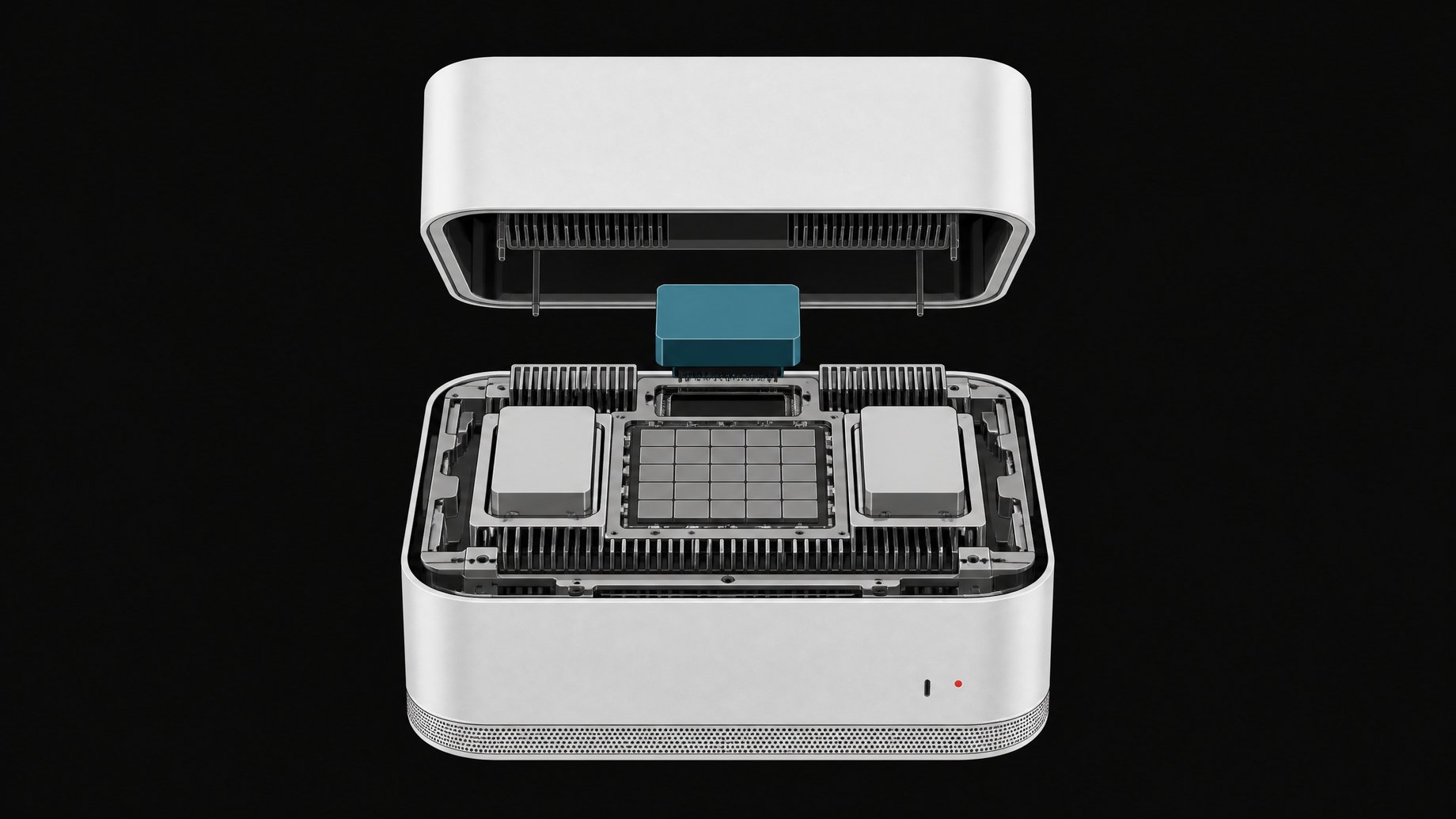
The mechanic is simple. A cloud API charges per token, forever. A Mac Studio charges once, then runs at the marginal cost of electricity. Apple's unified memory architecture is what makes this workable: instead of splitting compute between a small GPU VRAM pool and slower system RAM, the chip shares one large, fast memory pool between CPU and GPU, which lets consumer-class hardware hold models that would otherwise need a data-center GPU.
The clearest real-world proof is a small SaaS company whose OpenAI bill for high-volume classification, extraction, and summarization tasks ran $1,487 a month. Six weeks after putting a Mac Studio (M4 Max, 64GB) on a shelf running a local 7-8B model behind an OpenAI-compatible endpoint, the bill was $96. The $2,500 hardware paid for itself against the blended bill in about six weeks.
The trick wasn't going 100% local. It was routing:
- Local by default. Roughly 94% of calls resolve on the Mac Studio itself, at zero marginal cost.
- Cloud on low confidence. The remaining 6% of calls, the ones the small local model isn't confident on, escalate to a frontier API.
- Net result. A $96/month bill that also measured more accurate than the pure-cloud, budget-tier setup it replaced.
That 94/6 split is the real answer to "run local AI agents on Mac Studio vs cloud API costs": you don't choose one, you route between them and let the split do the saving.
What does the three-year math look like against a $200/month subscription?
Run the same logic at enterprise scale and the numbers get louder. A Mac Studio M3 Ultra, even at its post-price-hike cost of $5,299, nets out to about $3,058 over three years after resale value. A single $200/month cloud subscription, the Claude Max or ChatGPT Pro tier, costs $7,200 over the same three years. A heavier two-subscription stack at $400/month runs $14,400, nearly five times the Mac's net cost.
The case study's own rule of thumb: if a company's cloud spend on tasks a small model can handle sustains above roughly $300/month, a Mac Studio pays for itself within a year. Below that, the ops overhead of running your own inference stack probably isn't worth it, and staying on the API is the rational move.
This is the same logic we've written about with self-hosted alternatives to enterprise SaaS: rent looks cheap until volume shows up, then owning the asset is cheaper than renting it forever.
Who's actually running local Mac AI in production?
This stopped being a hobbyist story a while ago. Apple's June 2026 "Business at the Park" event featured Ford, Disney, and Anthropic as a deliberate pivot of Mac mini and Mac Studio toward business buyers. Disney's creative teams are using on-device AI workflows specifically to cut token costs. French retail bank Credit Agricole is running regulatory workflows on-device. Apple's CFO cited both as concrete examples of on-device AI displacing cloud token spend, telling investors that "more companies are choosing Mac for on-device AI advantages, including lower costs, better performance and enhanced privacy and security."
This is a shift in where the compute budget line lives, not a fad among developers running Ollama on a spare desktop.
What's the catch with capability gaps, obsolescence, and the memory tax?
None of this is free lunch.
- Local models are slower and less capable than frontier cloud models. A Mac Studio M3 Ultra running Llama 3.1 70B at Q4_K_M quantization through Ollama manages about 13.7 tokens per second. That's usable for background agent work. It's not competitive with the near-instant throughput of a frontier API when a task genuinely needs frontier reasoning.
- The memory decision is permanent. Apple Silicon's unified memory can't be upgraded after purchase, which turns your initial memory configuration into a one-time, high-stakes bet. Undersize it and you're stuck; oversize it and you overpaid. Analysts don't expect DRAM and NAND price relief before 2027 or 2028, and an M5 Ultra with meaningfully more bandwidth is expected within 12 to 18 months of any M3 Ultra purchase. Buy today, and you're buying obsolescence on a clock.
- The hardware is getting more expensive as demand grows. The same AI-driven demand that's making local inference attractive is making the hardware itself pricier. Apple raised Mac prices by up to 33% on June 25, 2026, taking the Mac Studio M3 Ultra from $3,999 to $5,299, because of an AI-data-center-driven memory and storage chip shortage, not tariffs. Tim Cook has confirmed Mac mini and Mac Studio shortages could persist for several months, because AI-workload-driven demand has outpaced Apple's manufacturing capacity, officially validating the "ordering frenzy" reports around high-unified-memory configurations bought specifically to run local AI agents.
Owning your inference layer is still cheaper than renting it. But you're buying into a supply-constrained, one-shot hardware decision at a moment when the sticker price is actively climbing.
Should you run local for the boring 80% and cloud for the hard 20%?
Don't buy a Mac Studio expecting to replace your frontier API entirely. Buy it to own the boring, high-volume, cost-predictable 80% of your inference workload: classification, extraction, routine RAG lookups, agent tool-calling that doesn't need deep reasoning. Keep a cloud API in the loop for the hard 20%, the low-confidence cases and genuinely difficult reasoning tasks, the same way the $96/month case study kept 6% of calls on cloud rails.
That's a build-vs-buy decision dressed up as a hardware purchase. The teams treating a Mac Studio as amortized infrastructure, not a consumer device, are the ones who've done that math. If you're standing up that kind of routing layer for your own agents, Remy is built for exactly this: deciding what runs locally, what escalates, and what you actually need to own versus rent.
| Upfront Cost | Ongoing Cost at Scale | Raw Inference Speed | Frontier Reasoning Capability | Upgrade Flexibility | Best For | |
|---|---|---|---|---|---|---|
| Mac Studio (local)High-volume, low-complexity workloads | $3,000-$5,300 once | Low | Medium | Low | Low | Classification, extraction, RAG |
| Cloud API subscriptionLow-volume or frontier-reasoning tasks | $0 upfront | High | High | High | High | Complex reasoning, low volume |
| RecommendedHybrid routing (local + cloud escalation)Most production agent workloads | $3,000-$5,300 once | Low | Medium | Medium | Medium | Boring 80% local, hard 20% cloud |
The desk really is the new server room. Just budget for the fact that server rooms have supply chains, and this one's currently squeezed.
Frequently Asked Questions
Is running AI locally on a Mac Studio actually cheaper than cloud APIs?
Yes, for high-volume, routine workloads. A three-year Mac Studio M3 Ultra costs about $3,058 net of resale value versus $7,200 for a single $200/month cloud subscription over the same period, and about a fifth of a $400/month two-subscription stack. One documented case saw a company's OpenAI bill drop from $1,487 to $96 a month after switching to a Mac Studio with hybrid routing.
What tasks should stay on cloud APIs instead of running locally?
Anything requiring frontier-level reasoning or speed. A Mac Studio M3 Ultra running a 70B local model manages about 13.7 tokens per second, workable for background tasks but far behind cloud API throughput. The practical pattern is routing roughly 94% of calls locally and escalating the hardest 6% to a frontier API.
Why did Apple raise Mac prices right when enterprise AI demand for Macs is surging?
Both are driven by the same cause: an AI-data-center-fueled memory and storage chip shortage. Apple raised Mac Studio M3 Ultra pricing by up to 33% (from $3,999 to $5,299) in June 2026 because of that shortage, not tariffs, while the same shortage is fueling the enterprise rush to buy Mac hardware for local inference.
How much cloud spend justifies buying a Mac Studio for local AI inference?
The rough threshold from a documented case is about $300 a month in sustained cloud spend on tasks a small local model can handle. Above that, a Mac Studio typically pays for itself within a year; below it, the operational overhead of running your own inference stack usually outweighs the savings.
Which companies are actually buying Mac Studios and Mac minis for AI, not just developers?
OpenAI has reportedly bought tens of thousands of Mac minis and Mac Studios for training computer-use agents, while Anthropic rents equivalent hardware through AWS. Disney and Credit Agricole were cited by Apple's CFO as enterprise customers using on-device AI to cut token costs and run regulatory workflows.
How we source, write, and correct our articles. Editorial standards