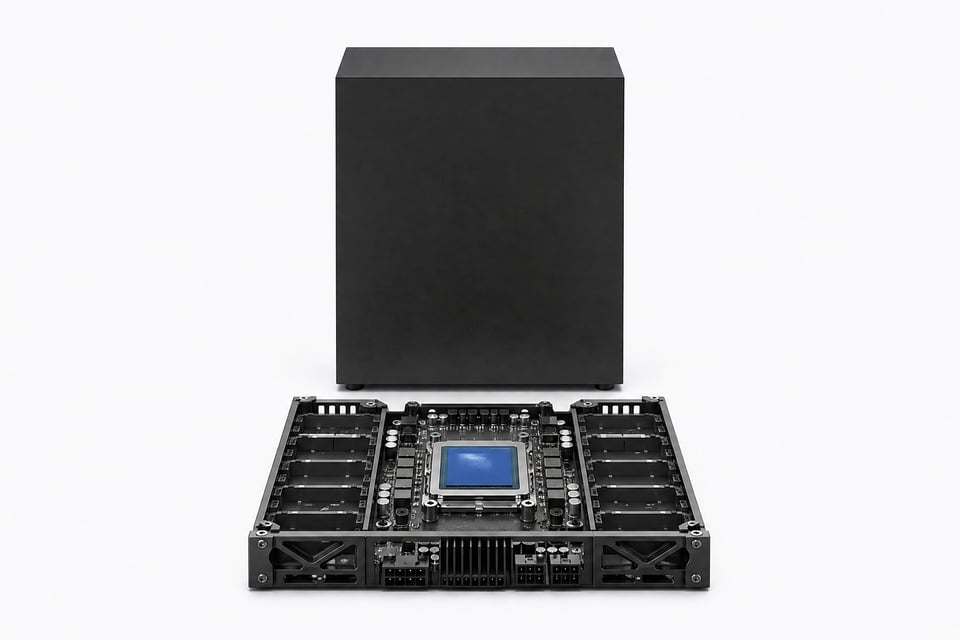
The Mac Studio M5 Ultra Makes the Case for Owning Your AI Compute
Local AI vs cloud AI cost, explained with real numbers. Why Apple's M5 Ultra and open models like Granite 4.2 change the local-versus-cloud math.

Is owning your AI compute with a Mac Studio M5 Ultra cheaper than using cloud AI?
Local AI beats cloud AI on cost only past a certain volume, and that volume just dropped. A Mac Studio with an M5 Ultra chip starts at $5,499 and runs open models like Qwen and IBM's Granite 4.2 well enough that, at meaningful usage, the electricity and hardware amortization can undercut metered API pricing by an order of magnitude. But cloud APIs got cheaper too, so the decision isn't automatic. It depends on how much you actually use the thing.
I've spent enough years watching internal tools get built and re-built to distrust any pitch that sounds like a slogan. "Own your compute" is a good slogan. It's also, for the first time in this AI cycle, backed by real numbers.
TL;DR
- Local AI beats cloud AI on cost only past a certain volume threshold, and that threshold just dropped.
- The M5 Ultra Mac Studio starts at $5,499 with 96GB of unified memory and up to 1.2TB/s of memory bandwidth, which is the number that matters for running large language models.
- Open models like IBM's Granite 4.2 and Qwen mean locally runnable models are no longer the compromise choice.
- Local electricity alone ran $0.06 to $0.55 per million output tokens, against $1.25 to $5.00 for hosted small models, so the marginal token is close to free once the machine is paid for.
- The break-even depends on which API you compare against and how much volume you actually push.
- Teams with a low metered API bill should stay on the API, while steady, high-volume usage is where owning the machine starts to pay off.
- Local hosting is not free, since setup, model management and the lack of an SLA add real overhead on top of hardware and electricity.
What actually shipped in the new Mac Studio?
Apple's new Mac Studio splits into two chips: M5 Max starting at $2,499, and the new M5 Ultra starting at $5,499 with 96GB of unified memory, scaling up to a 512GB configuration coming later this year. Apple is calling the M5 Ultra its most powerful chip ever, with up to 1.2TB/s of memory bandwidth and a claimed 4.3x jump in AI compute over the previous generation.
Memory bandwidth is the number that matters for AI, not raw core count. Running a large language model is mostly a memory-bandwidth problem: for every token generated, the chip has to stream weights out of memory. Apple's unified memory architecture means the CPU and GPU share one big pool of fast RAM, which is exactly what lets a desktop the size of a lunchbox load a 100-billion-parameter class model that would otherwise need a rack of GPUs.
Have open models finally caught up?
Hardware is only half the story. The other half is that open, locally-runnable models stopped being the compromise choice.
IBM shipped Granite 4.2 in August 2026, a family of 3B, 8B, and 30B parameter reasoning models built specifically for agentic enterprise work: tool use, multi-step coding tasks, terminal environments. It's released under Apache 2.0, so a company can download it, fine-tune it, and run it in production with no licensing string attached. Qwen's model family has followed a similar arc, and independent testing on Apple Silicon backs up the practical case: on a Mac Studio, a well-quantized 120-billion-parameter mixture-of-experts model measured cheaper and faster per token than a smaller 27B dense model, because the model only activates a fraction of its parameters for any given token. That finding matters because it kills the old intuition that bigger models always cost more to run. On this hardware, the opposite can be true.
That same measurement put real numbers on the marginal cost of local inference: electricity alone ran from $0.06 to $0.55 per million output tokens depending on the model, against $1.25 to $5.00 per million output tokens for hosted small models like GPT-5.4-nano, Gemini 2.5 Flash, and Claude Haiku 4.5. That's not a total-cost-of-ownership number, it's the electricity floor beneath the hardware you already own. But it's the number that convinces you the marginal token really is close to free once the machine is paid for.
Where does the break-even actually sit?
Here's where I get less evangelical. The break-even point for local hardware moved in two directions at once in 2026. Cheap hosted models like GPT-4o-mini and Gemini Flash got cheaper, which raised the bar for local hosting to beat them. At the same time, consumer and Apple Silicon hardware got more capable per dollar, which lowered the cost of getting into local hosting at all.
One widely cited framework puts a $1,600 RTX 4090, amortized over 24 months plus electricity and maintenance, at about $104 a month in fixed cost. Against GPT-4o's blended rate of roughly $13 per million tokens, that breaks even at around 8 million tokens a month, which is a couple of active coding days for a busy team. Against a cheap model like GPT-4o-mini at roughly $0.51 blended, you need north of 200 million tokens a month before local hosting wins. The takeaway isn't "local always wins." It's that the decision hinges entirely on which API you're currently comparing yourself against, and how much volume you're actually pushing.
A Mac Studio changes that math further because it swaps a GPU that draws 350-400 watts for a chip that draws closer to 60-90 watts while holding a much larger model in memory. Less power, bigger models resident, roughly comparable throughput on well-optimized MoE architectures. That's a genuinely different cost curve than the GPU-based analyses most people are still running in their heads.
What does this mean if you run engineering or ops?
If your team is paying a metered API bill in the low hundreds of dollars a month, stay on the API. The convenience is worth more than the hardware you'd need to buy. But if you're running an internal tool with steady, high-volume usage, a coding assistant, a document pipeline, an internal support bot, hitting real double-digit-million-token months, the math changes. You're not renting inference anymore. You're buying a machine that depreciates like any other capital asset and produces tokens at a marginal cost close to your power bill.
That's the same argument we've made about the token math elsewhere on this site: the real comparison isn't API price per token against zero, it's API price per token against the fully loaded cost of quantized, self-hosted models over their useful life (see The True Cost of Renting Tokens vs. Owning Quantized Models). The Mac Studio just made the hardware side of that equation cheaper to buy into and easier to justify to a finance team, because it's a line item that shows up on a balance sheet instead of a subscription that vanishes into opex.
There's also a governance angle worth naming. Once a team can run a capable model on a machine sitting under someone's desk, you get all the upside of local inference (privacy, no rate limits, no per-token anxiety) and all the risk of software nobody signed off on. If you're going to own the compute, you should also own the accounting for what runs on it, which is the same discipline this publication argues for around employee-built AI tools generally. Platforms like Remy exist for exactly this handoff: treating internally built or internally hosted AI tools as owned software assets with a real inventory, rather than shadow projects nobody tracks.
What is the honest caveat?
Local hosting is not free, and anyone telling you it is hasn't run the numbers. Setup time, model management, no SLA when your machine has a bad day, and the opportunity cost of a machine dedicated to inference all add real overhead on top of hardware and electricity, commonly estimated at 20 to 40 percent above the raw amortization math. Quality also isn't uniform. A quantized open model can hold up well on coding and tool-calling tasks and still lag a frontier model on the hardest multi-step reasoning. Clear your quality bar first. Then let the cost math break the tie.
How we source, write, and correct our articles. Editorial standards