The Cloud Dev Stack Is Fragile: Why the GitHub Outage Broke Cursor Origin Too
GitHub went down for seven and a half hours. Cursor launched its GitHub rival that same day, and it broke too. Here's what that says about renting your dev infrastructure.

The short answer
On August 17, 2026, a major GitHub outage did not just break GitHub. It also degraded Cursor Origin, the new AI-native code hosting platform Cursor launched that same day as a GitHub alternative.1 Origin still leans on GitHub as the source of truth for existing repositories, so when GitHub went down, Origin's Automations, Review Agents, and Cloud Agents went down with it.2 The episode is a clean demonstration that a rented cloud dependency does not disappear just because you build a nicer product on top of it.
What actually happened
GitHub's outage started at 6:40 a.m. Pacific and ran for roughly seven and a half hours. Within ninety minutes nearly every part of the service was degraded: the website, code review tools, GitHub Actions, and Copilot. Error rates hit 20% on web and API traffic and as high as 50% on repository downloads.31 GitHub said it found the source of the problem by mid-morning but kept working into the afternoon on lingering login failures affecting Copilot.3
That same morning, Cursor rolled out Origin, a Git hosting platform built directly into its editor, to all paid users. Origin was pitched as "Git hosting, at agent scale," designed for AI agents that commit, clone, and merge at a pace no human team approaches. Cursor published performance numbers to make the point: 296,000 clone operations per hour and 22 commits per second per repository.1
The irony landed fast. Origin's own status page logged an incident titled "GitHub degradation affects Cursor Origin, its new Git platform," listing Automations, Review Agents, Cloud Agents, and Origin itself as affected.2 Origin syncs bidirectionally with GitHub and treats GitHub as the source of truth for repos migrated over, so when GitHub's Git and API layers degraded, Origin inherited the failure.1 A tool built to be the alternative to a fragile dependency was still, functionally, downstream of it.
This was not a one-off
GitHub's reliability problems in 2026 have a clear cause, and the company has said so itself. GitHub CTO Vlad Fedorov wrote in April that the company began a plan in October 2025 to increase capacity tenfold, and by February 2026 concluded it actually needed to design for thirty times its prior scale.4 The driver, in his words, is the acceleration of agentic development: pull requests, commits, API calls, and automation have all grown sharply since AI coding agents became common, and that growth strains many systems at once rather than one bottleneck at a time.4
Third-party outage tracking cited alongside the Origin launch found 257 separate GitHub incidents between May 2025 and April 2026, of which 48 were classified as major, roughly one significant disruption a week. GitHub Actions was the single most-affected component with 57 outages. The average time to recover from an incident was over six hours, and August 2026 alone had logged 13 incidents across nine separate days by the time Origin launched.1
GitHub outage frequency, May 2025 to April 2026
GitHub's own two disclosed April 2026 incidents illustrate the same pattern from the inside. A merge queue regression on April 23 produced incorrect merge commits, affecting 658 repositories and 2,092 pull requests. Four days later, an Elasticsearch cluster serving search-backed features across pull requests, issues, and projects became overloaded, likely from a botnet attack, and stopped returning results.4 Neither incident lost data, but both took working teams offline for hours.
Why this matters beyond GitHub
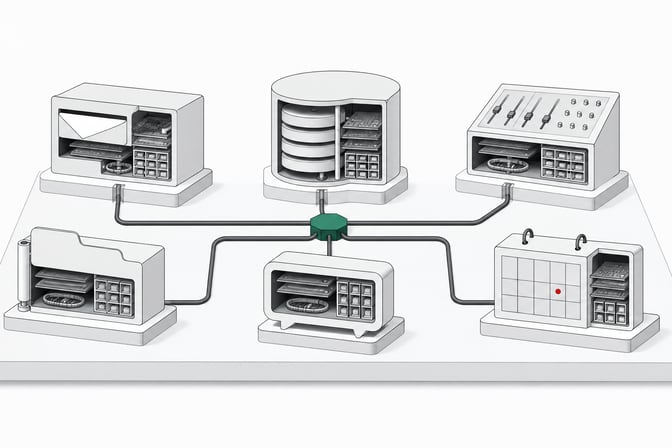
The lesson here is not "GitHub is bad." GitHub is dealing with a genuine and hard scaling problem: agentic workflows push git operations at a volume the platform was not built for, and it is racing to catch up.4 The lesson is structural. Your AI coding tools, your CI pipeline, your review bots, and now even the GitHub alternatives are all stacked on the same small set of rented cloud dependencies. When one link in that stack degrades, everything hanging off it degrades too, no matter how good the product built on top is.
Developers noticed this immediately. On the Hacker News thread discussing the incident, one engineer wrote that after a team discussion following the outage, "literally everyone wants to leave and looking for the best alternative."2 Another described their 500-person engineering org as already "charting an off ramp" from GitHub Actions specifically because of the recurring cost of downtime: "having 500 engineers who can't do any coding work for a day every {month,week}."2 Whether or not those teams actually migrate, the sentiment reflects a real cost that rarely shows up on an invoice: lost engineering hours during outages you have no control over and cannot predict.
This is the practical argument for treating core dev infrastructure as something you evaluate for ownership and resilience, not just features. A team that has thought through what happens when a vendor goes down, whether that vendor is GitHub, an AI coding assistant, or the orchestration layer connecting them, is in a fundamentally different position than one that assumes rented infrastructure will simply always be there. Tools like Remy exist because that assumption keeps failing, and teams increasingly want visibility into what they actually depend on before the next outage forces the question.
What teams can actually do
- Map your dependency chain. Know which of your tools, including AI coding agents and review bots, silently depend on GitHub or another single vendor underneath the surface.
- Separate git hosting from CI. If your source control and your build pipeline share a single point of failure, an outage in one takes down both.
- Ask vendors about their own dependencies. Cursor Origin's incident is a good reminder to ask any "alternative" tool what it actually depends on before you adopt it as your resilience plan.
- Budget for downtime, not just subscriptions. The real cost of a rented dev stack includes the hours lost when it goes down, which the outage data suggests happens roughly weekly at major-incident scale for GitHub alone.1
FAQ
Did the GitHub outage actually break Cursor Origin? Yes. Cursor's own status page recorded an incident titled "GitHub degradation affects Cursor Origin, its new Git platform," listing Origin, Automations, Review Agents, and Cloud Agents as affected during GitHub's August 17, 2026 outage.2
Why would a GitHub alternative depend on GitHub? Origin was designed to sync bidirectionally with GitHub, treating GitHub as the source of truth for repositories migrated from it. That design choice means Origin inherits GitHub's outages for any workflow touching a synced repo.1
How often does GitHub actually go down? Third-party outage tracking found 257 incidents between May 2025 and April 2026, with 48 classified as major, roughly one significant outage per week, and an average recovery time over six hours.1
What is GitHub doing to fix its reliability? GitHub's CTO said the company is redesigning for 30 times its prior scale, isolating critical services like git and Actions from other workloads, and moving toward a multi-cloud infrastructure strategy.4
Should companies drop GitHub because of this? Not necessarily. The bigger point is that any single vendor, including AI-native alternatives, can become a shared point of failure. The fix is understanding your actual dependency chain, not just picking a different vendor to depend on blindly.
Yes. Cursor's status page recorded an incident showing GitHub's degradation affected Origin, Automations, Review Agents, and Cloud Agents during the August 17, 2026 outage.
Origin syncs bidirectionally with GitHub and treats it as the source of truth for migrated repositories, so it inherits GitHub's outages for synced workflows.
Outage tracking found 257 incidents between May 2025 and April 2026, with 48 major, roughly one significant outage a week, and average recovery over six hours.
GitHub's CTO said the company is redesigning for 30 times its prior scale, isolating critical services, and moving toward a multi-cloud strategy.
Not necessarily. The deeper issue is that any single vendor, including new alternatives, can become a shared point of failure, so understanding your dependency chain matters more than switching vendors.
- 1Cursor Launches Origin Code Hosting Platform on Day of Major GitHub OutageBigGo Finance
- 2GitHub degradation affects Cursor Origin, its new Git platformHacker News
- 3GitHub outage disrupts developers worldwide in latest setback for Microsoft coding platformGeekWire
- 4An update on GitHub availabilityGitHub Blog