The Best Local Open-Source AI and Infrastructure Tools in 2026
Best local open-source AI and infrastructure tools in 2026: Ollama, llama.cpp, Valkey, OpenTofu, and n8n for self-hosting.


What are the best local open-source AI and infrastructure tools in 2026?
The best local open-source AI and infrastructure tools in 2026 are Ollama and llama.cpp for running models on your own hardware, Valkey for caching, OpenTofu for provisioning infrastructure, and n8n for workflow and agent automation. All five started as reactions to something: a licensing change, a hyperscaler squeeze, or a gap in local-AI tooling. All five are now stable enough to run in production without a vendor holding the keys.
TL;DR
- Ollama's switch to Apple's MLX framework nearly doubled decode speeds, from 58 to 112 tokens per second on Qwen3.5-35B-A3B.
- llama.cpp is the engine underneath Ollama, LM Studio, Jan, and GPT4All, which makes it a good test of how mature a local-AI tool's foundation is.
- Valkey's rapid enterprise adoption forced Redis to reintroduce an open-source license option when it added AGPLv3 back in May 2025.
- OpenTofu delivered client-side state encryption in under a year after the fork, a feature the Terraform community had requested since 2016.
- Foundation governance under the Linux Foundation and the CNCF prevents single companies from unilaterally relicensing Valkey and OpenTofu.
- n8n is distributed under a fair-code license, not an OSI-approved one, so self-hosting it is not the same as owning it.
Why did 'owning your stack' become a real option in 2026?
Three years ago this list didn't exist. Redis relicensed to a restrictive dual license in March 2024. Terraform moved to the Business Source License in August 2023. Both moves triggered the same response: a foundation-backed fork, built by the same engineers and cloud vendors who'd been running the original tool in production, showed up within months. Redis reversed course in May 2025 and added AGPLv3 back as an option. You don't restore a license people can walk away from unless the fork already won.
At the same time, local AI inference stopped being a hobbyist project. Model quantization got good enough, and Apple Silicon and consumer GPUs got fast enough, that running a serious LLM on a laptop or a single server became a real substitute for an API bill. The five tools below sit at the intersection of those two trends, license-driven forks and local-first AI. Together they cover inference, caching, infrastructure provisioning, and automation, which is most of what a SaaS bill actually itemizes.
Why is Ollama the easiest on-ramp to local AI inference?
Ollama is the default way most teams run open-weight models locally in 2026. It's MIT-licensed, ships an OpenAI-compatible API so existing integrations don't need rewrites, and handles model management the way Docker handles containers: pull, run, done.
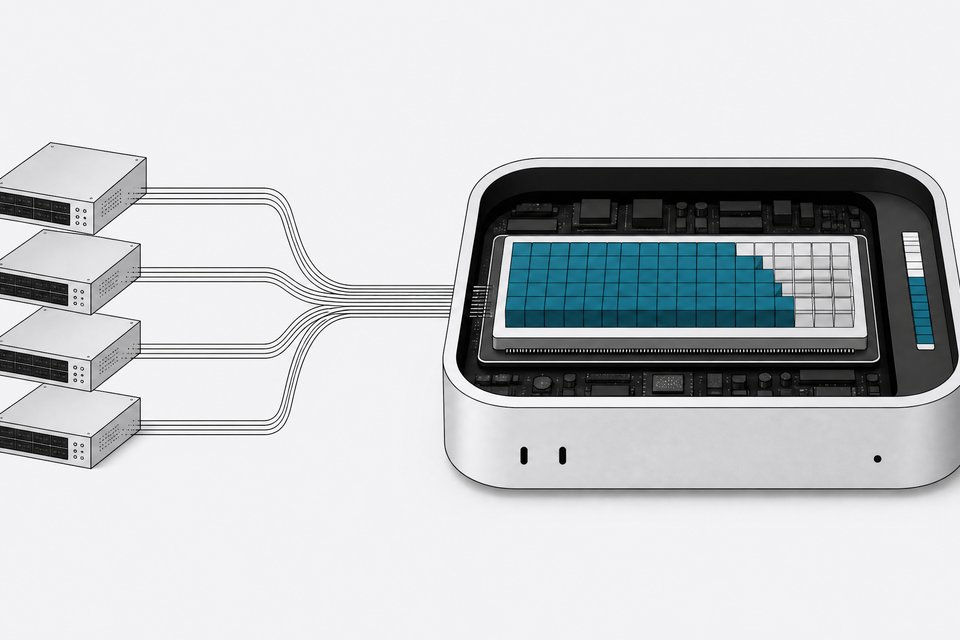
The biggest change this year happened under the hood. Starting with version 0.19 in March 2026, Ollama swapped its Apple Silicon backend from llama.cpp's Metal implementation to Apple's own MLX framework. On Qwen3.5-35B-A3B, prefill throughput went from 1,154 to 1,810 tokens per second, and decode speed nearly doubled, from 58 to 112 tokens per second. A June 2026 update pushed further, using NVFP4 quantization to gain another 20% on output speed compared to Q4_K_M, while roughly halving the quality loss you'd normally take from 4-bit quantization.
That's not a marginal tuning win. It's the difference between a local model feeling like a toy and feeling like infrastructure.
Why is llama.cpp the engine underneath almost everything?
Most of the local-AI tools people actually use, including Ollama, LM Studio, Jan, and GPT4All, are built on llama.cpp. It's an MIT-licensed C/C++ inference engine with almost no dependencies, which is why it runs on everything from a Raspberry Pi to a data center GPU.
By mid-2026 it had grown past 118,000 GitHub stars, with some trackers putting it closer to 124,700. It doesn't follow semantic versioning. Releases are nightly or tagged builds, driven by a constant stream of hardware-vendor contributions optimizing for new chips as they ship. If you're evaluating any local-AI tool and want to know how mature its foundation really is, check whether it's running llama.cpp underneath. Most of the credible ones are.
How did Valkey, the community fork, outgrow Redis?
Valkey is the clearest proof that a licensing fight can produce a better outcome than the original vendor's roadmap. When Redis moved off open source in March 2024, AWS, Ericsson, Oracle, and Google backed a BSD-licensed fork under the Linux Foundation within weeks.
A year later, the numbers told the story:
- Nearly 50 companies contributing code.
- 19,800 GitHub stars and 761 forks.
- 1,000+ commits, 150+ contributors, and 13 releases.
- 5 million-plus Docker pulls.
A 2025 Percona survey found 83% of large enterprises were testing or running Valkey, and its monthly GitHub PR volume was nearly double Redis's own. Redis adding AGPLv3 back in May 2025 wasn't generosity. It was a response to a fork that had already captured the enterprise conversation.
How does OpenTofu deliver infrastructure as code without the license risk?
OpenTofu forked from the last MPL-2.0 release of Terraform after HashiCorp's move to the Business Source License, and it's followed the same arc as Valkey: fast community growth, faster feature delivery, and a foundation home that outlasts any single vendor's incentives.
CNCF accepted OpenTofu as a Sandbox project on April 23, 2025. By 2026, it had more than 160 active contributors and roughly 29,300 GitHub stars, with downloads approaching 10 million. It also shipped client-side state encryption, a feature the Terraform community had asked for since 2016, in under a year post-fork. That's what happens when a roadmap answers to contributors instead of a board.
IBM completed its $6.4 billion acquisition of HashiCorp in February 2025 and hasn't reversed the BSL status on Terraform, which leaves OpenTofu as the only fully open-source continuation of the original codebase. For teams that got burned once by a licensing change, that's not a footnote. It's the whole reason to switch.
What does n8n offer for self-hosted AI agent and workflow automation?
n8n is a self-hostable, visual builder for workflow automation and AI agents, with more than 200,000 GitHub stars, 500+ integrations, and SOC2 compliance. You can run it entirely on your own infrastructure and wire it into whatever internal systems you already have.
One caveat worth flagging: n8n is distributed under a fair-code Sustainable Use License, not an OSI-approved open-source license. You get free rights to use, modify, and build on it, but the license carries restrictions a true open-source license wouldn't. That doesn't disqualify it from this list, but it does change the calculus if software ownership, not just self-hosting, is the goal. It's the same tension we've covered in The Shadow AI Tech Stack: a tool being free and self-hostable isn't the same as a tool being yours in the fullest sense.
For teams weighing n8n against building a workflow layer from scratch, platforms like Remy sit in the same conversation: infrastructure you run and own, rather than rent and hope stays priced the same next year.
What do these five tools have in common?
Line them up and the same three ingredients show up every time:
- Foundation governance. Valkey sits under the Linux Foundation and OpenTofu under the CNCF, so no single company can unilaterally relicense them out from under users.
- Permissive licensing. Ollama and llama.cpp are both MIT-licensed, the least restrictive terms available, which is a big part of why they became the default substrate for everything built on top of them.
- Hyperscaler-backed engineering. AWS, Google, Oracle, and Ericsson didn't just endorse Valkey, they staffed it. That's what turns a fork from a protest into a product.
n8n is the outlier, and it's instructive precisely because it isn't fully open source. It proves self-hosting alone doesn't buy you the same durability as a project with foundation governance and a permissive license behind it.
How do you decide whether to adopt one?
Before you swap a rented service for one of these, run through a short checklist:
- Hardware floor. Local inference tools like Ollama need real memory and, ideally, Apple Silicon or a recent GPU to hit the throughput numbers vendors publish. Budget for that before you budget for anything else.
- Governance model. Is the project under a foundation (Linux Foundation, CNCF) or a single company? Foundation governance is the strongest signal that a relicensing surprise won't happen twice.
- Migration effort. Valkey and OpenTofu were both built for drop-in compatibility with what they replaced. Confirm that compatibility holds for your specific config and version before you cut over.
- License terms. Read past the marketing. "Open source," "source-available," and "fair-code" are not the same thing, and n8n's Sustainable Use License proves the label matters as much as the feature set.
None of this is about ideology. It's about which line items on next year's SaaS bill you can move onto infrastructure you actually control, and which ones you can't yet. In 2026, that list got a lot longer.
Frequently Asked Questions
What is the best open-source alternative to renting AI inference in 2026?
Ollama is the most common choice for local AI inference. It's MIT-licensed, ships an OpenAI-compatible API, and now runs on Apple's MLX framework on Apple Silicon, roughly doubling throughput over its previous Metal-based backend.
Is Valkey a full replacement for Redis?
Yes, for most use cases. Valkey was forked from Redis OSS 7.2 under a BSD license and has drawn nearly 50 contributing companies and over 5 million Docker pulls in its first year, with a 2025 survey finding 83% of large enterprises testing or running it.
Is OpenTofu compatible with existing Terraform configurations?
OpenTofu forked from Terraform's last MPL-2.0 release, so most existing Terraform configs and providers work with minimal changes. It has since shipped features like client-side state encryption faster than Terraform did under its BSL license.
Is n8n fully open source?
Not in the OSI-approved sense. n8n is distributed under a fair-code Sustainable Use License, which grants broad rights to use and modify the software but isn't the same as a permissive open-source license like MIT or Apache 2.0.
Why did Redis and Terraform get forked instead of just staying proprietary?
Both companies restricted their licenses after building large user bases on open-source terms. Communities and hyperscalers who depended on the original tools forked the last open-source version and formed foundation-backed projects (Valkey, OpenTofu) rather than accept the new restrictions.
How we source, write, and correct our articles. Editorial standards