How Do You Become a Solopreneur With Claude Code?
How to start a one-person AI services business with Claude Code: what to build, real project earnings, the sales funnel and the offer formula.

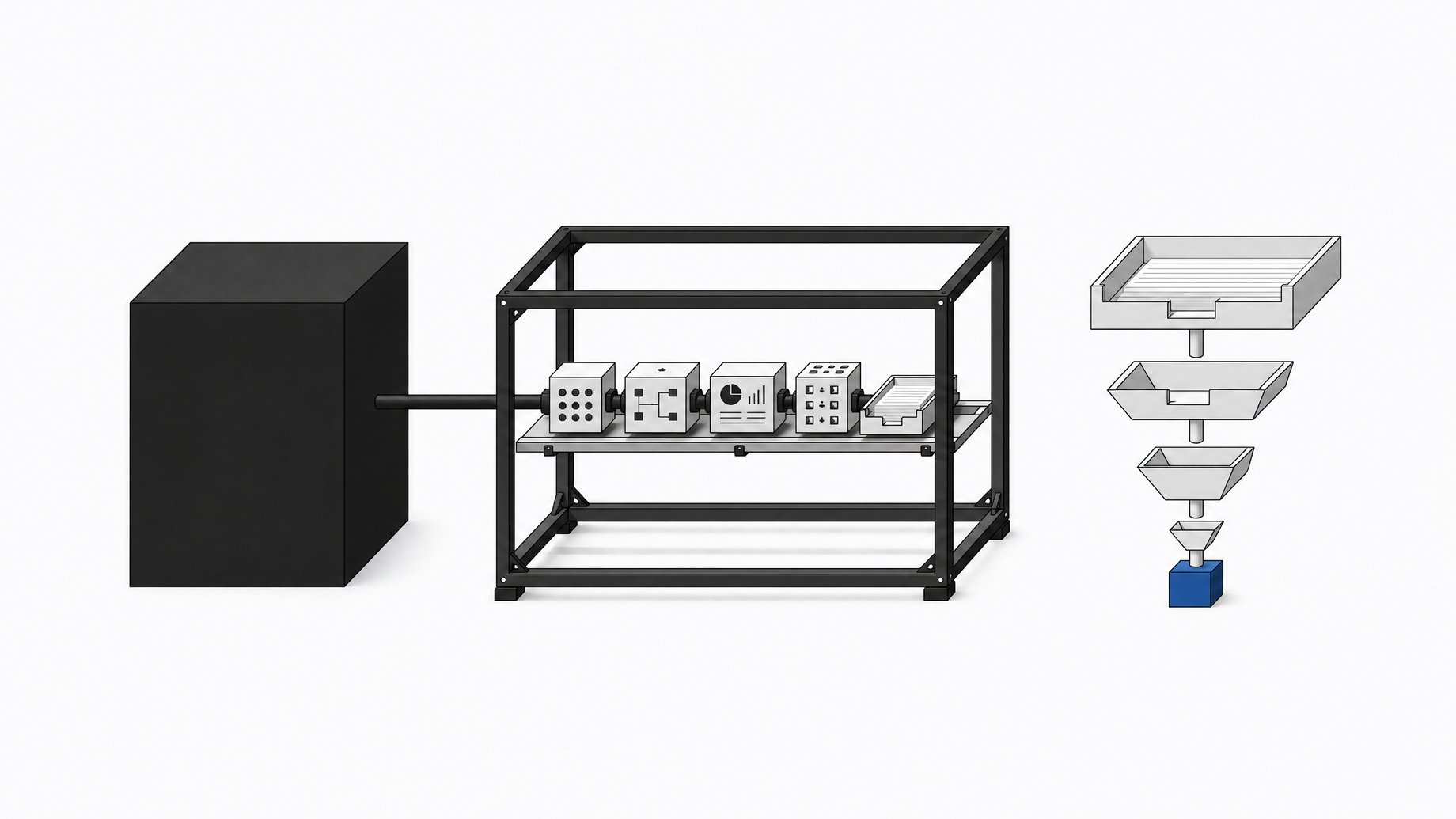
How do you become a solopreneur with Claude Code?
You combine three skills. First, use Claude Code (about $20 a month on the plan the creator recommends) to build things small businesses want, such as booking tools, landing pages and lead systems. Second, learn enough sales to explain the return on those builds. Third, stay consistent with outreach long enough for the market to respond. The building is the easy part. Choosing what to build and getting it in front of buyers is where the money is.
TL;DR
- Claude Code on a $20 monthly plan is the only paid tool the creator says you need to start building client-ready work.
- Clients mostly pay for growth systems (marketing and sales), because a growth gain has no ceiling while cost savings do.
- Two reported projects: a cleaning-company booking setup that closed at $1,200 on day 10, and two landing pages that took about two hours and paid over $800.
- The sales model is a funnel: pick three marketing channels and one sales approach, commit to daily volume, and hold the plan long enough to see results.
- The offer formula is money = stated ROI × belief ÷ friction. Raise the first two, cut the third.
- These earnings are anecdotes from the creator and his community, not guaranteed outcomes.
Why is this opportunity getting attention now?
The pitch starts from productivity numbers. The creator cites Lovable at 400 million in revenue with 146 employees (roughly $2.7 million per employee), Gamma at around $2 million per employee, and Base44, which he says one person built in four months and sold for $80 million. Treat those as the creator's figures, but the direction is clear: AI tools let very small teams produce a lot.
He also says demand for AI skills on Indeed, Upwork and Fiverr has climbed sharply over the last three or four months. Businesses want someone to modernize their operations and connect their tools, and he says he knows people earning upwards of $20,000 a month doing that.
The underlying idea is knowledge arbitrage. A busy owner of a cleaning company is focused on keeping the business alive. You have spent a few hours learning what current AI tools can do. You get paid for the gap between those two positions.
What can you actually build with Claude Code?
Claude is Anthropic's AI model. Claude Code is the version that runs on your computer, reads your files, writes code, fixes what breaks, and works as a general knowledge-work partner.
The creator's demo was a single large prompt: a one-page web app for a home cleaning company. Visitors enter square footage, floors, bedrooms, bathrooms and cleaning type (standard, deep or move-out). The page shows an instant price estimate, builds a 3D model of the house as inputs change, and opens a booking form from a "book this cleaning" button. After about 45 seconds and a design cleanup pass, it worked.
His point is that this beats the usual cleaning-company funnel of a WhatsApp thread or a "book a call" page. Other categories he lists:
- Lead generation systems
- Customer relationship management systems
- Marketing assets
- Sales systems
What do real projects pay?
The creator shares two examples from members of his paid community, Maker School. These are his reports, not independently verified.
| Project | Work | Reported pay |
|---|---|---|
| Cleaning business missing bookings | AI receptionist for new inquiries, tied to Google Calendar with a Cal.com-style booking slot on the site | $1,200, closed on day 10 |
| Client wanting landing pages | Two landing pages built with Claude, delivered before the client asked for them | Over $800 for about two hours of work |
He puts those at an implied $150 to $200 an hour and $400 an hour respectively. He also warns against tracking hourly rate too closely, calling it a trap. The takeaway he wants is that small, ordinary jobs are everywhere, and small businesses often lack capabilities that these tools now make cheap.
Which tools and services do clients ask for most?
The creator says his community scrapes job platforms such as Indeed and Upwork each month and publishes demand reports. The keywords that keep appearing:
| Category | Tools named |
|---|---|
| AI and coding | Claude Code and other agentic coding platforms, n8n (less popular, but many businesses run on it and need maintenance or new builds) |
| CRM and sales | GoHighLevel, HubSpot, Pipedrive |
| Scheduling | Calendly, Cal.com |
| Project management | ClickUp, Trello, Asana |
| Finance | QuickBooks, Ramp, Mercury |
| Automation | Zapier |
His claim is that you can learn what you need in roughly three to five hours with free resources. Whatever you think of that estimate, the list is useful as a search vocabulary: these are the terms buyers type into job posts.
Why focus on growth services?
The most in-demand services relate to growth: more attention on the business, or more sales and conversions. He separates the two. Marketing generates interest. Sales generates intent. He claims an hour spent on either returns five to 10 times the value of an hour spent on something like human resources.
His reasoning about pricing is the sharpest part. A cost-saving system can only save 100 percent of what a client spends. A growth system has no such ceiling. If a business makes $100,000 a month and you help it reach $200,000, you are responsible for a $100,000 monthly delta, and he argues the owner will happily pay a fraction, say $10,000 to $20,000 a month.
The practical shift: the hard question is no longer how to build something. It is which of the many things you could build actually moves the client's bottom line.
How does the business funnel work?
Every business moves customers through the same pipeline, left to right:
- Marketing produces opportunities, meaning people who might buy.
- Sales converts those opportunities into paying customers.
- Onboarding gets access, accounts, style preferences and timelines sorted.
- Delivery is the work they paid for.
- Retention keeps them paying, buying more and returning.
Each stage has many approaches. Marketing includes cold email, cold calling, Upwork and other freelance platforms, communities, YouTube and LinkedIn content, paid ads, referrals, partnerships, conferences and in-person networking. Sales can be a one-call close, a two-call close (discovery first, then the close), or a blend where a discovery call is followed by a proposal the client shares with their team.
His advice is to focus on marketing and sales first, since nothing downstream happens without them. Pick three marketing approaches and one sales approach, set a daily volume, and hold it. The examples he gives from his community: 300 cold emails a day, five Upwork applications a day, 15 LinkedIn DMs a day. The key is staying with the plan long enough for the market to respond, rather than switching channels after a quiet week.
What is the offer formula?
The creator reduces sales and marketing to one equation:
Money you make = stated ROI × how much they believe it ÷ friction to say yes
- Stated ROI. If you tell a client their problem costs $10,000 a month and you can solve it, $10,000 a month is your stated return.
- Belief. Social proof raises it: work with a dozen businesses at the same growth stage, named case studies, public content on the same problem.
- Friction. Lower it by asking for little. His example: five minutes at the end of the call, an invoice sent through Stripe from your phone, self-managed delivery after onboarding, and a guarantee that refunds the fee plus a $200 Amazon gift card if you do not deliver the money in 30 days.
The guarantee in that example is a design choice, not a requirement. The useful part is the framing. When an offer is not selling, ask which of the three terms is weak.
Is this realistic for a beginner?
Partly. The tool barrier is low, and the reported projects are modest in scope. But the sources here are one creator describing his own community, and he sells a paid program. Earnings stories are selected examples. There is no data on how many people attempt this and earn nothing.
What holds up independent of the hype: clients pay for outcomes, growth work is easier to price than cost-cutting work, and outreach needs volume and patience. He adds that the people who succeed most in his community tend to be young, often 18 to 22, and start with little knowledge. The implication is that persistence matters more than prior expertise.
Frequently Asked Questions
How much does it cost to start?
According to the creator, the Claude Code plan at about $20 a month is all you need to begin building. Your other costs are time and whatever outreach tools you choose. Check Anthropic's current pricing before you commit, since plans change.
Do I need to know how to code?
The creator argues no. He says the skill that matters is recognizing which problems make a business grow, not coding or elaborate prompting. A single prompt or a voice-dictation session was enough for his demos.
What should I sell first?
Start with growth-related work: booking and inquiry capture, landing pages, lead generation and CRM setups. The two reported projects were an AI receptionist tied to a calendar and a pair of landing pages. Both are small, fast to build and easy to explain to a business owner.
How many outreach channels should I use?
He recommends three marketing channels and one sales approach. Commit to a fixed daily volume on each and keep going long enough for the market to respond before you change anything.
Are the earnings numbers guaranteed?
No. The figures come from the creator and his community members and are not independently verified. Use them to understand what projects can look like, not to forecast your own income.
How we source, write, and correct our articles. Editorial standards


