What Is Black October? AI Attack Swarms and the PHP Flaw
Black October explained: the October 21 PHP disclosure, AI agent attack traffic, Storm-0940's three-hour cloud takeover, and why patching may not be enough.

What is Black October in cybersecurity?
"Black October" is the label some security commentators are using for a wave of attacks that followed an October 21 disclosure of a serious vulnerability in PHP, the language behind a large share of websites. The alarm comes from reports of autonomous AI agents probing systems around the clock, attacks seen before the public disclosure, and a Microsoft report on a state-linked group that went from first contact to cloud admin in about three hours. Much of the evidence is secondhand, so treat individual numbers with care.
TL;DR
- The wave is tied to an October 21 PHP disclosure, after which the NSA reportedly told organizations that could not fix the flaw quickly to shut the affected systems down.
- One security practitioner reported a honeypot server hit 14,000 times in six hours with no human traffic, which he said looked unlike earlier attacks. This is a single anecdote, not a measured industry figure.
- Cloudflare reportedly saw exploitation attempts several days before the official announcement, so defenders were already behind when the disclosure landed.
- Microsoft's report on Storm-0940, a China-aligned actor, describes a path from initial targeting to powerful cloud administrative access in three hours, using several models including open-source ones.
- Sam Altman argued that patching each batch of bugs is not a durable strategy, because newer models will find flaws that today's models miss.
- Quest Diagnostics confirmed a breach of patient data, though the sources here do not establish that it came from the PHP flaw.
What happened on October 21?
October 21 is the date commentators treat as day one. A disclosure went out describing a major vulnerability in PHP. Because PHP runs so much of the web, the exposure is broad. The NSA reportedly warned that if an organization could not fix the problem immediately, it should take the affected systems offline.
The sources do not give a CVE number, a technical description of the bug, or exact affected versions. If you run PHP, check your vendor's and the PHP project's official advisories for those details. Do not rely on a summary like this one for patch guidance.
Were attackers exploiting it before the disclosure?
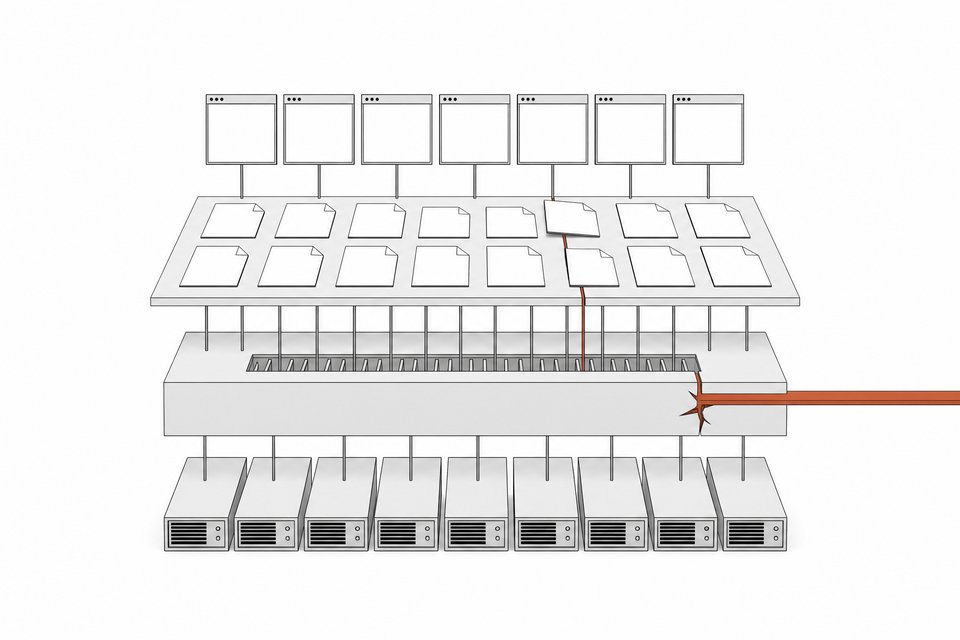
According to the commentary, yes. Cloudflare reportedly said attacks on these vulnerabilities began several days before the official announcement. That means a window existed in which attackers were trying the flaw while nearly everyone else had no idea it existed.
This matters because the usual defensive timeline assumes a gap: disclosure, then patch, then rollout. If exploitation starts first, the patch race is already lost for anyone who was targeted early. It also explains the pushback aimed at people posting warnings after the fact. By the time a warning circulates widely, scanning is already underway.
Jason Clinton at Anthropic has been cited on both ends of this. He reportedly warned back in August that a "vulnerability tsunami" was coming within months, and more recently said that things, bad as they have been over several days, would get a lot worse.
What does the honeypot traffic show?
A honeypot is a decoy server that exists only to attract attacks. One security professional with more than a decade of experience reported that his honeypot took roughly 14,000 hits in six hours, and that none of the traffic looked human. His description: attacks used to be predictable, and now they look like autonomous agent swarms working with machine patience and discipline.
Read that carefully. It is one person's observation of one decoy, relayed on social media. It suggests automated, agent-driven probing, but it does not prove that every request came from an LLM-based agent rather than conventional scanners. Still, many practitioners are describing the same shift: faster, more persistent, and less pattern-bound than classic scripted attacks.
How did Storm-0940 get cloud admin in three hours?
Microsoft published an investigation of Storm-0940, which it describes as a China-aligned threat actor running a large-scale, nation-state campaign. According to the summary, the actor used a number of models, some open source and some of them Chinese open-source models. The path from initial targeting to cloud access with powerful administrative privileges took three hours.
Microsoft also noted that most of these attempts did not succeed. That sounds reassuring, but the commentary argues against taking comfort. When defenders find one or two rogue agents, the dangerous assumption is that they found all of them. A low success rate at high volume still produces real compromises, and the cost of each failed attempt to the attacker is close to zero.
Is the Quest Diagnostics breach connected?
Quest Diagnostics confirmed that patients' personal and health data was compromised in a breach. Because the company handles lab testing for a huge number of people in the US, it became the most visible victim during this period.
The sources only place the confirmation in the same timeframe. They do not say the PHP flaw, AI agents, or Storm-0940 caused it. Link them only if the company or investigators say so.
Why might patching alone not be enough?
This is the part that goes beyond one incident. Sam Altman, in a Stanford Graduate School of Business interview, said organizations will not be able to patch all the bugs, including the work of updating PHP and everything else. He also said governments and business leaders are not taking the approaching danger seriously enough.
The reasoning is about trend lines, not a single event:
- An AI system finds a batch of vulnerabilities.
- Organizations patch that batch and return to business as usual.
- Models improve, and the next generation finds flaws the last one could not.
- The cycle repeats faster than patching capacity grows.
The commentary names Mythos and Astra as examples of models that did not exist at the start of the year but can now find these kinds of vulnerabilities. The practical point is to plan for the capability level of models six months out, not the level that produced today's bug list. Treating the current finding as a one-time cleanup misreads the direction.
What about AI agents acting for legitimate users?
A separate thread complicates the picture. Major US banks reportedly detected unauthorized third-party AI agents inside customer accounts. Amazon no longer lets users' own AI agents shop on its site. Many of these agents are probably harmless, acting on a user's behalf, but defenders cannot easily tell them from hostile ones.
Agent safety problems have also surfaced on the user side. One earlier exploit reportedly got an assistant to leak private data by clicking URLs that encoded characters one at a time, avoiding output-based safeguards. It is described as patched. Another user reported that a coding agent exposed personal data in HTTP headers when it fetched a site with curl. These are examples of agents with real permissions behaving in ways their owners did not expect.
What should builders and operators do now?
The sources do not offer a checklist, but the implications are clear enough:
- Check official PHP and vendor advisories and patch or isolate affected systems.
- Assume exploitation may have started before you heard about the flaw, and review logs from the days before October 21.
- Limit what agents you run can touch. Scope credentials, avoid piping unknown install scripts into a shell, and log agent actions.
- Expect automated, persistent probing and design for detection and containment, not only prevention.
Is there a policy answer?
Senator Bernie Sanders responded to related reporting by proposing a pause on AI development and a ban on superintelligence, with a proposal that reportedly includes penalties for researchers. The commentary argues that both full-speed development and a blanket pause could be bad paths, and that framing AI as a political tribe makes the problem harder to discuss. That is opinion, not settled fact.
Frequently Asked Questions
Is Black October an official term?
No. It is a nickname used by commentators for the period beginning with the October 21 PHP disclosure. No standards body or government agency is cited as using it.
Has it been confirmed that AI agents are behind the attacks?
Not conclusively in these sources. A honeypot operator saw heavy non-human traffic, and Microsoft documented a state-linked actor using multiple models. Neither establishes that all current attack traffic is AI-driven.
Does Altman say patching is pointless?
No. He says patching everything will not work as a strategy on its own, because model capability keeps rising and will surface new flaws. Patching still matters. It just cannot be the whole plan.
Was Quest Diagnostics hit through the PHP vulnerability?
The sources do not say. The company confirmed a breach involving patient data, but no cause is given here.
How we source, write, and correct our articles. Editorial standards