Tencent Open-Source World Model vs Genie 4: Can You Run It?
Tencent's open-weight world model claims Genie 4-style interactive generation on one consumer GPU, with minute-long keyboard steering. How it compares.

How does Tencent's open-source world model compare with Genie 4?
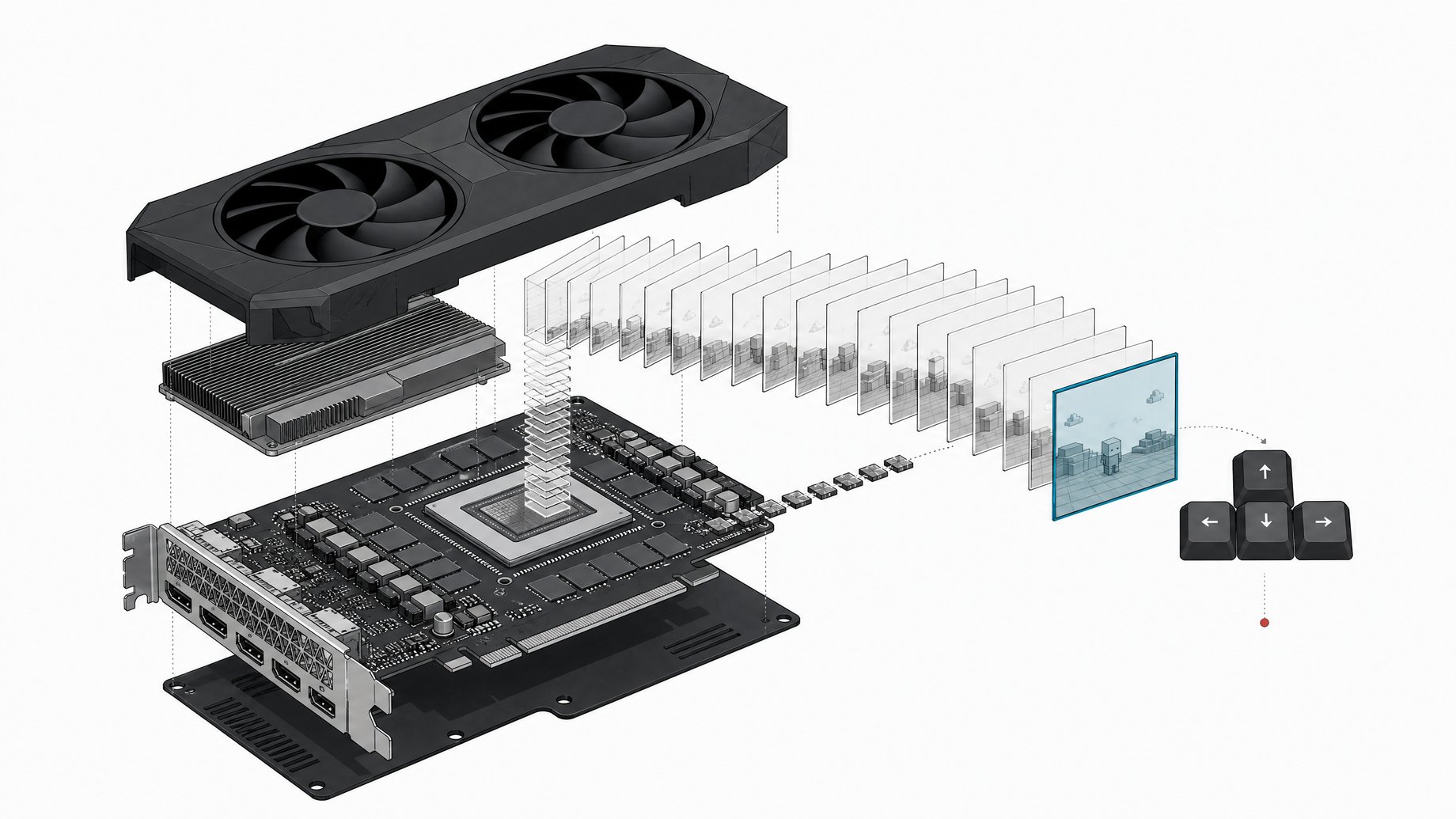
Tencent has released an interactive world model that works like Google's Genie 4 but is open source, with no waitlist. Per the creator coverage, you can steer it with a keyboard for up to one minute, and it should run on a single consumer-grade graphics card. Tencent also compared its output against Google's Genie 4 demos side by side and claims its model follows camera movement better. Those are Tencent's claims, not independent benchmarks.
TL;DR
- Tencent's model is pitched as a free, open alternative to Genie 4, and it can be tried now without a waitlist.
- Users can steer with the keyboard for up to one minute, so sessions are short and bounded.
- Tencent says it should run on one consumer-grade GPU, though the claim is hedged ("theoretically") and no exact VRAM figure was available to verify.
- Tencent's side-by-side comparison against Genie 4 demos claims better camera following. No third-party test backs this yet.
- Its demo gallery includes Pokémon characters such as Charizard and Blastoise, which suggests loose IP filtering, and that could change if lawyers get involved.
- Text prompts drive the scene. One example: "Unfurl the bamboo leaf paraglider and glide out," after which a panda pulls out a giant leaf and floats away.
What is an interactive world model?
A world model generates a video-like environment frame by frame in response to your inputs, instead of rendering a fixed clip. You describe a scene in text, then move through it with controls such as the keyboard. The model predicts what the next frames should look like given where you are headed.
That differs from a game engine. There is no hand-built geometry or physics code. Everything you see is generated. The tradeoff is that consistency, control and length are all hard problems, which is why the details below matter.
What can Tencent's model actually do?
The demos shown cover a few things:
- Text-driven scenes. A panda climbs a stone pillar, and the whole world is generated from a sentence.
- Mid-scene prompting. A new text instruction ("Unfurl the bamboo leaf paraglider and glide out") changes what happens, and the panda pulls out a giant leaf and glides off.
- Keyboard steering. You can navigate for up to one minute per session.
- Character variety. The public gallery includes recognizable characters from other companies' franchises.
The exact model name is garbled in the source transcript, so check Tencent's official release page or repository for the correct name, license terms and download links before you plan around it.
How does it compare with Genie 4?
| Area | Tencent's open model | Google's Genie 4 |
|---|---|---|
| Access | Open source, no waitlist | Not described as openly available in the source |
| Steering length | Up to one minute with keyboard | Not stated in the source |
| Hardware | Claimed to run on one consumer GPU | Not stated in the source |
| Camera following | Tencent claims it is better in side-by-side demos | Used as the comparison baseline |
| IP handling | Gallery shows Charizard and Blastoise | Creator struggled to get King Kong |
I am leaving Genie 4's own specs out of the table because the source does not give them. Fill them in from Google's documentation rather than from secondhand summaries.
Is the camera control claim believable?
Treat it as plausible but unverified. Tencent took Google's own Genie 4 demos and compared its output side by side, so Genie 4's demos were the test material. A vendor choosing the examples tends to favor itself. Camera following is a real weakness area for interactive generators, since the view has to respond to inputs without drifting or ignoring them. So the claim is worth testing.
If you build with this, run your own checks:
- Use the same prompt and the same control sequence across both systems where you can access them.
- Test turns, reversals and stops, not just forward motion.
- Watch for the view lagging behind your input or snapping to a different heading.
- Repeat each test several times, since generative output varies between runs.
Can I run it on my own GPU?
Tencent's claim is that it should run on a single consumer-grade graphics card. The creator says it will "theoretically" run on just one consumer grade graphics card, and gives no VRAM number, resolution, frame rate or latency. Those details decide whether "runs" means a smooth interactive session or a slow, low-resolution one.
Before you commit hardware time, look for these in the official release:
- Minimum and recommended VRAM
- Supported resolution and target frame rate
- Whether real-time interaction needs quantized weights
- The software stack and inference code provided
- The license, especially for commercial use
Until you see those, "one consumer GPU" tells you about the target, not the experience.
Why does the IP difference matter?
The creator noted trouble getting Genie 4 to generate King Kong, while Tencent's gallery already shows Charizard and Blastoise. That suggests the open model applies fewer content restrictions, at least for now. The creator's own caveat applies: that may last only until lawyers get involved.
For builders, this has practical weight. Generating protected characters might be fine for private experiments, but it is risky in anything you publish or sell. Open weights also mean you control the filtering. Any guardrails are yours to add, and so is the responsibility. Read the license and think about what your product would output.
Is the open-source option worth choosing?
It depends on what you need.
Choose the open model if you want to inspect, modify or self-host a world model, you care about running locally, or you are researching how these systems behave. Open weights let you test it without asking permission.
Stay with Genie 4 if you value a more tightly managed product, want stricter content handling, or find Google's output quality better in your own tests. The source gives no quality evidence either way beyond Tencent's own comparison.
The more useful takeaway is the speed. The creator said they did not expect an open version this soon after Genie 4. If that gap stays small, interactive world models may become a commodity tool you can run yourself rather than a gated demo.
Frequently Asked Questions
Is Tencent's world model really free and open source?
The source describes it as open source with no waitlist, and says you can try it now. Check the official repository for the specific license. "Open" can still carry limits on commercial use or redistribution.
How long can you steer the model?
The coverage says you can steer with the keyboard for up to one minute. That is a per-session limit, so it suits short interactive experiences more than long play sessions.
Does it need a data center to run?
Tencent's claim is that it should run on one consumer-grade GPU, which would put it within reach of a good gaming or workstation card. The claim is hedged, and no VRAM requirement was provided, so confirm the specs before buying or renting hardware.
Is it better than Genie 4?
Tencent claims better camera following based on side-by-side comparisons with Genie 4 demos. That is a vendor comparison using selected clips. Independent testing with identical prompts and controls is needed before treating it as settled.
Can it generate copyrighted characters?
The demo gallery includes Charizard and Blastoise, so it appears to do so without much resistance. That may change, and using such output in a public or commercial project carries legal risk.
How we source, write, and correct our articles. Editorial standards