Minico M1 Review: Does the Thinking Dial Help a 350M Model?
Minico M1 tested at every effort level on a two-sentence prompt, a texting task and a battery puzzle. The thinking dial barely helped. Here are the results.

For Engineering
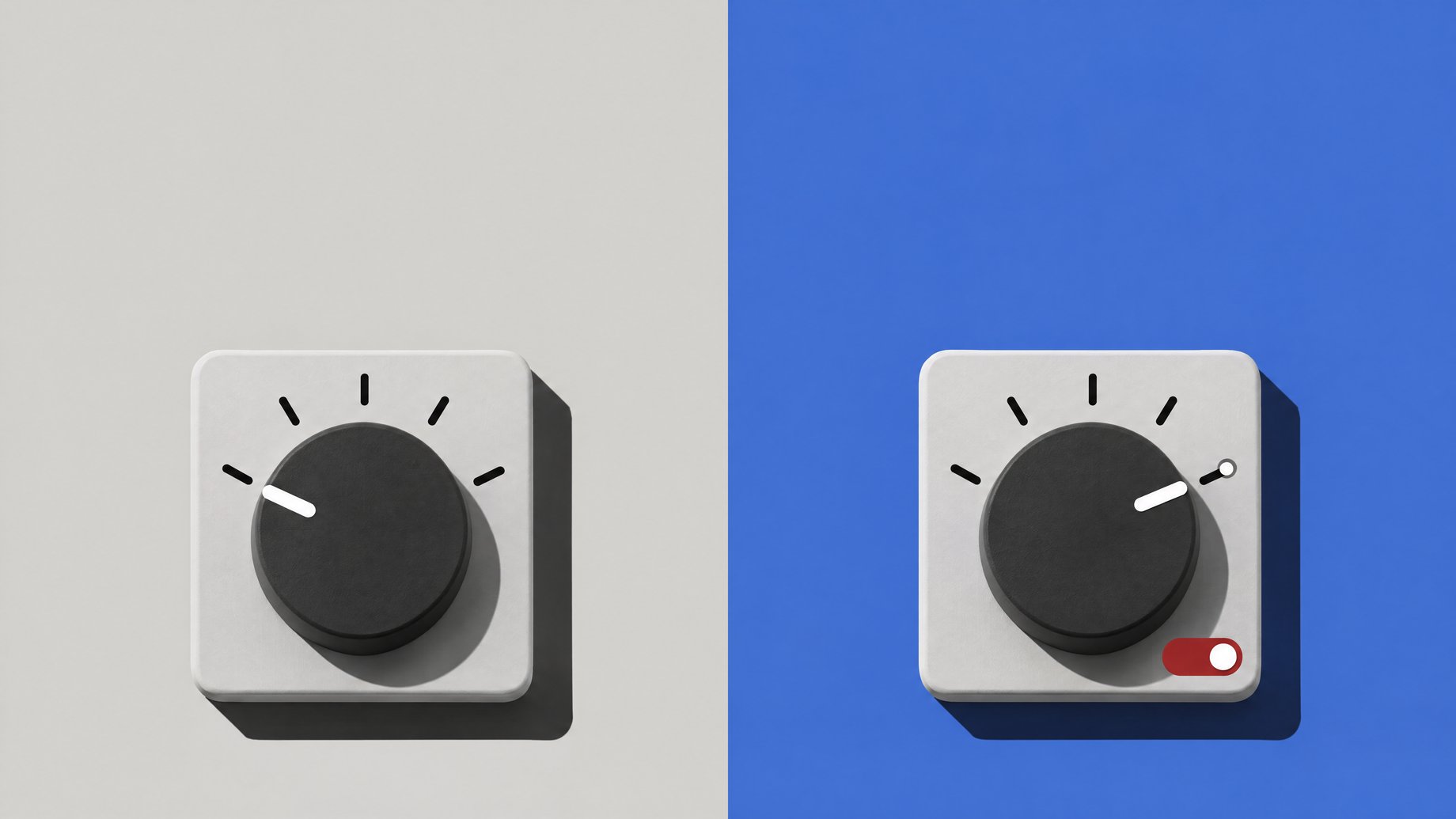
Does the Minico M1 thinking effort dial actually help?
Not in the tests run so far. Minico M1 is a tiny reasoning model with a dial that sets thinking to off, low, medium, high or max. In three small tasks (a two-sentence answer, a text message with strict rules, and a battery puzzle), turning the dial up cost about one to two extra seconds and did not reliably improve the answer. In two of the three tests, the "off" setting did as well or better than any level that thought first. Medium, high and max looked much alike.
TL;DR
- The dial did not earn its keep. Across three tasks, higher effort levels were slower and not clearly more accurate.
- "Off" won the texting test. It was the only low-effort setting that followed every rule (playful, under 20 words, exactly one emoji), and it answered in 0.31 seconds.
- The battery puzzle failed at every level. Every setting answered "yes" when the correct answer was "no."
- Thinking changed the style, not the facts. The influencer voice got stronger with thinking, but the science stayed wrong and the length limit was broken.
- The model is very small. The quantized file is about 229 MB, small enough to run on almost any device.
- These are single runs. The tester used sampling, so a different run could differ. Treat this as a first look, not a benchmark.
What is Minico M1?
Minico M1 is a fine-tune of Liquid AI's LFM 2.5 350M, a language model with about 350 million parameters. (Parameters are the learned numbers inside a model. Frontier chatbots have hundreds of billions of them, so this is tiny.) The feature that drew attention is the effort dial. You pick off, low, medium, high or max, and the model decides how long to reason before it answers.
In the Q4_K_M quantization (a compressed format that shrinks the file), the model is about 229 MB, small enough to run on almost any device. It can run through llama.cpp, a popular tool for running models locally. The tester used a Ubuntu machine with a GPU, but a CPU should also work.
The intended jobs are small and everyday: a voice assistant that turns a spoken request into a tool call, following simple instructions, or running on your own device where privacy matters. It is not meant for deep research, hard math or coding. LFM models are not built for coding.
How was Minico M1 tested?
A creator ran the model locally and gave it the same prompt at each effort level, measuring time and tokens per second (how fast it produces text). The three tests were chosen to match the model's stated purpose: following tight instructions and handling simple everyday reasoning.
One caveat matters. Each test was one run with sampling, which the tester said called for another test, since the model has some randomness. A second run could give different answers. The pattern across all three tests is still informative, but it is not a statistical result.
How did it do on the two-sentence influencer test?
The prompt: explain why the sky is blue in exactly two sentences, as a sarcastic TikTok influencer. This checks both instruction following and basic science.
| Effort level | Time | Tokens | Followed "two sentences"? | Science |
|---|---|---|---|---|
| Off | 0.61 s | 36 | Yes | Wrong ("blue is the only way to see the sun" explains nothing) |
| Low | 1.9 s | 131 | No (four sentences) | Wrong (said blue is the longest wavelength, which is backwards) |
| Medium | about 2.2 s | not reported | No | Wrong (claimed the sun throws off green light) |
| High | about 2 s | not reported | No | Closest: mentioned Rayleigh scattering, but added a nonsensical "purple smudge" line |
| Max | about 2.2 s | 151 | Not reported | Wrong (said the sun emits blue light and the air has a green tint) |
The four thinking levels all landed around two seconds and about 68 to 69 tokens per second. Thinking produced a stronger influencer voice, but only "off" kept to two sentences. None of the levels got the science right, and this is not a hard question.
How did it do on the texting test?
The prompt asked for a reply to a classmate who texted at 11 p.m. suggesting they study together. Rules: playful, under 20 words, exactly one emoji, and not desperate or nervous.
This is where the dial looked worst. "Off" answered in 0.31 seconds with a short, friendly reply, one emoji, well under 20 words. It passed every rule.
Low, medium and high spent time thinking. In their thinking they even wrote down the one-emoji rule, then produced a final reply with no emoji. Low appeared to misread the rule as "no emoji" and left a "[Name]" placeholder in the text, which you could not send. Max did get the emoji right, but the message read more like a study timetable than a flirty text.
So the fastest, simplest setting gave the best reply, and extra thinking cost about a second without improving it.
How did it do on the battery puzzle?
The prompt: a phone has 15% battery, drains 5% every 20 minutes, and boarding starts in 70 minutes. Will the phone survive until boarding? Answer yes or no, then explain in one sentence.
The correct answer is no. At 5% per 20 minutes, 15% divided by 5 is three chunks of 20 minutes, which is 60 minutes. Boarding is 10 minutes later.
Every effort level from off to max said yes. Details:
- Off answered in 0.15 seconds with two tokens. That is why its tokens-per-second figure looks odd.
- Low was the only level where the math showed up in its thinking, and it divided 70 by 20.
- Medium, high and max did not start the math. They restated the question and said yes.
- None gave the one-sentence explanation that was requested.
This is a simple everyday problem, and the extra thinking did not rescue it.
Is the Minico M1 effort dial worth using?
Based on these tests, not as a quality control. The pattern was consistent:
- Thinking made responses slower (roughly 0.15 to 0.6 seconds when off, versus about two seconds when on).
- Thinking did not fix wrong facts.
- Thinking sometimes made instruction following worse, as with the missing emoji and the extra sentences.
- Medium, high and max were hard to tell apart.
There is a likely reason a dial like this struggles at 350 million parameters. Reasoning effort controls how much the model writes before answering, but it cannot add knowledge or reliability the model does not have. More thinking text from a model that misreads the rules just gives it more room to drift from them.
The tester's verdict was blunt: fun little model, but not useful for serious tasks, even on an edge device. That is one person's view from three tests. It is fair to say the model's claimed strength, adjustable reasoning, did not show up here.
What does this mean for you?
If you are curious about local AI: A 229 MB model that runs on ordinary hardware is a neat idea, but size has a cost. Do not expect it to handle facts or logic the way a chatbot you use at work does. Check any answer that matters.
If you are evaluating small models for a business job: Test on your own tasks, not on the marketing claim. The cheap, repeatable way to do this is what the tester did: write three to five realistic prompts with clear pass/fail rules, run each at every setting, and record the time and result. Count rule-following separately from correctness. A reply can sound right and still break the rules.
If the job is a simple, constrained one (turning a spoken request into a tool call, for example): a small model might still fit, but test the "off" setting first. In two of these three tests it was the fastest and no worse than the thinking levels.
Rule of thumb: if a task has a right answer that you cannot easily verify (dates, math, scheduling), do not hand it to a model this small.
Could you build your own model-testing tracker?
If you end up comparing several models, the testing log gets messy fast: prompt, setting, time, pass or fail, notes. A spreadsheet works for a day or two. With Remy, you can describe that tracker in plain English (fields for the prompt, the model and setting, the response, a pass/fail checklist and a timing column) and get a deployed app with a database and sign-in that your team can share. Remy apps can also call a large catalog of AI models without separate API keys, so the same app could run a prompt across several models and store the results side by side.
Frequently Asked Questions
What is the Minico M1 effort dial?
It is a setting with five levels: off, low, medium, high and max. The model decides how long to reason before it answers, with higher levels meant to allow more thinking. In these tests, the thinking levels cost about one to two extra seconds compared with off.
How big is Minico M1 and what hardware does it need?
In the Q4_K_M quantization it is about 229 MB. In the test it ran on an Ubuntu machine with a GPU, and a CPU should also work. It can be run with llama.cpp.
Did any effort level get the battery puzzle right?
No. The correct answer was no, because 15% battery at 5% per 20 minutes lasts 60 minutes and boarding starts in 70. Every level, from off to max, answered yes.
Are these test results reliable?
They are a useful first look, not a benchmark. Each test was a single run with sampling, so results can vary. The consistent pattern across all three tests is the more meaningful signal than any one answer.
What is Minico M1 supposed to be good for?
Small everyday jobs: turning a spoken request into a tool call, following simple instructions, and running on your own device where privacy matters. It is not intended for deep research, hard math or coding.
Useful for
How we source, write, and correct our articles. Editorial standards
Related articles

Live Nerf vs Margin Lab: Do AI Models Really Get Worse?
Why Is Nvidia So Dominant in AI Chips? The CUDA Moat Explained
Do AI Models Get Nerfed After Launch? What Labs Admitted