Can You Run LongCat 2.5 Locally? Size, Hardware, License
LongCat 2.5 is a 1.6T-parameter MoE with 48B active and an MIT license. Here is what running it locally takes and what access options exist.

For IT and Engineering
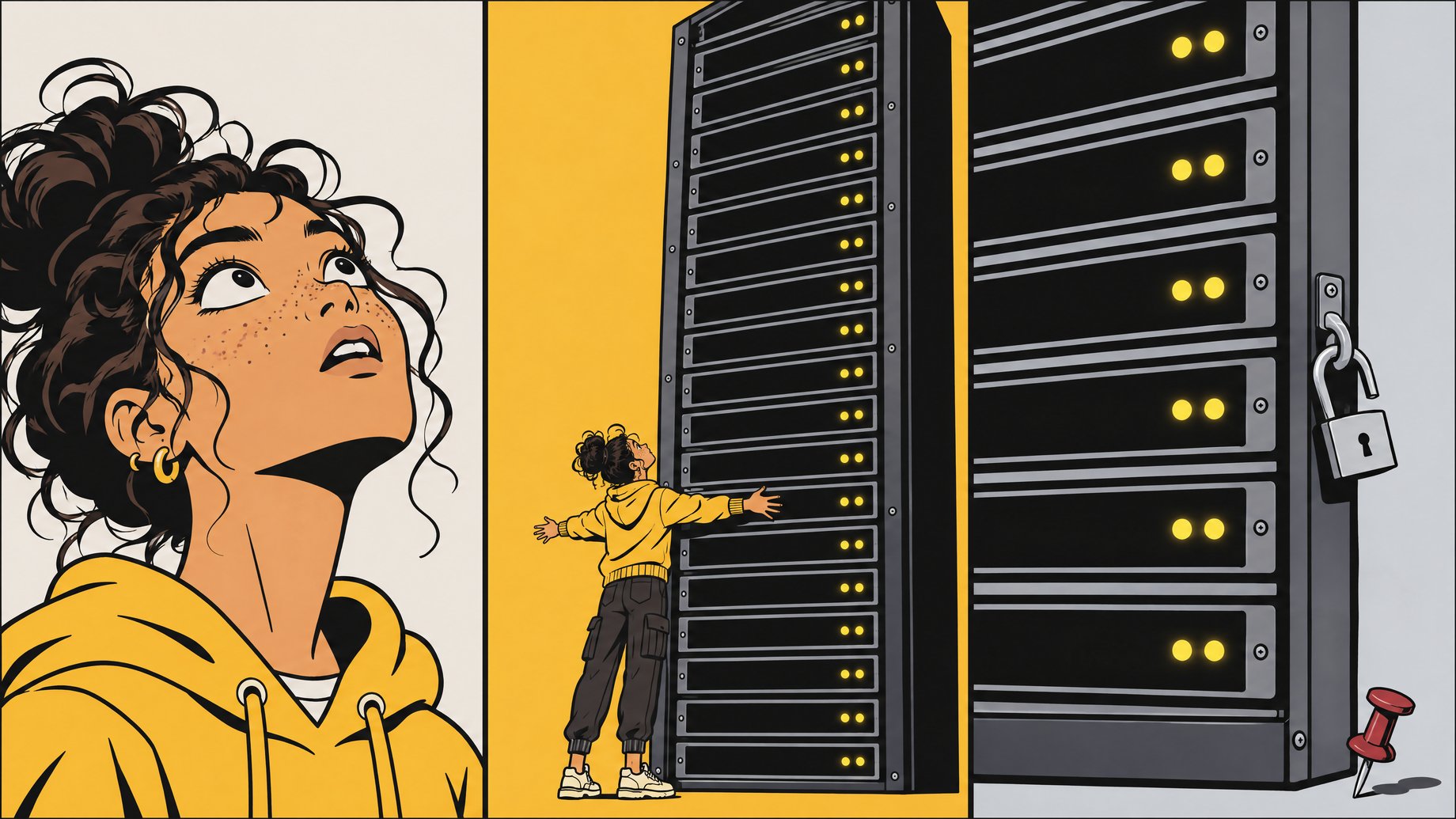
Can you run LongCat 2.5 locally?
Not on a normal computer. LongCat 2.5, from Meituan, has 1.6 trillion parameters in total, and the weights are published openly under an MIT license. But the files are far too large for a laptop or a single gaming GPU. Running it yourself means a server with many data-center GPUs, or renting one. Hosted access from providers has also been limited so far. For most people, the practical route is to read the benchmarks, wait for broader hosting, and test it on your own work before committing.
TL;DR
- LongCat 2.5 is a 1.6 trillion parameter mixture-of-experts model with about 48 billion parameters active per token, and it accepts text and images as input.
- The MIT license is permissive, and the weights are listed on Hugging Face and ModelScope, so legally you can download and run it.
- The practical blocker is memory, not license. Even at aggressive compression, the weights alone run to roughly 800 GB by simple arithmetic.
- "48B active" lowers the compute per token, not the amount of memory you need to hold the model.
- A reviewer who covers this model family reported that hosted access was thin. Even a paid account on a free-access promotion stalled after two prompts.
- Meituan's own benchmark table is mixed against the top closed models, and unstarred scores were measured in-house and are only indicative. Test it on your own tasks first.
What is LongCat 2.5?
LongCat 2.5 is the latest model in Meituan's LongCat family. Meituan is a Chinese company that started as a group-buying site in 2010 and grew into one of China's biggest food delivery and local services platforms.
The model card describes it as a native multimodal mixture-of-experts (MoE) model built for long-horizon agentic tasks. "Agentic" means the model works through a long task in many steps, using tools, rather than answering one question. Meituan points to coding inside a large codebase, building a whole project, creative design, and 3D tasks. It builds on LongCat 2.0.
A mixture-of-experts model is split into many specialist sub-networks ("experts"). For each token (a word or word fragment), the model routes the work to only a few of them. That is how a model can hold 1.6 trillion parameters but use about 48 billion of them at any moment.
It also reads images. According to the technical material, images are converted into discrete tokens at their native size, so a larger image becomes a longer token list instead of being shrunk to a fixed resolution.
How big is LongCat 2.5, and what hardware does that imply?
The model card does not publish a minimum VRAM figure in the material we reviewed. So treat the numbers below as rough arithmetic, not official requirements. The calculation is simple: parameters multiplied by bytes per parameter.
| Weight precision | Bytes per parameter | Approx. weight size | 80 GB GPUs needed (weights only) | 24 GB GPUs needed (weights only) |
|---|---|---|---|---|
| 16-bit | 2 | about 3.2 TB | 40 | about 134 |
| 8-bit | 1 | about 1.6 TB | 20 | about 67 |
| 4-bit | 0.5 | about 0.8 TB | 10 | about 34 |
These counts cover only the weights. Real serving also needs memory for the KV cache (the working memory the model keeps for your conversation), and long agentic sessions make that cache large. So the real requirement is higher.
Two caveats. First, check the model page for which weight format was actually released, because that sets your starting point. Second, a 4-bit version only exists if someone produces one, and compressing a model this size costs some quality. Don't assume a ready-made small version is out there.
You can push part of a model into ordinary system RAM or onto disk. That makes it possible on paper, but it is typically very slow, and an agent that takes dozens of steps per task will feel that slowness at every step.
Doesn't "48B active" make it small enough to run?
No, and this is the most common misunderstanding with MoE models.
The 48 billion figure describes how much computing happens per token. It does not describe how much memory the model needs. Which experts get used changes from token to token, so every expert has to be loaded and ready. You pay for all 1.6 trillion parameters in storage, and only about 3% of them in computation per token.
The upside is speed once the model is loaded. Generation should cost about what a 48B-class model costs, not what a 1.6T dense model would. That makes the model attractive for companies that already run large GPU clusters. It does little for someone with a single workstation.
What does the MIT license let you do?
MIT is one of the most permissive licenses in common use. In general terms, it lets you use, copy, modify and distribute the software, including commercially, as long as you keep the copyright and license notice. It carries no warranty.
For a model this size, that matters in a specific way. You can host it for your own company, fine-tune it, or build a product on it without negotiating terms with Meituan. Read the actual LICENSE file on the model page before you build anything important, and ask your legal team if the use is commercial. But a permissive license is not the same as easy access. The license removes the legal barrier. The hardware barrier remains.
What access options exist if you can't host it?
Here is the realistic list.
- Download the weights. They are listed on Hugging Face (meituan-longcat/LongCat-2.5) and ModelScope. This only helps if you have, or can rent, a multi-GPU server.
- Rent GPUs. Cloud GPU rental by the hour is the usual way for individuals to try a model too big for their own hardware. Price out the number of cards from the table above before you start, because a 10 to 40 card requirement gets expensive quickly.
- Use a hosted API or coding tool. This is where people have struggled. The reviewer behind one hands-on test said API access from providers is very limited. Free access was on offer through the OpenCode coding tool, but even with a paid account he couldn't get past two prompts. That is one person's experience at one point in time, and it may improve as more providers pick the model up.
- Read the technical blog. Meituan published a detailed write-up at longcat.ai/blog/longcat-2.5, including how the vision tokenizer and the agentic training work.
Is LongCat 2.5 worth the effort?
On Meituan's own numbers, it is a big step up from LongCat 2.0 and competitive with other leading models, but not a clear winner. A few examples from the model card's table:
| Benchmark | LongCat 2.5 | LongCat 2.0 | Claude Opus 5 |
|---|---|---|---|
| Terminal Bench v2.1 | 88.4 | 70.8 | 89.1 |
| Terminal Bench v4.0 | 38.5 | 3.0 | 53.9 |
| Program Bench (Almost Resolved) | 25.5 | 2.5 | 37.0 |
| BrowseComp | 91.9 | 79.9 | 90.8 |
It jumps sharply over its predecessor, edges ahead on BrowseComp (a web-browsing research test), and trails clearly on the harder coding tests. Meituan also notes that scores without a star were measured in-house and are only indicative. Scores with a star were cited from public reports or leaderboards.
Hands-on results were less flattering. In one reviewer's tests, a prompt to build a web page simulating a doner kebab from a photo produced something that did not look like one. A second test asked for a political party name in each of 83 languages. The model covered every language and script but mostly translated the same idea instead of inventing culturally grounded names. Two tests prove little, but they are a reminder that benchmark tables and your own tasks can disagree.
What does this mean for you?
If you work in IT or run an engineering team: treat LongCat 2.5 as a model to watch, not to deploy. A self-hosted setup needs a serious GPU budget, and you would need to justify it over simply paying for a hosted model. The MIT license is the reason to keep it on your list, especially if data cannot leave your network.
If you are an individual or a small team: do not buy hardware for this. If you want to try it, wait for a hosted option that works reliably, or rent GPUs for a short experiment with a hard spending cap.
If you are a manager evaluating AI tools: ignore the headline parameter count. Ask what the model does on your real tasks, who hosts it, and what it costs per month. A 1.6T model you can't reach is worth less than a smaller one you can use today.
What you can do now: pick two or three tasks from your actual work, run them through any hosted version that becomes available, and compare results against the model you already use.
What if you want the tool, not the model?
Most people reading about LongCat 2.5 want a result, such as a tracker, a research summary or an internal dashboard, not a model to babysit. If that describes you, Remy lets you describe the app in plain English and builds and deploys it, with access to nearly 400 AI models and no API keys to manage. Remy bills AI tokens at cost, so you can use whichever model fits the job without renting a GPU cluster. That doesn't make LongCat 2.5 available there; it means the tool you needed doesn't have to wait on one model's availability.
Frequently Asked Questions
How many parameters does LongCat 2.5 have?
It has 1.6 trillion parameters in total, with approximately 48 billion activated for each token. It is a mixture-of-experts model, so only a small share of the network does work on any given token.
Can LongCat 2.5 run on a single GPU?
No. Even at 4-bit precision, the weights alone come to roughly 800 GB by simple arithmetic, which is about ten 80 GB data-center GPUs before counting the KV cache. A single consumer GPU, with around 24 GB, is nowhere close.
Is LongCat 2.5 free for commercial use?
The model is released under the MIT license, which is permissive and generally allows commercial use if you keep the license notice. Read the LICENSE file on the model page and check with your legal team for your situation.
Does LongCat 2.5 understand images?
Yes. It takes both text and images as input. According to Meituan's technical material, images are converted into discrete tokens at their native resolution and aligned with text inside one model.
Where can I download LongCat 2.5?
The weights are listed on Hugging Face under meituan-longcat/LongCat-2.5, and on ModelScope. Meituan's technical blog at longcat.ai/blog/longcat-2.5 has the detailed write-up.
Useful for
How we source, write, and correct our articles. Editorial standards
Related articles
OpenBot vs Grok Bot: Which AI Agent Should You Use?
Will an LLM Fit in GPU Memory? Estimate Tokens per Second
HP ZGX Fury Benchmarks: Local LLM Tokens per Second