What Is Traction? Physical AI Monitoring for Industrial Assets
Traction raised a Series D at a $1.4B valuation with over $100M ARR. Here is how its sensors and AI predict failures in industrial machines.

For Engineering and Executives
What is Traction and what does it do?
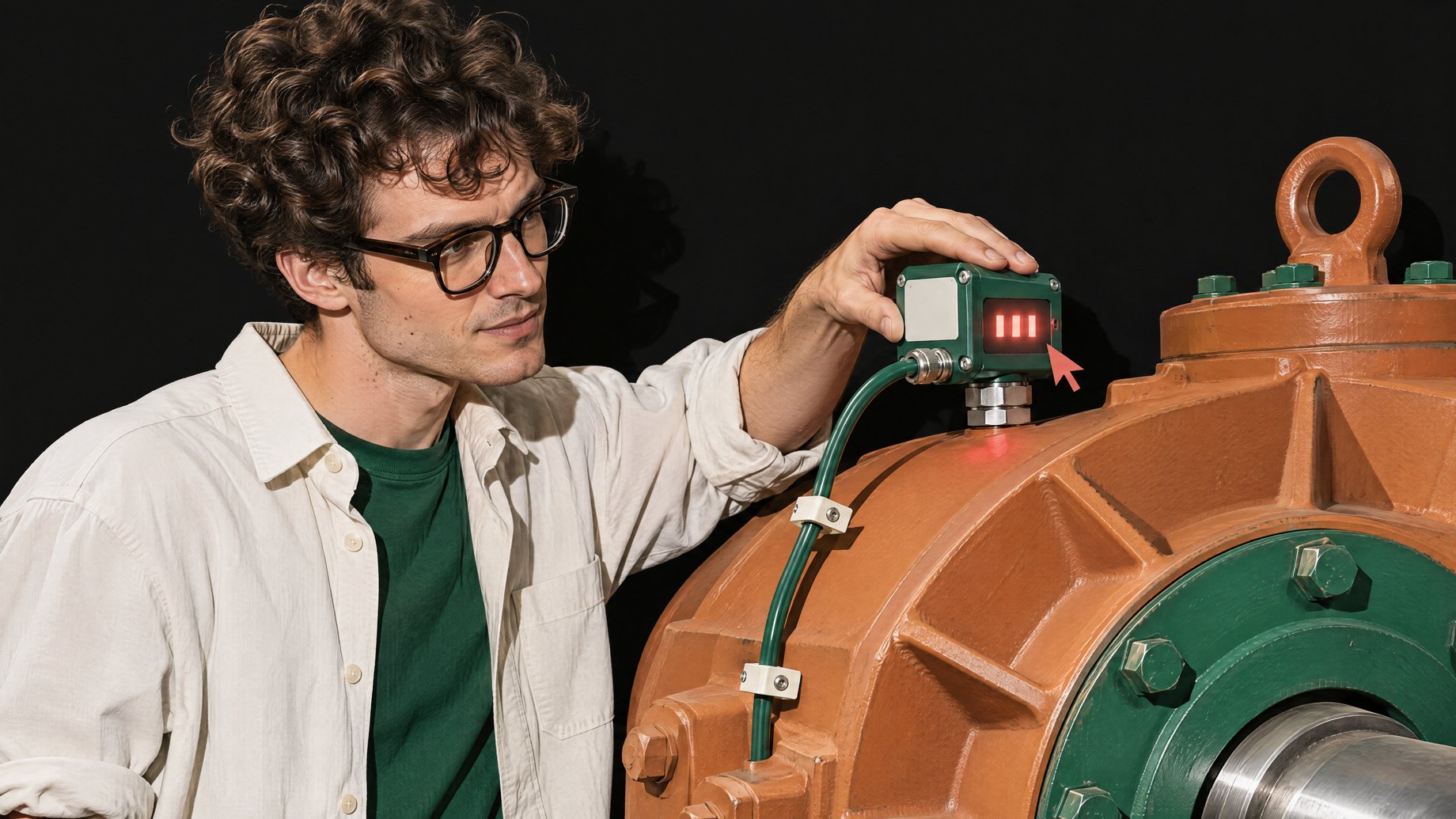
Traction is a startup that builds physical AI for asset-heavy industries. It sells proprietary sensors plus AI software that monitor critical machines such as chillers, HVAC units, compressors and robotic arms, and warn operators before those machines fail. Co-founder and CEO Igor Marinelli describes it as observability for the physical world. The company announced a Series D at a $1.4 billion valuation and says it has passed $100 million in ARR. Customers include Eli Lilly and McKesson.
TL;DR
- Traction targets machine downtime, which its CEO frames as a trillion dollar problem for industrial operators.
- The product is hardware plus software plus AI: non-invasive sensors collect analog data, and models turn it into alerts.
- Sensors cover vibration, ultrasound, magnetic field and current.
- A Shazam-style classifier identifies the machine's condition first, then LLMs with manuals and memory judge how urgent it is.
- The company reports a $1.4B valuation and over $100M ARR with the Series D.
- Sales run on in-person site visits: about 2,500 on-sites last year, according to Marinelli.
What problem is Traction solving?
Machines break, and when they do, production stops. Marinelli cites an estimate that across the 500 largest industrial operations, about 11% of revenue is blocked by asset downtime. He puts the opportunity cost at $1.4 trillion in industrial GDP. That is his figure and an estimate, not an audited number.
The assets in question are often unglamorous. He points to a data center, where power flows from a transformer to battery packs, then through chillers, evaporators and diesel generators. GPU capacity gets the attention, but the cooling and power gear behind it has to stay up. The same logic applies to the HVAC unit in an office ceiling, which Traction could also monitor.
Marinelli says the company aims to guarantee full capacity and availability for the assets it watches. Treat that as a company goal rather than a verified performance claim.
How does Traction's physical AI monitoring work?
The system has three layers: sensors, a condition classifier, and a reasoning layer.
- Sensors. Traction makes its own hardware. Marinelli lists vibration, ultrasound, magnetic field and current sensors. He calls them non-invasive, meaning they attach to equipment without rebuilding it.
- Condition detection. The raw analog signals go to Traction's AI. Marinelli compares this stage to Shazam. Shazam decomposes audio to decide whether you are hearing Metallica or Guns N' Roses. Traction decomposes machine signals to decide what condition the asset is in. He describes this part as having deterministic properties.
- Context and prioritization. Other models then ask how serious the condition is. Should someone go now, or can it wait? Here Traction uses trained LLMs. They draw on the asset's manual, datasheet, and OEM (original equipment manufacturer) documents. They also use a memory layer, because what counts as critical in one factory may not in another.
The output is simple even if the pipeline is not: information ahead of time for the people who run the plant.
What kinds of failures does it catch?
Marinelli groups machine failures into three causes and gave examples from pharmaceutical manufacturing, where a drug like Mounjaro depends on compressed air and palletizer robotic arms along the line.
| Failure type | Example given |
|---|---|
| Mechanical | A robotic arm joint that was not lubricated correctly |
| Electrical | A discharge or surge that burns out a component |
| Operational | An operator kicking a box so a palletizer stops working properly |
He says Traction detects all three categories, and that the mechanical and electrical examples were identified before the failures happened.
Why was this hard to build?
Hardware startups face a different bar than software ones. Marinelli says an MVP does not work here. It has to be a "minimum awesome product," because the team has to build hardware, software and AI before it can even test product-market fit.
Trust is the second barrier. A customer must hand over a critical piece of equipment, and a missed failure is hard to recover from. There is also a chicken-and-egg data problem: the system needs a lot of data to work, and customers want proof before giving access. Marinelli says it took about two years from founding to get the first yes. His first hire was a sales development rep, because the technical founders knew they needed someone selling in parallel with building.
How did Traction start?
Marinelli and co-founder Gabriel started the company in September 2019. Both grew up around heavy industry. Marinelli's father was a plant manager at a paper manufacturing facility. Gabriel's father spent 35 years in a cement factory. Marinelli says his father complained often about the technology available to him.
The founders began with a problem, not a solution. In the first year, Marinelli visited 88 facilities, looking for overlaps across pharmaceutical lines, food and beverage plants and paper production. The team went through Y Combinator in 2021, which he says was the first believer. He described the YC application as the second attempt, made when the company had zero revenue.
Their first customer, a hydraulic pump manufacturing facility, is still a customer.
Why does Traction sell through on-site visits?
Marinelli says Traction ran 2,500 on-sites last year. He argues this is cheaper than marketing once you count rising inbound costs from Google against a rental car, flight and hotel. The visit also does work for the prospect. Traction performs a risk assessment, maps the facility, and identifies which assets need observability and protection. The customer sees a proposal built around their own plant before they sign.
The company also stayed narrow. Marinelli says it resisted adjacent products and focused on classes of equipment. It is sector agnostic in who it sells to, because an HVAC unit is largely the same machine in a home, an office or a factory. It is domain specific in what it monitors.
Is Traction's growth credible?
The reported numbers are large: a $1.4 billion valuation and more than $100 million in ARR. They come from the company's announcement and interview, and the source material here does not include investor names, round size, customer counts or independent verification. The named customers, Eli Lilly and McKesson, suggest enterprise adoption in regulated, high-uptime settings. Beyond that, the claims about downtime reduction are the company's own.
How is this different from software observability?
Software teams already use logs, traces and metrics to see crashes or traffic. Marinelli's pitch is that physical assets lacked an equivalent. The difference is that the data has to be created. Software emits logs by default. A pump or chiller does not, so Traction adds sensors, interprets analog signals, and then layers on documentation and plant-specific memory to decide what matters.
Frequently Asked Questions
What does Traction do?
Traction provides sensors and AI software that monitor industrial equipment and flag problems before they cause downtime. It covers assets such as chillers, HVAC systems, compressors and robotic arms. The idea is observability for physical machines, similar to what logging tools do for software.
How much has Traction raised and what is it valued at?
The company announced a Series D at a $1.4 billion valuation and said it has crossed $100 million in ARR. The source material does not state the round size or the investors, so those details are not covered here.
What sensors does Traction use?
Marinelli listed vibration, ultrasound, magnetic field and current sensors. He described them as proprietary and non-invasive, built to collect data from running equipment.
Who are Traction's customers?
Eli Lilly and McKesson are the two named in the announcement. Marinelli also said the company's first customer, a hydraulic pump manufacturer, still uses it. He gave examples from pharmaceutical manufacturing, food and beverage, and paper production when describing the segments he explored.
Who founded Traction?
Igor Marinelli, the CEO, and his co-founder Gabriel started the company in September 2019. They later joined Y Combinator in 2021.
Useful for
How we source, write, and correct our articles. Editorial standards
Related articles

Meta Muse Ember vs Claude Haiku 5.5 vs GPT-6 Luna: Small Model Comparison
How Good Is Qwen4 Max? Hands-On Tests vs Qwen 3.8

Should You Say Please to AI? Cost, Quality and Habit