What Is Nvidia MotionBricks? AI Motion for Characters & Robots
Nvidia MotionBricks generates game character and Unitree G1 robot motion from a destination and style, trained on about 700 hours of mocap, code released.

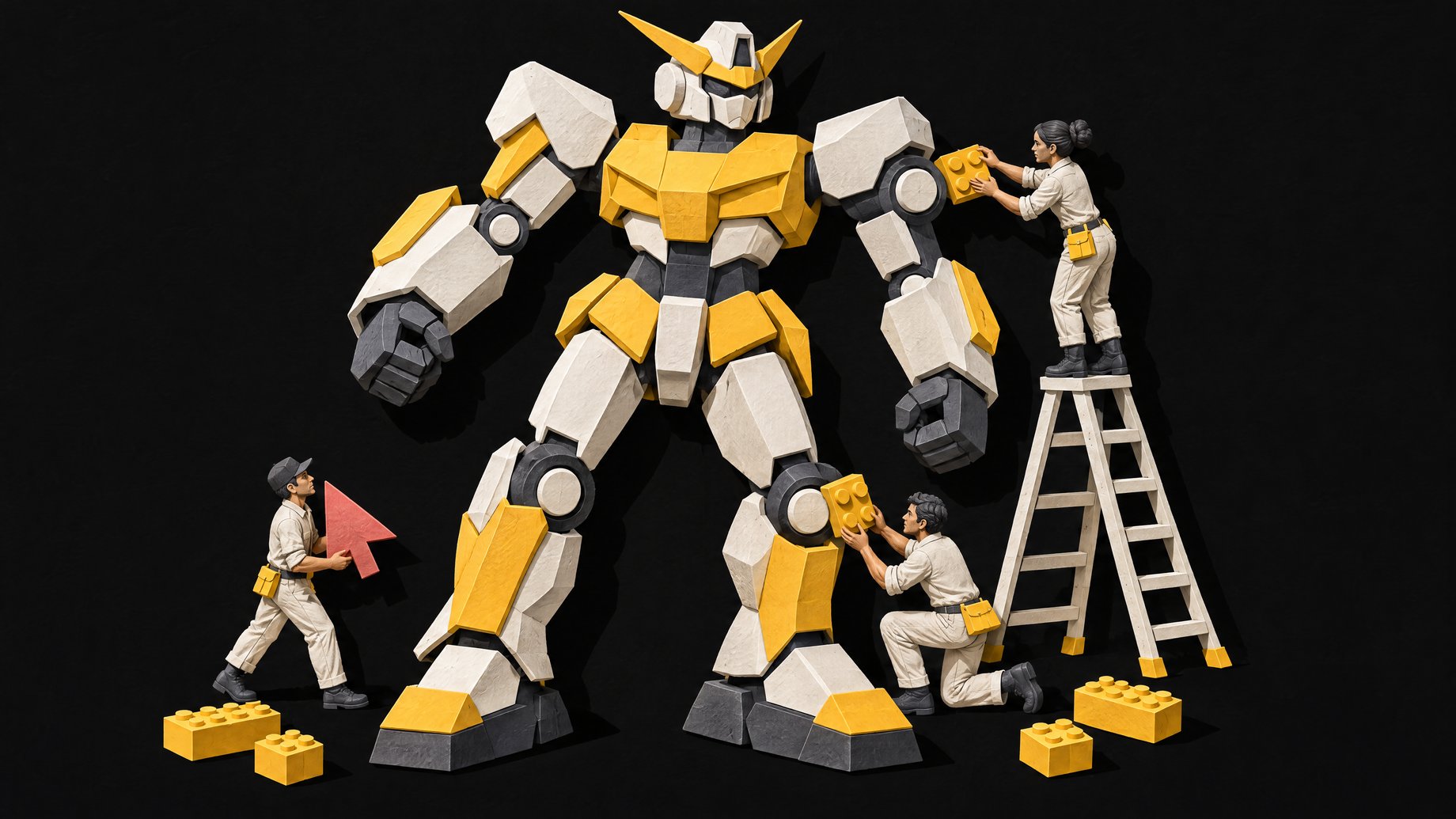
What is Nvidia MotionBricks?
Nvidia MotionBricks is an AI system that generates movement for video game characters and robots on the fly. You tell it where the character should go and what style to use, such as a zombie walk, skipping, or limping, and it produces the motion in between. Nobody hand-animates those moves. Nvidia trained it on roughly 700 hours of real human motion capture, and the code has been released.
TL;DR
- MotionBricks generates motion at runtime from a target location and a style, instead of playing back pre-made animation clips.
- Styles shown in the demo include zombie walks, skipping, and limping, all without per-move hand animation.
- The same system also drives a Unitree G1 humanoid robot, which moved around an office and dropped to all fours to crawl.
- It learned from about 700 hours of motion capture of real people.
- Output varies between runs. In one demo, a character grabbed a sword slightly differently each time.
- The code is public, so developers can test it themselves rather than wait for a product.
Why does game animation need something like this?
Games usually rely on a library of authored animation clips. An animator or a mocap session produces each move: walk, turn, vault, pick up an item, limp, crouch. Then a state machine or blending system decides which clip plays and how clips transition.
That library gets huge. The creator who covered the release pointed to big open-world games like Assassin's Creed as examples where the move count can reach something like 15,000. That figure is a rough claim from the demo coverage, not an audited number, but the broader point holds. Every new style, prop, or terrain interaction multiplies the content someone must author, clean up, and wire together.
MotionBricks targets that bottleneck. If a model can produce plausible motion from a goal and a style tag, the animation team spends less time on coverage and more time on the moves that define a character.
How does MotionBricks animate a character?
From what has been shown, the interface is simple. You supply two things:
- A destination. Where the character or robot should end up.
- A style. How it should move there, for example a zombie shuffle, a skip, or a limp.
The model fills in everything between those inputs. That includes the stepping pattern, body posture, and transitions. It does not replay a stored clip for each case. It generates the motion, which is why the sword pickup looked a little different every time.
I do not have the architecture details, model size, or runtime numbers from a primary source, so I will not guess at them. The released code and any accompanying paper are the right place to check how the generation works, what hardware it needs, and how fast it runs.
What was MotionBricks trained on?
The training data is about 700 hours of real motion capture of humans performing a range of motions. Motion capture records the movement of actual performers, usually with markers and cameras, and converts it into skeletal animation data.
This matters for two reasons.
- Realism comes from human data. The model's output is grounded in how people actually move, which is why styles like limping or crawling can look believable.
- Coverage depends on the dataset. A model can only imitate what its data contains. Styles and actions that are rare or absent in 700 hours of mocap are likely to be weaker. That is a general property of learned motion models, and it is worth testing on your own use case.
Does it work on real robots?
Yes, according to the demo. Nvidia is using the same system on a Unitree G1, a humanoid robot. In the footage, the robot moves around an office and then gets down on all fours and crawls across the floor.
That detail is the most interesting part. Game characters and humanoid robots both need a stream of body motion that goes from point A to point B in a chosen manner. Using one motion system for both suggests the human mocap data transfers across very different bodies and purposes.
A caution applies. A game character lives in a simulation with forgiving physics. A robot has to handle balance, contact, and hardware limits. The demo shows it working, but I have no source detail on how much robot-specific control sits underneath, or how often it fails. Treat the clip as a proof of concept, not a statement about reliability.
How is this different from traditional animation tools?
| Approach | How motion is made | Main cost |
|---|---|---|
| Hand-authored clips | Animators or mocap sessions produce each move | Content volume grows with every new move and style |
| State machines and blending | Pre-made clips are chosen and blended by rules | Engineering effort to wire up transitions |
| MotionBricks | Motion is generated from a destination and style | Training data and compute, plus validating output quality |
The table simplifies things. Studios already mix these methods, and a generative system could sit alongside existing pipelines rather than replace them. The clearest immediate win is filling gaps: varied locomotion styles and small interaction differences that would be tedious to author one by one.
Who can use MotionBricks today?
The code is out and available. That makes it relevant to a few groups:
- Game developers who want to prototype stylized locomotion without commissioning a full clip library.
- Robotics researchers working with humanoids like the Unitree G1 who need human-like motion sources.
- Animation tool builders exploring generated motion as a layer in a pipeline.
Before building on it, check the repository for the license, the setup requirements, the supported character rigs, and any robot-specific components. Those details decide whether it fits a commercial game or only research work, and I do not have them from a primary source.
What should you watch for?
- Variation cuts both ways. Slightly different motion each time feels organic, but it can complicate gameplay that needs precise, repeatable timing, such as combat or cinematics.
- Art direction. A signature character often needs deliberate, authored motion. A general model trained on human mocap may produce natural movement but not distinctive movement.
- Evaluation. Demo reels show best cases. Run your own tests on edge cases like tight spaces, uneven ground, and rapid style changes.
- Open-world fit. The creator expects to see this in upcoming open-world games. That is speculation, not an announcement, and no studio adoption was stated.
Frequently Asked Questions
Is Nvidia MotionBricks open source?
The code has been released and is available to use. The source material does not specify the license terms, so read the license in the repository before using it in a commercial project.
Does MotionBricks replace animators?
Nothing in the demo suggests that. It removes the need to hand-animate every individual move, but animators still shape style, review output, and craft signature motion. It looks most useful for covering the large volume of routine movement.
What robot does MotionBricks run on?
The demonstrated robot is the Unitree G1, a humanoid. It was shown walking around an office and crawling on all fours. Other robots were not mentioned in the source.
How much data was it trained on?
About 700 hours of real human motion capture. The sources do not give model size, training compute, or breakdown by motion type.
Can I give it any style I want?
The demo showed styles like zombie walks, skipping, and limping. How flexible the style system is, and whether you can add new styles, is not covered in the source. The released code is where to confirm that.
Useful for
How we source, write, and correct our articles. Editorial standards
Related articles
GPT Image 2.6 Pricing: Sunburst vs Flare, Which to Use?
How Is an AI Film Made? The Planet Hell Production Workflow
What's New in OpenAI Images 2.6? GIFs, Edits and Speed Tested