Is the AI Bubble Real? Nvidia's Avalanche Worry Explained
The WSJ reports Jensen Huang feared an "avalanche" of chip and memory commitments. Here is how cheaper tokens and flat spending shape the AI build-out debate.

For Executives, Finance and Engineering
Is the AI bubble real?
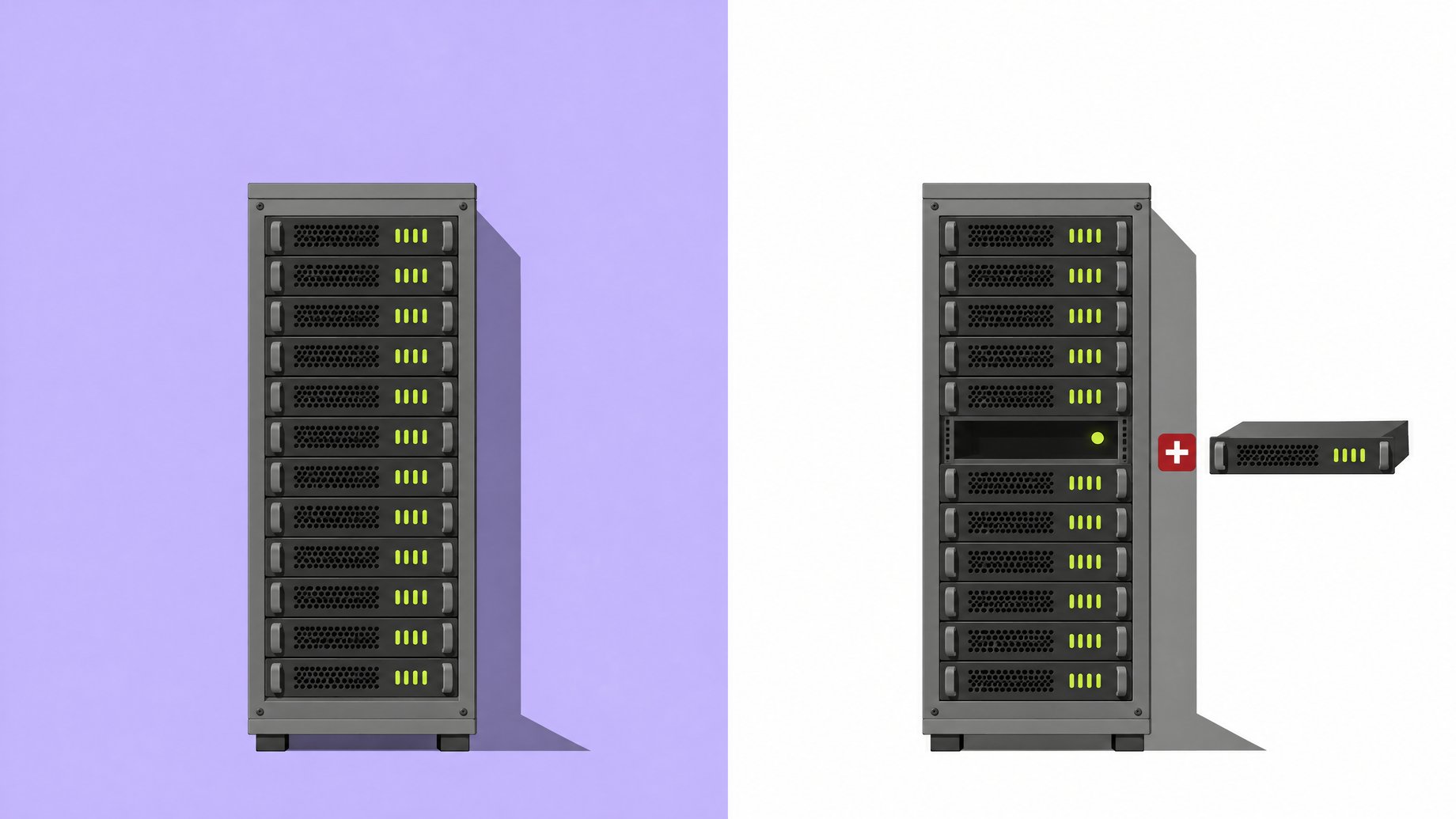
Nobody can say yet, and the evidence points two ways. Demand for AI is large and still rising. But the Wall Street Journal reports that Nvidia CEO Jensen Huang worried internally about an "avalanche" of chip wafer and memory commitments, while data from the spend-management company Ramp shows business token spending barely grew in August and September. If customers use far more AI but pay far less per unit, the companies that financed the build-out may not earn what they planned.
TL;DR
- The WSJ reports that in an August meeting about Nvidia's financial support for prospective customers, Huang worried about commitments piling up and cloud providers looking at alternative chips.
- Ramp's data showed virtually no growth in business token spending across August and September, with the second month up less than 2%.
- Customers are learning to move routine work to cheaper models, so token usage can climb while the bill stays flat.
- This is not proof of overbuilding. Token demand is still growing, but the profitability of individual data centers is not public.
- The most expensive frontier models still take roughly 70% of the spend Ramp can see, and gained share in October.
- At the next Nvidia earnings call, the useful questions are about order books, demand and financing, not just the quarterly numbers.
What did the WSJ report about Nvidia and the "avalanche"?
The Wall Street Journal described an August meeting about Nvidia's financial support for prospective customers. Huang was reportedly worried about commitments piling up, and about major cloud providers looking at alternative chips as a result.
The "avalanche" comment concerned supply Nvidia had already committed to buy: chip wafers and memory. Nvidia buys these ahead of time so it has chips and capacity to sell to data centers. If the customers on the other end can't or won't pay enough, Nvidia is left holding the commitments.
It was already well known that Nvidia has been deeply involved in financing the AI build-out. What the report adds is concern inside Nvidia about how those commitments were developing and what exposure they could create over time.
This is a report of internal worry, not a confession of trouble. It tells us a person who sees the order book up close was thinking about the risk.
Why does it matter that customers are trading down to cheaper models?
AI companies have ordered computing capacity years in advance. Their customers, meanwhile, are getting better at buying intelligence efficiently.
Here is the pattern. A company tries a cheaper model on a routine task. It works well enough, so the company keeps using it. Then it sets defaults that steer employees toward cheaper models. Ramp reports that businesses describe exactly this.
Take a customer who moves routine work to a cheaper model from the same lab. The lab keeps the customer. Token usage goes way up. The bill barely moves.
The arithmetic is simple. Suppose a business uses twice or four times as much AI but pays half or a quarter as much per unit:
| Usage | Price per unit | Total bill |
|---|---|---|
| 1x | 1x | 1x |
| 2x | 0.5x | 1x |
| 4x | 0.25x | 1x |
The provider serves far more requests and collects no extra dollar. Demand "grew astonishingly quickly" and the people who financed the equipment still got nothing extra.
What does Ramp's data actually show?
Ramp tracks AI spending by businesses, and its data points in a few directions.
- Flat recent months. Token spending showed virtually no growth across August and September. Two nearly flat months, followed by a rise of less than 2%, is slow. A build-out on the scale the labs describe would need something closer to a tenfold increase.
- Noisy numbers. Ramp's monthly figures bounce around. Some months show 30 to 40% growth, others are flat. Two soft months are not a trend by themselves.
- Expensive models still win share. In October, the most expensive models gained share of spending. That helps their suppliers, but it doesn't mean the overall market is growing fast enough to carry the capacity.
- Frontier models still dominate dollars. The most expensive new frontier models make up roughly 70% of the spend Ramp can identify.
- AI is spreading beyond engineering. Among spending Ramp can attribute to a department, customer success and support went from under 1% of AI spend in June to more than 13% in October.
That last point matters. A support question like "where is my shipment?" needs the right order record and a correct status. It does not need deep reasoning. That kind of work can grow a lot while using cheap models, and the overall bill stays about the same.
How are cheaper models showing up in real tools?
Google gave customers another way to trade down this month. It released two new Gemini models, one aimed at difficult reasoning and one built for faster execution. In its Antigravity software, a feature called Orchestrator switches between them automatically during a task.
Think of a coding job. You want a very capable model to work out why something is broken and plan the fix. Once the plan exists, you hand much of the remaining work to a cheaper, faster model.
In Google's own testing, Orchestrator came very close to the stronger model's success rate while using 24% less quota and finishing 19% faster. The creator who discussed this also cited open source models reaching 80 to 90% lower cost, or more, with equivalent results and faster finishes. Treat that as an anecdotal claim, not a benchmark.
For anyone buying tokens, this is good news. More work fits inside the same allowance, and the bill stays flat or drops. For anyone who sold the capacity in advance, it is a pressure point.
Is this the dot-com bubble all over again?
The source material is careful here, and so should you be. Unlike the dot-com era, token demand is still skyrocketing. Nothing so far shows the industry has overbuilt.
The real question is whether the capacity being ordered matches what businesses will be willing to pay over time. Whether a given data center earns its money back depends on three things:
- How much it can charge.
- How much business it wins.
- What it cost to build.
Those numbers are proprietary and differ by data center. A cheap model can be a good business if it is cheap enough to run. A busy data center can be a bad investment if the price doesn't cover costs. Better hardware and more efficient models are lowering provider costs too, which is part of why cheaper service is possible at all.
So we don't know the margins, we don't know where the triggers and guarantees sit in the financing, and we don't know whether new data centers cover their costs. Anyone claiming certainty either way is guessing.
The bigger macro question is whether businesses see a clear return. The creator's view is that the economy is still underallocated to AI, but that most businesses will stall at a small fraction of revenue (he cited 0.1 to 0.4%) until they see that return.
What should you watch at the next Nvidia earnings call?
Quarterly results are the least interesting part. Look for answers to these:
- Order book. Is a bigger one on the horizon?
- Demand. Is there secure growth in customer demand, not just announced plans?
- Financing. How are Nvidia's commitments and its support for customers developing, and is the financing secure?
- Alternative chips. Are major cloud providers shifting orders elsewhere?
- Export controls. A bipartisan push backed by Anthropic and OpenAI would further restrict chip exports to China. One proposal, the Chip Security Act, would require location verification for advanced chips covered by export controls. Tighter rules could change how Nvidia's sales work, especially through routes where Chinese firms can rent compute.
What does this mean for you?
If you buy AI at work, you have the upper hand. The market is rewarding customers who match the model to the task. Try a cheaper model on routine steps such as summaries, status lookups and first drafts. Keep the expensive one for hard reasoning. Compare results on your own work, not on leaderboard scores.
If you manage a budget, set defaults. Ramp reports businesses steering employees toward cheaper models, and that is where savings come from. Track spend by team and task, not just by vendor.
If you invest or your employer's plans depend on AI vendors, watch spending data, not usage data. Usage is rising. Spending is the number that pays for data centers. Also expect prices to keep falling, and don't build a plan that assumes today's per-token price.
If you worry about a crash, keep the scale in mind. A shaky financing story for chipmakers and labs is a different thing from AI tools becoming less useful to you.
Can you build a tool to track your own AI spend?
Yes, and it is a sensible small project. A simple internal log of which model each team uses for which task, what it costs and whether the result was good enough would show you where trading down is safe. Remy builds full-stack business apps from a plain-English description, so you could describe that tracker, along with a request form for approving pricier models, instead of juggling spreadsheets. Remy lets you choose which model each of its agents uses, and it bills AI tokens at cost with no markup, so the same trade-down logic applies to the tool itself.
Frequently Asked Questions
Did Nvidia say there is an AI bubble?
No. The WSJ reported that Jensen Huang voiced concern internally in August about commitments for chip wafers and memory piling up, described as an "avalanche." That is reported worry about exposure, not a statement that the industry is in a bubble.
If token usage is booming, why would revenue be flat?
Because price per token is falling and customers are shifting work to cheaper models. A business that uses four times as much AI at a quarter of the price per unit pays the same bill. Usage grows, and revenue doesn't.
Is Ramp's data reliable for judging the AI economy?
It is a useful signal but a limited one. Ramp tracks business AI spending, and its monthly figures swing a lot, from flat months to 30 to 40% growth. Two flat months are a reason to keep watching, not a verdict.
Are the most expensive AI models losing customers?
Not according to the Ramp data discussed here. The most expensive models gained spending share in October and make up roughly 70% of identifiable spend. The concern is whether that market grows fast enough compared with the capacity being built around it.
Do we know whether AI data centers are profitable?
No. Margins, financing triggers and guarantees are mostly proprietary and vary by site. That is why the debate rests on indirect evidence like spending data and reports about company concerns.
How we source, write, and correct our articles. Editorial standards
Related articles

Anthropic IPO Explained: ANT Ticker, $81B Raise, Lockup Dates

Ling 3.2 Flash Review: Does 200 Images in One Prompt Work?

Will AI Token Usage Grow 1,000x? Agents and Budgeting