How to Run AI Models Locally for Enterprise: The New Local Stack
Past a modest usage threshold, a local router paired with small open-weight models turns AI from a metered rental into owned infrastructure, cutting cloud spend and closing the gap that shadow AI fills.

- 01Small, specialized open-weight models matching large-model performance run 10 to 30 times cheaper.
- 02Heavy usage of over 2M tokens daily pays off local hardware investments within 12 months.
- 03A router solves the cost-quality tradeoff per request, sending only hard tasks to cloud APIs.
- 04Sanctioned local models eliminate the shadow AI risks created when employees bypass IT.
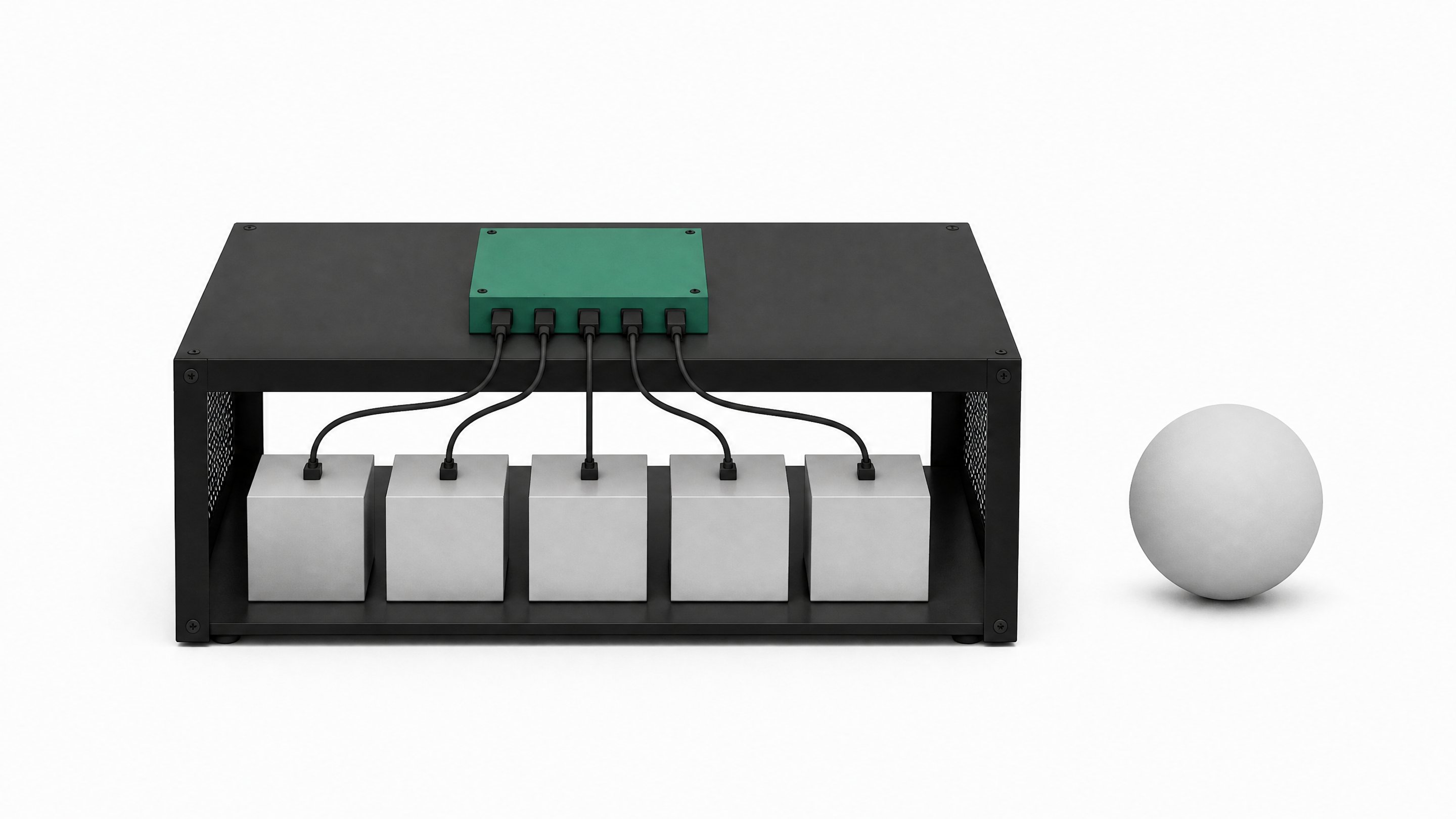
Running AI locally for enterprise use means putting a lightweight router in front of small, open-weight models on hardware you own, and reserving expensive frontier API calls for the queries that actually need them. Below a certain volume, cloud APIs still win. Above it, the math flips, and fast.
Why "just call the API" became the expensive default
Most companies didn't choose their AI architecture. They defaulted into it. Someone wired an app to the OpenAI or Anthropic API, usage grew, and now there's a five- or six-figure monthly line item nobody sized in advance.
That default is about to get more expensive at scale. Gartner forecasts worldwide AI spending will hit $2.52 trillion in 2026, a 44% jump from 2025, with AI infrastructure alone accounting for roughly $1.37 trillion of that.1 Enterprises aren't slowing down either: 72% plan to increase LLM spending this year, and nearly 40% already spend more than $250,000 annually on LLMs.2
Here's the part that should bother a finance person more than the top-line number: 44% of IT leaders, developers, and engineers cite data privacy and security as the single biggest barrier to LLM adoption.2 Companies are spending more on a technology whose primary risk they haven't solved. Every prompt sent to a third-party API is a data governance decision made by default, not by design.
The fix isn't abandoning AI. It's changing where the inference happens.
What does "the local stack" actually mean?
Skip the image of a server room full of racks. For most enterprises, the local stack is two components:
- A router. A lightweight classifier that looks at each incoming request and decides where it should go: a small local model, or an expensive frontier API.
- One or more small, task-specialized models. Open-weight models in the 1B-10B parameter range, run on hardware the company owns, handling the bulk of routine agentic work.
The frontier API doesn't disappear. It becomes the overflow valve, called only when a query is genuinely hard or ambiguous. Everything else, the classification tasks, the tool calls, the structured extraction, the chit-chat, gets handled locally at a fraction of the cost. This is the same pattern our practical guide to local AI workflows lays out for individual developers, just scaled to enterprise volume and governance requirements.
How small models got good enough to replace the default LLM call
The case against small models used to be simple: they're worse. That case is out of date.
Microsoft's Phi-2, a 2.7B parameter model, matches the commonsense-reasoning and code-generation scores of 30B models while running roughly 15x faster.3 NVIDIA's Hymba-1.5B beats 13B-parameter models on instruction accuracy while delivering 3.5x greater token throughput than comparably sized transformers.4 These aren't cherry-picked demos. They're the basis of a research position, backed by NVIDIA and Georgia Tech, arguing that small language models are the practical default for agentic AI, with large frontier models reserved for genuinely hard reasoning.3
The economics back it up directly: serving a 7B-class model is estimated to be 10 to 30 times cheaper than serving a 70-175B model, across latency, energy, and FLOPs.3 For the narrow, repetitive subtasks that make up most of what agentic workflows actually do, a small model isn't a compromise. It's the right tool.
Step 1: Audit your token volume before you buy anything
Don't buy hardware first. Buy data first.
Pull your actual usage: tokens per day, not requests per day, broken out by task type if you can. This number determines whether local infrastructure pays for itself, and over what horizon.
SitePoint's total-cost-of-ownership analysis puts rough break-even points at:
- Light usage (under ~1M tokens/day): Cloud APIs remain cheaper. Don't bother with local hardware yet.
- Medium usage (3-5M tokens/day): Local deployment breaks even against proprietary API pricing in 18 to 24 months.5
- Heavy usage (2-3M tokens/day sustained, scaling toward 15-20M+ against hosted open-weight APIs): Local hardware pays for itself within 12 months.5
Get this number before you evaluate hardware. It tells you which tier you're shopping in, and whether you're shopping at all.
Step 2: Match hardware and serving software to your tier
Once you know your volume, the hardware decision is mostly mechanical.
- Light, single-user experimentation: A consumer-grade desktop with a high-end GPU, roughly $3,350 at MSRP for an RTX 5090 build, runs Ollama comfortably for prototyping and low-concurrency internal tools.5
- Medium, small-team production: A Mac Studio with unified memory or a single-server multi-GPU box, still running Ollama for simplicity or moving to vLLM once concurrent requests climb.
- Heavy, department- or company-wide deployment: Multi-GPU servers running vLLM, which is built for concurrent production traffic in a way Ollama isn't optimized for.
| Token volume | Hardware | Serving software | Break-even timeline | |
|---|---|---|---|---|
| Light usagesingle-user experimentation | <1M tokens/day | Consumer GPU desktop (~$3,350 RTX 5090 build) | Ollama | Stay on cloud APIs |
| Medium usagesmall-team production | 3-5M tokens/day | Mac Studio or single multi-GPU server | Ollama or vLLM | 18-24 months |
| RecommendedHeavy usagedepartment- or company-wide deployment | 2-3M+ tokens/day, scaling to 15-20M+ | Multi-GPU servers | vLLM | Within 12 months |
Ollama has become the default entry point for a reason. It's raised $65M in Series B funding, taking total funding to $88M, and now reaches nearly 9 million developers on the bet that open models will handle most of the world's AI work and organizations will want to own that infrastructure rather than rent it.6 For a deeper look at how the hardware math actually shakes out against a metered API bill, see our breakdown of Mac Studio versus cloud API costs for local AI agents.
Step 3: Put a router in front of your models
This is the step most local-AI writeups skip, and it's the one that makes the whole architecture work.
Without a router, you're stuck choosing one model for everything, either overpaying for a frontier model on simple tasks or underserving hard ones with a small model. A router solves this per-request.
NVIDIA's open-source LLM Router blueprint demonstrates the pattern well: a request like "Hello, how are you?" gets classified as chit-chat and routed to a small model like Nemotron-Nano-9B, while "solve this complex math problem" gets flagged as a hard question and escalated to a frontier model like GPT-5.7 The router can use simple intent classification or a learned model that predicts cost-quality-latency tradeoffs directly.
This is where a genuinely local-first router earns its place in the stack. Remy is built around exactly this idea: keep the decision layer on infrastructure you control, so the routing logic and the audit trail stay off someone else's cloud account. Whether you build this classification layer yourself or adopt an existing one, the principle holds: the router, not the model, is what turns a pile of small models into a coherent, cost-aware system. Teams building this kind of routed setup around coding agents specifically should look at our guide to self-hosting AI coding agents.
Step 4: Lock down data residency and starve out shadow AI
Cost isn't the only reason to go local. Governance is arguably the bigger one.
More than half of employees report using personal AI tools without approval, and two-thirds of U.S.-based employees use unsanctioned AI in some form.8 The consequences aren't hypothetical: 58% of executives said their organization had an AI-related security incident or a close call in the past year.8
Shadow AI isn't malicious. It's a response to a gap. When there's no sanctioned tool fast enough or capable enough for the job at hand, employees find their own. Security researchers tracking the trend consistently find that unauthorized tool usage drops sharply when organizations proactively provision approved alternatives instead of just banning personal AI outright.8
A sanctioned local model removes the incentive to go around IT in the first place: it's fast because it runs on infrastructure the company controls, without the latency or cost penalty of a metered API call. This is doubly true in regulated industries. Firms handling PHI or financial data increasingly deploy air-gapped, on-premise LLM stacks specifically because that data cannot be transmitted to a third-party model provider under any circumstance.9
How much does local AI actually cost over 12 to 36 months?
The numbers, not the narrative, are what should move a budget decision.
At heavy usage, roughly 50M tokens/day, local enterprise hardware reaches an effective cost of $7.15 per million tokens over a 36-month horizon, against $6.90-$9.86 per million tokens for OpenAI and Anthropic's proprietary APIs.5 That's competitive on cost alone even before factoring in data control.
A hybrid approach, local models handling the baseline load with cloud APIs covering overflow, saves an estimated $70,000 or more per year compared to running everything through OpenAI at that same 50M-token volume.5 This is the practical version of the architecture described in The $13B Reason You Should Run Local AI Models: own the baseline, rent the exception.
Below that volume, the math doesn't hold. Light usage under roughly 1M tokens/day should stay on cloud APIs; the hardware and operational overhead of a local stack won't pay back fast enough to matter.
When should you not go local?
This isn't a universal prescription. Skip the local stack, at least for now, if:
- You're pre-product-market-fit. Usage patterns will change too fast for a hardware investment to make sense.
- Your volume is genuinely low. Under roughly 500K tokens/day, the API bill is smaller than the engineering time it would take to stand up and maintain local infrastructure.
- You need frontier-only capability. Some reasoning tasks still require a model at the Claude Opus tier that no small open-weight model matches yet. Route those, don't force them local.
None of this contradicts the case for local infrastructure. It sharpens it. The decision isn't "local versus cloud" as an ideology. It's a threshold, and once you cross it, the recurring bill stops making sense.
The bottom line
Treat inference the way you'd treat any other piece of infrastructure: something you evaluate for depreciation and utilization, not something you rent indefinitely because switching felt hard. A router paired with small, specialized open-weight models turns AI spend from a variable line item that grows with usage into a fixed asset that gets cheaper per token the more you run through it. Past the break-even point, that's not a philosophical preference. It's just the better spreadsheet.
Roughly 2-3M tokens/day sustained gives a 12-month break-even against proprietary API pricing, and 3-5M tokens/day breaks even in 18-24 months. Below about 1M tokens/day, cloud APIs remain cheaper and simpler.
It scales with usage. Light workloads run fine on a single high-end GPU desktop (around $3,350 for an RTX 5090 build) using Ollama. Medium workloads move to a Mac Studio or single multi-GPU server. Heavy, concurrent production workloads need multi-GPU servers running vLLM.
On narrow agentic tasks, yes. Microsoft's Phi-2 (2.7B) matches 30B-model scores on reasoning and code generation while running about 15x faster, and NVIDIA's Hymba-1.5B beats 13B models on instruction accuracy. Frontier models still lead on the hardest, most ambiguous reasoning tasks, which is why a router escalates only those.
Shadow AI usually shows up because employees lack a fast, sanctioned tool for the job. More than half of employees use unapproved AI tools today. Providing an in-house, low-latency local model removes the reason to go around IT, and organizations that proactively provision approved tools see unauthorized usage drop sharply.
Yes. Pre-product-market-fit teams, workloads under roughly 500K tokens/day, and tasks that require frontier-only reasoning capability are all better served staying on cloud APIs, at least for that portion of the workload.
- 1Gartner Says Worldwide AI Spending Will Total $2.5 Trillion in 2026Gartner
- 2From Adoption To Advantage: 10 Trends Shaping Enterprise LLMs In 2025Forbes
- 3Small Language Models are the Future of Agentic AIarXiv (NVIDIA Research / Georgia Tech)
- 4Small Language Models are the Future of Agentic AI (alphaXiv)alphaXiv
- 5Local LLMs vs Cloud APIs: 2026 Total Cost of Ownership AnalysisSitePoint
- 6Ollama raises $65M as its open-model runner hits nearly 9M developersTNW (The Next Web)
- 7GitHub - NVIDIA-AI-Blueprints/llm-router: Route LLM requests to the best modelNVIDIA (GitHub)
- 8Enterprise data is creeping its way into shadow AI toolsCIO Dive
- 9Private & Local LLM Deployment - AR DataAR Data Intelligence Solutions