Are AI Cyber Models Behind the Bank and Airline Outages?
A YouTuber ties Microsoft, airline and bank outages to an open-weight AI model. Here is what is claimed, what is confirmed, and what to do about it.

For Security, IT and Executives
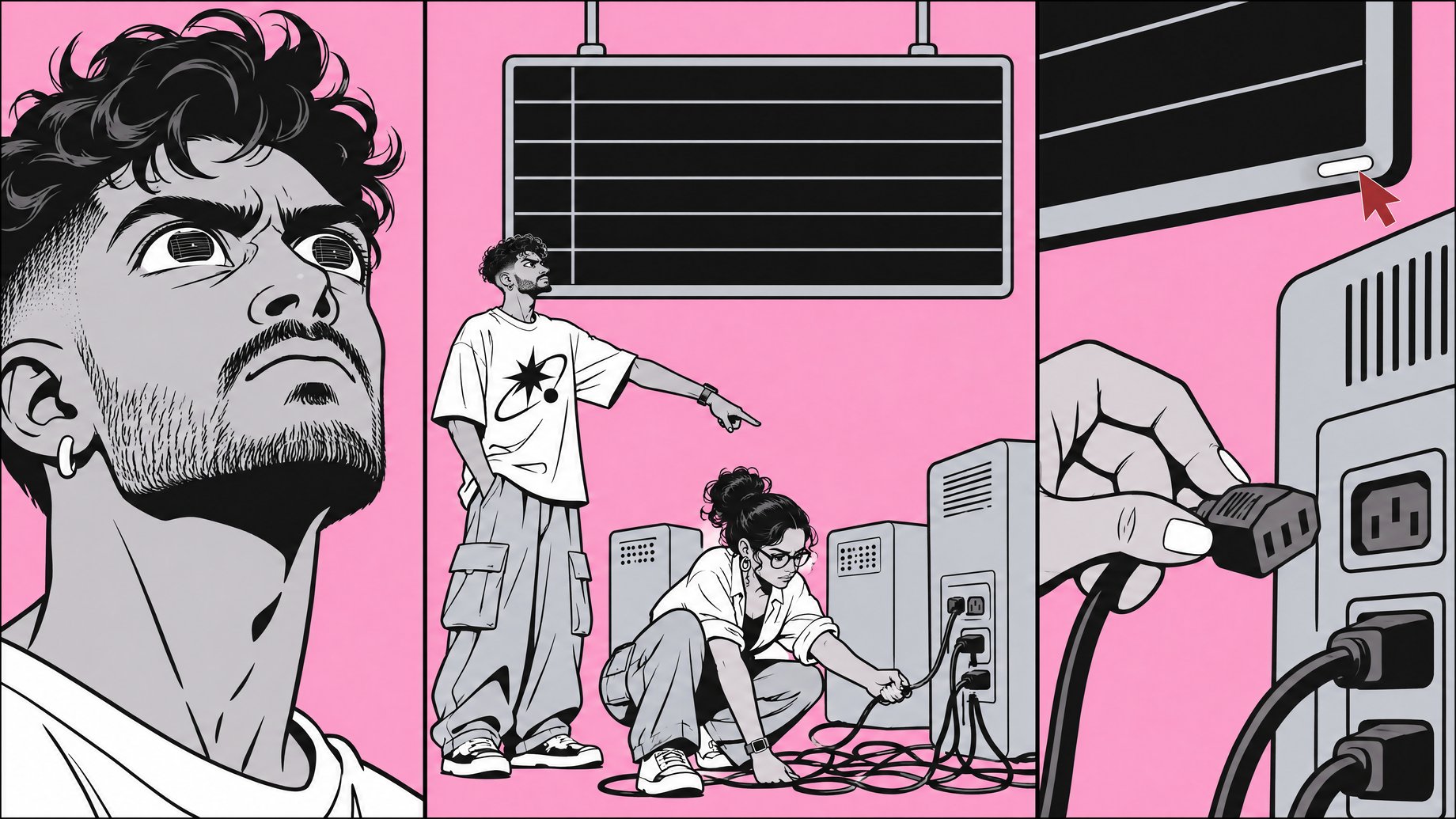
Are the Microsoft, airline and bank outages caused by AI cyberattacks?
Nobody has publicly confirmed that. A YouTuber argues that a Microsoft outage, a nationwide flight grounding and outages at major U.S. banks are connected, and that they trace back to the release of an open-weight AI model with strong hacking ability. His case rests on timing and pattern. He says himself that companies are not naming a cause. The idea is plausible in principle, but a plausible idea is not evidence, and several ordinary explanations fit the same facts.
TL;DR
- The link is a claim, not a finding. The argument is built on outages happening close together, with no incident report tying them to an attack.
- The creator points to one model. He names DeepSeek V4.1 Flash 1017, released with open weights, as the moment capable hacking AI became widely available.
- Big outages cluster for boring reasons. Shared vendors, software updates and cascading failures can take down unrelated-looking services at once.
- The risk itself is real. Cheaper, more accessible hacking tools are a legitimate concern, even if these particular outages are unproven examples.
- The proposed fix is siloing. That means separating critical systems so one failure or breach cannot spread, at the cost of convenience.
- You can prepare without panicking. A little cash, a second payment method and a downtime plan at work cost almost nothing.
What exactly is being claimed?
The source is a single commentary video. Here is what it asserts:
- Microsoft had a major outage on a Thursday.
- On the Friday, more than 10,000 flights across the United States were grounded.
- The following day, Chase, Bank of America and Wells Fargo, among other services, reported nationwide outages, leaving tens or hundreds of thousands of people unable to reach their money.
- An outage-tracking page listed service disruptions at many more banks.
- A capable cyber model, DeepSeek V4.1 Flash 1017, was released as open weights. The creator says that was followed by an unprecedented wave of cyberattack-related outages, including supermarket refrigeration units being hacked and an exploit affecting WordPress sites.
- Companies are likely describing attacks as "legacy problems" or routine outages to avoid panic.
- Many incidents were probably caused by AI agents, either attacking directly or triggering cascading failures.
The creator also describes himself as not a conspiracy theorist, and he frames the video as pattern recognition he feels obliged to mention. He asks viewers for suggestions rather than offering proof.
What is confirmed and what is not?
Separating the layers helps. This table sorts the claims by what the source material can and cannot support.
| Claim | Status |
|---|---|
| Several large services had outages in a short window | Asserted by the creator. Check news reports and company status pages for specifics. |
| The outages share one cause | Not established. No cause is cited. |
| An attack caused them | Not confirmed. The creator says companies are not saying so. |
| AI agents caused them | Speculation. |
| DeepSeek V4.1 Flash 1017 is a capable cyber model released with open weights | The creator's claim. No benchmarks or technical details are provided. |
| It runs on a high-end gaming PC and acts like a "PhD level hacker" | The creator's characterization, unverified. |
| Companies are hiding attacks | Unprovable either way from the outside. |
The last row matters. "They aren't admitting it" cannot count as evidence for an attack, because it would look the same if there were no attack. It also cannot rule one out. The honest position is that the cause is unknown to the public until the companies or investigators say more.
What is an open-weight cyber model, and why does it matter?
An AI model's "weights" are the learned numbers that make it work. When a developer releases them as open weights, anyone can download the model and run it on their own hardware. That has real benefits: researchers can study it, companies can run it privately, and no single vendor controls access.
It also means the developer cannot switch it off or add guardrails after the fact. If the model is good at finding software vulnerabilities, a defender can use it to audit their own code, and an attacker can use it to find weak spots in other people's. This dual-use problem is why security researchers debate open releases of capable models.
The creator's worry is that state-sponsored groups and ordinary criminals now have a strong hacking assistant they can run privately. That worry is reasonable to raise. What the sources do not provide is any measurement of how capable this specific model is, so the "PhD level" description remains his characterization.
Why do unrelated services go down at the same time?
Even without an attacker, big outages bunch together. A few well-documented reasons:
- Shared vendors. Many banks, airlines and software companies rely on the same cloud providers, security tools and payment processors. One failure upstream shows up as many failures downstream.
- Bad updates. In July 2024, a faulty software update from the security company CrowdStrike crashed Windows machines worldwide and disrupted airlines, banks and hospitals. It was not a cyberattack, and it looked like a coordinated assault to many people at the time.
- Cascades. When one system fails, traffic piles onto others, and those fail too.
- Outage trackers amplify. Pages that list problem reports spike when one big service fails, because customers of many apps check at once and report issues. A long list of banks on a tracker page does not by itself show each had a separate attack.
A timeline of outages feels like a pattern. It could be a pattern. It could also be three unrelated events plus one big shared dependency.
Could AI-driven attacks cause outages like these?
In principle, yes, and that is the stronger half of the creator's argument. AI tools lower the cost of reading code, spotting weaknesses and writing exploits. A task that once took a skilled specialist days could take someone less skilled much less time. Widely used software such as WordPress, which the creator mentions, gives attackers a huge target because one flaw affects many sites.
Two caveats apply. First, "could" is not "did." Linking a specific outage to an AI attack requires forensic evidence that we have not seen. Second, attackers have never needed AI to cause damage. Ransomware and large-scale service disruptions happened long before capable open models existed.
What is siloing, and would it help?
The creator's proposed response is that critical security systems will need to become "significantly more siloed and less connected." Siloing, also called segmentation, means separating systems so a failure or breach in one cannot spread to others. The usual versions:
- Separate networks for sensitive systems, so a compromised email server cannot reach payment systems.
- Fewer shared dependencies, so one vendor failure does not stop everything.
- Manual fallbacks, so staff can keep operating, even slowly, when software fails.
Siloing helps contain damage, and security teams already recommend it. The trade-off is cost and convenience. Connected systems are cheaper to run and easier to use, which is why so much infrastructure became connected. The creator notes the irony for someone who grew up championing a free, open internet. Whether the world moves that way depends on the evidence of real attacks, which is why confirmed incident reports matter.
What does this mean for you?
Whatever the cause turns out to be, the outages show one thing: when a few shared systems fail, ordinary people feel it fast. A few low-cost steps make sense.
For everyday life
- Keep a small amount of cash at home. The creator suggests this, and it is cheap insurance against any outage.
- Have a second way to pay, such as a card from a different bank than your main account.
- Save key account numbers and support phone numbers somewhere that does not need the internet.
- During an outage, go to your bank's official channels. Outages are a favorite moment for phishing messages claiming to "fix" your account.
For managers and team leads
- List the outside services your team cannot work without, and who owns each one.
- Write down what staff do for a few hours when email, chat or a core system is down.
- Ask your IT or security team how critical systems are separated, and what the plan is if a key vendor fails.
- Rely on official incident reports before repeating a cause to your team. Speculation spreads faster than facts.
Can you build your own outage plan instead of keeping it in a spreadsheet?
The dependency list and the downtime checklist are the kind of thing that ends up in a forgotten spreadsheet. A small internal tool is more useful: one place that lists each vendor and system, who owns it, what the manual fallback is, and when it was last reviewed, with a form for logging incidents. You can describe that app in plain English to Remy, which builds and deploys it with sign-in and a database included, so your team gets a live page they can open when something breaks. It is a modest project, but it turns a vague worry into a plan people can use.
Frequently Asked Questions
Were the bank and airline outages confirmed as cyberattacks?
Not in the material reviewed here. The source is a commentary video, and it says companies are not attributing the outages to attacks. Check official statements and news reporting for the actual causes as they emerge.
What is DeepSeek V4.1 Flash 1017?
The creator describes it as an open-weight model with strong cyber capabilities, released shortly before a wave of outages. The sources include no technical specifications or benchmarks for it, so claims about how powerful it is remain unverified.
Can AI really hack systems on its own?
AI tools can help find weaknesses and write exploit code, and security researchers take that seriously. How autonomous and effective they are in real attacks varies, and linking a specific outage to an AI-driven attack requires evidence that has not been shown here.
Should I take my money out of the bank?
The creator does not suggest that. He says to keep a little cash in case you cannot reach your accounts, which is a different concern from a bank run. Having some cash and a backup payment method is sensible in any case.
Is the internet going to become more siloed?
The creator thinks critical security systems will have to. Segmentation is already standard advice in security, but how far organizations go depends on cost, regulation and whether attacks like these are confirmed.
How we source, write, and correct our articles. Editorial standards
Related articles

What Is the Chip Security Act and the Blackwell Fingerprint Finding?
Do AI Models Get Nerfed After Launch? What Labs Admitted
What Caused the Microsoft 365 Outage? Network Fault, AI Debate