What Is RLCD AI? The Decision Architecture Behind Jev
RLCD trains a model to make calibrated decisions instead of writing text. Here's what that buys you, and where the marketing gets ahead of the accuracy.


RLCD stands for Reinforcement Learning for Calibrated Decisions. It's the training method TypeSafe AI built for Jev, a model that doesn't generate text at all. Instead, Jev takes an unstructured description of a situation plus a predefined typed question and returns a probability-scored answer, in one parallel pass, with no autoregressive sampling.1 That's the whole idea. Everything else is detail.
One thing to flag first: a 2023 paper also used the acronym RLCD, for "Reinforcement Learning from Contrastive Distillation." That's a different technique from UC Berkeley and Meta researchers for aligning chatbots using positive- and negative-prompted preference pairs, accepted to ICLR 2024.2 It has nothing to do with TypeSafe's model. Same four letters, two different things, three years apart. If you're researching one, make sure you're not reading about the other.
RLCD vs RLHF: why a ChatGPT co-inventor built something new
Diogo Almeida spent four years on OpenAI's post-training team. He co-authored the InstructGPT paper and contributed to the GPT-4 technical report, which makes him one of the people who built RLHF itself, the technique that turned GPT-3 into ChatGPT.3 In 2024 he left to start TypeSafe AI with Erik Gafni and Sasha Sheng, and the company came out of two years of stealth on September 15, 2026 with a $40 million seed round led by DCVC.45
His critique of the thing he helped build is blunt. "We've been optimizing for humans and we're super human at pleasing humans," Almeida told Forbes, arguing that today's AI is overconfident because RLHF rewards text that sounds right to a human rater, not decisions that are calibrated against reality.6 RLHF trains a model to produce the response a person would approve of. RLCD trains a model to pair a decision with a confidence score that tracks how often that decision turns out to be correct.7 Same reinforcement-learning scaffolding, different reward signal, different job.
For the mechanics of what a next-token predictor is actually doing under RLHF, see our explainer on how LLMs really work. RLCD is a deliberate break from that lineage, not a variation on it.
How does Jev's 'System One Model' actually work?
TypeSafe calls Jev a "System One Model," borrowing the fast, intuitive, pattern-matching sense from behavioral psychology, as opposed to the slower, deliberate reasoning of a chatbot working through a problem token by token.
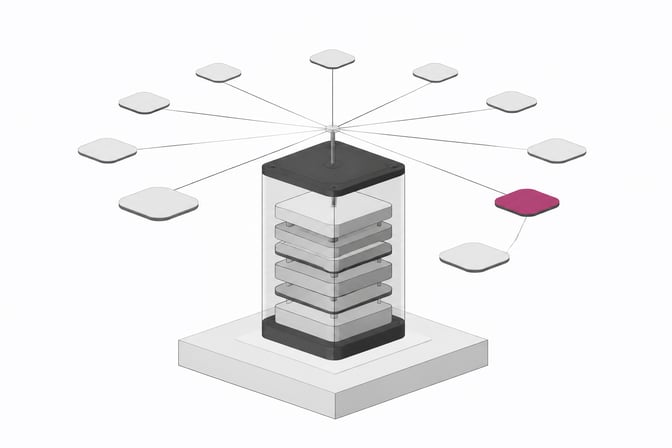
Instead of open-ended generation, Jev works against three typed primitives:
- Choice. Pick one option from a fixed set, up to 255 discrete candidates, scored in a two-stage process that ranks options independently before selection.8
- Score. Return a calibrated numeric value.
- Noul. A yes/no judgment with an attached confidence level.
The model receives unstructured context, the "state," alongside one of these predefined question types and returns a probability distribution over valid answers in a single non-autoregressive forward pass.18 There's no token-by-token sampling, no chain of reasoning written out in prose, and structurally no way to answer outside the schema you defined. That constraint is the whole engineering bet: narrow the output space enough and you get speed plus a provably well-formed answer.
How fast and cheap is Jev, really?
The headline numbers are real, and they're also measured on TypeSafe's own terms. The company reports Jev's end-to-end response time at 70 to 500 milliseconds, against 3 to 329 seconds for the frontier LLMs it benchmarked against on comparable workflows.1 Input tokens run $0.042 per million, with output tokens free.19 Stacked together, TypeSafe claims up to 193.6x faster and 444.6x cheaper outcomes on its own published workflow evaluations.1
Three caveats worth holding onto:
- These are TypeSafe's own evaluations. The company itself describes the headline multiples as "the higher end of real-world gains," generated by its own capabilities team.1
- The reference answers are also AI-generated. The frontier-LLM comparisons TypeSafe measured against use GPT-6 Astra and Claude Fable 5.1 outputs as the correct answer. Agreement with those models tells you Jev matches another model's judgment, not that either judgment is right.9
- Independent commentators flag the same gap. MindStudio's review of the launch material notes plainly that "the benchmarks are self-reported and unverified... nothing has been independently tested."7
None of that makes the speed claim false. A classification task that doesn't need to generate prose genuinely runs faster on a model built only to score typed options. It just means the multiples describe a narrow, favorable slice of work, not a general AI upgrade.
Contrastive Language Models: the open-source answer to Jev
Nine days after TypeSafe's launch, a different team answered with an open version of the same idea. Contrastive Language Models (CLMs), introduced by researcher Jacky Kwok along with Stanford and Berkeley collaborators, are trained with a contrastive learning objective instead of RLCD.1011 CLM-8B builds a state encoder and an action encoder on top of a frozen Qwen3-8B, trained with a contrastive loss that pulls matching state-action pairs together and pushes mismatched pairs apart.1012 It's a different training mechanism aimed at the same output shape: a fast, typed, probability-scored decision instead of generated text.
The practical difference that matters most: CLM-8B ships under Apache 2.0. The trainable head is 75MB, sits on top of the open Qwen3-8B weights, and runs on a single NVIDIA GPU, including a consumer card.1310
How is RLCD different from CLM?
RLCD is a training method behind a closed, hosted, proprietary model. CLM is an open training approach and a downloadable model. That's the real dividing line, more than any single benchmark number.
On the benchmarks that do exist, CLM-8B trades roughly evenly with Jev:
- On a T-Rex game and Super Mario zero-shot tasks, CLM-8B matched Jev's success rate while running up to 9x faster.1211
- On tool-calling (BFCL v4), CLM trailed slightly at 95.2% versus Jev's 99.2%, and on WikiRacing it scored 26 of 30 versus Jev's 30 of 30, while still finishing faster on every task tested.12
- With around 1,000 cached candidates, CLM's state and action caching pushed the speed gap to 13x faster than Jev.10
- Fine-tuned CLM verifier heads reportedly set new highs on two coding-agent benchmarks, 81.6% on DeepSWE and 87.6% on Terminal-Bench 2.1, running 4 to 6x faster than Jev on the same verifier task.12
Worth flagging: those verifier results use lightweight fine-tuned heads evaluated on held-out subsets, not full leaderboard submissions, so treat them as promising rather than settled.12 But the pattern holds across every comparison available: CLM is competitive on accuracy and consistently faster, because it's a smaller, purpose-built encoder stack rather than a full model doing extra work per decision.
Does RLCD actually stop Jev from hallucinating?
This is the part enterprise buyers need to sit with. TypeSafe's marketing leans hard on the claim that Jev "can't hallucinate," and structurally that's true: the schema constraint means it cannot return an answer outside the typed options you defined.1
But a model that can't be malformed can still be confidently wrong. KDnuggets put it precisely: "'Zero hallucinations' is therefore closer to zero out-of-schema outputs, not zero incorrect decisions."14 TemperatureZero's review is more direct: "Jev doesn't hallucinate. It decides wrong."15 And the evidence for that critique comes straight from TypeSafe's own disclosed numbers: on invoice processing, a structured, well-understood domain that should favor a typed classifier, Jev scored 61.8% accuracy against a general-purpose LLM baseline of 79.1%.15 ModemGuides' summary is the cleanest version of the distinction: "'Can't hallucinate' means Jev cannot return a malformed or off-schema answer. It can still be wrong."13
Schema safety and judgment accuracy are two separate guarantees. RLCD, and by extension any System One model trained this way, gives you the first one by construction. It does not automatically give you the second. If your workflow needs both, you still have to measure accuracy the hard way, task by task, against ground truth you trust, not against another model's output.
Should you rent Jev or build your own decision layer?
Strip away the branding and RLCD and CLM are both answers to the same practical question: most software doesn't need an AI that writes essays, it needs an AI that picks option 3 out of 12 in under a second and tells you how confident it is. That's a decision layer, not a chatbot, and it's a legitimate new category sitting underneath the agents and dashboards teams are already building.
How you get that decision layer is where build-vs-buy shows up again. Jev is only available as a closed-weight, hosted API in early access. TypeSafe has published no self-host or open-weight path.13 Every classification call is a rented API call, priced per token, running on someone else's infrastructure.
CLM-8B is the other path. Because the weights are Apache 2.0 and the deployable head is 75MB, a team can run it themselves via an inference engine like vLLM on hardware they already own or lease, following the same math laid out in our guide to running LLMs locally for enterprise. At meaningful call volume, that's the difference between a metered bill that scales with usage and a fixed infrastructure cost you control. If you're weighing what GPU that actually takes, our hardware breakdown for local inference covers the range from a single consumer card to a full rack.
The teams already building their own internal agents and approval workflows on top of platforms like Remy are the ones who feel this tradeoff first: a decision layer you can inspect, retrain, and own outright behaves very differently in an audit than a black-box API you're renting by the token. RLCD proved the category is real. Whether you rent it or own it is the bigger decision.
| Access model | Deployment | Cost structure | Hardware control | Customizability | Speed on shared benchmarks | |
|---|---|---|---|---|---|---|
| Jev (TypeSafe)Teams wanting a fully managed API with no infrastructure overhead | Closed, hosted API (early access) | TypeSafe-hosted cloud only | Metered per token ($0.042/M input, output free) | Low | Low | Medium |
| RecommendedCLM-8B (Contrastive-LM)Teams wanting to self-host, retrain, and own the decision layer | Open weights (Apache 2.0) | Self-hosted on owned/leased GPU, including a consumer card | Fixed infrastructure cost, no per-token fee | High | High | High |
In the context of TypeSafe AI's Jev model, RLCD stands for Reinforcement Learning for Calibrated Decisions, a training method that optimizes a model to pair a decision with a confidence score reflecting real-world accuracy. An unrelated, earlier RLCD (Reinforcement Learning from Contrastive Distillation) is a 2023 academic technique for LLM alignment and is a different thing entirely.
No. Jev doesn't generate text through autoregressive sampling like a standard LLM. It takes unstructured context plus a typed question (Choice, Score, or Noul) and returns a calibrated probability distribution in a single parallel forward pass, which TypeSafe calls a 'System One Model.'
No. Jev is available only as a closed-weight, hosted API in early access, with no published self-hosting or open-weight option. The open alternative, CLM-8B, can be run locally on a single GPU because its weights are released under Apache 2.0.
It's a class of AI, distinct from generative LLMs, trained to make fast, typed, probability-scored decisions rather than generate open-ended text. Jev (trained with RLCD) and CLM-8B (trained with contrastive learning) are the two current examples.
No. RLCD is a proprietary training method owned by TypeSafe AI, and Jev's model weights are not public. CLM-8B, built with a different contrastive training approach, is the open-source alternative released under Apache 2.0.
- 1Introducing System One Models & JevTypeSafe AI Blog
- 2RLCD: Reinforcement Learning from Contrastive Distillation for Language Model AlignmentarXiv (ICLR 2024)
- 3Diogo Almeida on ChatGPT, RLHF, and TypeSafe AI (2026 Founder Profile)explainx.ai
- 4TypeSafe emerges from stealth with a new way of doing AIDCVC
- 5TypeSafe AI Emerges From Stealth With $40M in FundingYahoo Finance / Business Wire
- 6This $200 Million Startup Wants To Fix AI's Overconfidence ProblemForbes
- 7RLCD vs RLHF: What Is Typesafe's Jev Model Actually Claiming?MindStudio
- 8ChatGPT pioneer launches Jev model for programmatic logicAI News (TechForge)
- 9TypeSafe launches Jev for AI decisions inside softwareThe Rundown AI
- 10Contrastive-LM Releases CLM-8B: An Open System One Model That Scores Agent Actions Up to 9× Faster Than JevMarkTechPost
- 11Contrastive Language Model (CLM-8B): An Open System One Model That Matches Jev at Up to 9x Lower Latencyexplainx.ai
- 12CLM-v0.1-8B Model CardHugging Face (Contrastive-LM)
- 13TypeSafe Jev Reality Check: What the "Can't Hallucinate" Model Is, and How to Run the Same Pattern LocallyModemGuides
- 14What Everyone Is Getting Wrong About TypeSafe AI's JevKDnuggets
- 15Jev Doesn't Hallucinate. It Decides Wrong.TemperatureZero