What Is an Agentic Operating System? The OS Is Now Your Build Tool
SUSE, Microsoft, and Canonical are racing to wire agentic AI and MCP into the operating system itself. That turns build vs. buy from a per-project decision into a question of what your OS can already do.

- 01Major operating systems from SUSE, Microsoft, and Canonical are now natively embedding AI agent runtimes.
- 02Fivetran replaced a $65,000 SaaS subscription with a custom tool built by AI agents in roughly four months.
- 03Production hardening accounted for 56% of the effort in a recent internal build, not the AI-generated MVP.
- 04Procurement delays of up to 93 days make rapid agent-built prototypes highly competitive against SaaS.
- 0560% of surveyed developers built software without IT oversight in the past year, posing new security risks.
What is an agentic operating system?
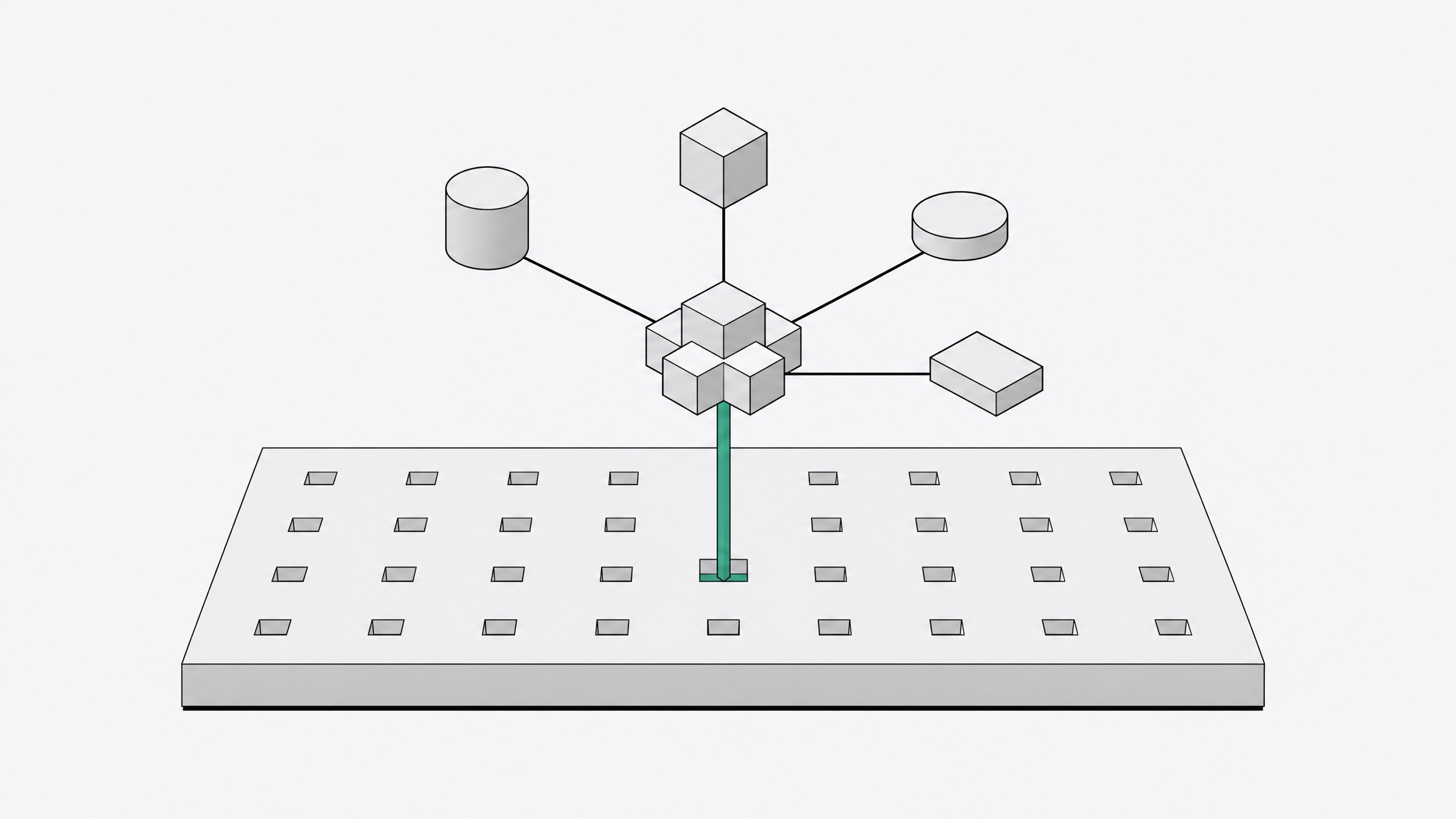
An agentic operating system is a desktop or server OS that ships with a built-in AI agent runtime, direct access to local tools and files, and a standard way to connect that agent to outside data sources, most often the Model Context Protocol (MCP). Instead of installing an AI app on top of the OS, the agent becomes part of the OS layer, able to read your file system, call your APIs, and act on background tasks the way a shell script or a system service would.
That's the technical definition. The practical one matters more: once the OS can build and run small software on demand, the OS itself becomes the build tool. A lot of what used to require a SaaS subscription or a procurement ticket becomes a weekend project instead.
This isn't a forecast. It's already shipping.
The OS vendors are all making the same bet, at the same time
Three operating systems that together run most of the world's servers and desktops are converging on the same idea within months of each other. That convergence, not any single vendor's marketing, is the real signal.
- SUSE shipped SUSE Linux Enterprise Server 16 on October 29, 2025, marketed as the first enterprise Linux distribution with a built-in agentic AI framework. It implements MCP natively, so AI models can connect to existing tools and data without vendor lock-in to a single LLM provider.1
- Microsoft has been repositioning Windows 11 as an "agentic OS" since November 2025, building AI agents into the taskbar so they can access files and folders and run background tasks as part of the OS experience rather than as a separate app. Windows chief Pavan Davuluri put it plainly: "This integration isn't just about adding agents; it's about making them part of the OS experience."2
- Canonical is moving more cautiously. Ubuntu's 2026 roadmap splits AI into two lanes: invisible AI enhancements to existing OS functionality, and separate "AI-native" agentic workflows for people who want them. Canonical is explicit that "Ubuntu is not becoming an AI product," even as it becomes more capable of hosting agentic work.3
Three vendors, three different postures, one shared bet: the operating system, not a SaaS dashboard, is where agentic building happens next.
Why MCP is the plumbing that makes this work
None of this works without a common protocol for agents to talk to tools. That protocol is MCP, and its trajectory looks less like a vendor feature and more like durable infrastructure. In December 2025, Anthropic donated MCP to a new Agentic AI Foundation under the Linux Foundation, co-founded with Block and OpenAI and backed by Google, Microsoft, AWS, Cloudflare, and Bloomberg.4 A year after its November 2024 launch, MCP had more than 10,000 active public servers and over 97 million monthly SDK downloads, with adoption spanning ChatGPT, Cursor, Gemini, Microsoft Copilot, and VS Code.4 Enterprise uptake is already material: roughly 28% of Fortune 500 companies have implemented MCP servers, and about 80% are running active AI agents in production workflows.5
That neutrality matters for build-vs-buy math. When the connective tissue between agents and tools is an open standard rather than a proprietary API, an internal build isn't locked to one cloud or one model vendor. The switching cost that used to make SaaS the safe default starts working in the other direction.
What does building software with an agentic OS actually cost?
The abstraction gets concrete fast once you look at an actual build. Fivetran's engineering team used AI coding agents to replace a $65,000-a-year Atlassian Statuspage subscription with an in-house status page.6 The numbers are worth sitting with:
- Team and timeline. Two engineers, roughly four months, about 1,050 hours total.6
- Total cost. Around $109,500, including about $4,500 in AI token spend.6
- Payback period. Roughly 2.5 years against the subscription it replaced.6
- Where the effort actually went. 56% of total effort was production hardening: auth, migrations, monitoring, edge cases. Not the flashy AI-generated MVP.6
- The real bottleneck. Roughly two hours of specification and agent-context prep were needed for every hour of feature-building. Generating code was never the hard part; specifying intent precisely was.6
That 56% figure is the whole story in one number. The agentic OS makes the MVP nearly free. It doesn't make the boring parts of software free, and teams that skip them ship something that looks finished and isn't. This is the same math laid out in Fable 5.1's build-vs-buy framework: the moment a subscription costs more than a few developer-weeks, building becomes the rational default, provided you budget for the hardening, not just the demo.
The procurement math this is up against
Here's what buying still costs, in time, not just dollars. Vertice's Q2 2026 procurement data shows contracts under $10,000 taking an average of 54 days to clear internal approval. That climbs to 73 days for $10k-$50k deals, 81 days for $50k-$100k, and 93 days for six-figure-plus contracts, with every bracket slower than the quarter before.7 A weekend prototype built on an agentic OS doesn't compete with SaaS on features first. It competes on the calendar, and it wins before the vendor's sales team has even scheduled the second call. That's the practical version of the four-question framework this publication has laid out for deciding what deserves a weekend build versus real engineering investment.
Teams are already doing this
This isn't speculative. Retool's 2026 survey of 817 builders found 35% of teams have already replaced at least one SaaS tool with a custom build, and 78% expect to build more in 2026.8 Workflow automation and internal admin tools, at 35% and 33% respectively, are the categories most at risk of replacement.8 The financial markets noticed too: when Anthropic released Claude Sonnet 4.6 in February 2026, SaaS incumbents sold off hard: Oracle down nearly 4.5%, Intuit down about 5.5%, Salesforce down roughly 3.8%. Forbes framed the drop not as a cause but as the market catching up to a shift toward SaaS replacement already underway.9 That shift is the subject of why building is starting to beat buying on the income statement, not just the spec sheet.
The governance problem hiding inside the opportunity
Here's the part that should worry IT leaders more than it seems to. Retool's same survey found 60% of builders across seniority levels built something outside official IT oversight in the past year; 31% cited speed and 18% cited IT's process being too slow.8 That's not a capability gap. It's a procurement-friction problem, and an agentic OS removes the friction without adding the oversight.
IDC's April 2025 employee survey backs this up from the data-handling side: only 23% of EMEA employees say they use AI tools their employer actually provided, while 39% use free tools and 17% pay for their own.10 In that same year, the share of sensitive corporate data fed into AI tools jumped from about 10% to over 25%.10 Put an agent runtime directly in the OS, and every laptop becomes a place where an employee can build and run software with company data, with or without IT's knowledge.
Even the technical case for an agentic OS admits it isn't finished. Engineer Eric Burel argues mainstream Linux distributions still lack the structural pieces to genuinely qualify: centralized API-key management, containerized AI tools treated as a first-class app marketplace, and agentic-tool support that goes beyond plain APIs.11 He assesses Ubuntu's current roadmap as still too centered on AI itself and not enough on the software environment agents need to act inside safely.11 That gap is exactly where shadow building turns into shadow risk, and it's the reason a build-first posture has to come with visibility and audit trails, not just enthusiasm, a point this publication returns to often when SaaS vendors with no real moat start losing clients to in-house builds.
So when should you still buy?
The agentic OS doesn't make every SaaS category obsolete. It changes which categories are worth the fight. A practical filter, drawing on Fivetran's own heuristic and Retool's risk data:
| Best-fit problem type | Time to deploy | Ongoing hardening burden | Default IT visibility | Cost as usage grows | |
|---|---|---|---|---|---|
| Build on the agentic OSwell-specified, modest-complexity tools with an owner for hardening | Well-specified, modest complexity | Days to weeks | High | Low | Roughly fixed after the build |
| Buy (SaaS subscription)regulated, compliance-heavy, or still-being-discovered requirements | Complex, regulated, or undefined requirements | Weeks to months (procurement cycle) | Low | High | Scales with seats or usage |
- Well-specified problem. If you can write the spec in an afternoon, the agent can build it in a weekend. If the requirements are still being discovered, buy, because discovery is the expensive part and vendors have already paid it.
- Modest complexity. Status pages, internal dashboards, and admin tools fit. Anything touching compliance-grade auth, multi-region data residency, or regulated workflows doesn't, yet.
- Badly-scaling vendor pricing. If the subscription price scales with seats or usage far faster than your actual need, the payback math favors building, the way it did for Fivetran's status page.6
- An owner who will do the hardening. Someone has to sign up for the 56% of the work that isn't glamorous. If no one owns that, don't build it, no matter how fast the MVP looks.
- A governed environment to build it in. Whether that's an IT-sanctioned sandbox or a platform like Remy built for teams that want to own their internal tools without losing visibility into how they were built, the build needs a home IT can actually see.
Workflow automation and internal admin tools are the categories most builders are already targeting, and the data backs the instinct.8 Anything more specialized, more regulated, or more genuinely novel is still safer bought, at least until the agentic OS matures past the gaps its own advocates admit are still open.11
The question was never whether the OS could build software. It always could, in the sense that a terminal and a compiler are also a build tool. What changed is that the OS now handles the scaffolding, the tool connections, and a good chunk of the specification work automatically. That's a genuine shift in what build vs. buy means. It's not a reason to stop asking who's watching what gets built.
An agentic operating system is an OS with a built-in AI agent runtime that can access local files, tools, and background tasks directly, usually connected to outside data sources through the Model Context Protocol (MCP). SUSE Linux Enterprise Server 16, Windows 11's taskbar agents, and Ubuntu's 2026 AI roadmap are the three clearest examples shipping today.
No. MCP is an open standard, and Anthropic donated it to the Linux Foundation's Agentic AI Foundation in December 2025, with Google, Microsoft, AWS, Cloudflare, and Bloomberg backing it. SUSE explicitly markets its MCP implementation as vendor-neutral, letting you swap LLM providers without rebuilding integrations.
Fivetran's team spent about $109,500 and four months with two engineers to replace a $65,000-a-year status page subscription, hitting payback in roughly 2.5 years. More than half that effort, 56%, went to production hardening like auth and monitoring rather than the initial AI-generated MVP, which is the part most estimates underweight.
As of Q2 2026, average procurement cycles run 54 days for contracts under $10,000 and climb to 93 days for six-figure-plus deals, and every bracket got slower in the prior quarter. An agent-built prototype can ship in days, which is why 60% of builders in a 2026 Retool survey said they built something outside official IT process just to move faster.
Yes, if it happens without visibility. IDC found only 23% of EMEA employees use AI tools their employer actually provided, and the share of sensitive data fed into AI tools more than doubled in a year. An agentic OS multiplies that risk unless IT provides a sanctioned build environment with audit trails.
- 1Announcing SUSE Linux Enterprise Server 16 General Availability: The First Enterprise Linux with Built-in Agentic AISUSE
- 2Microsoft is turning Windows into an 'agentic OS,' starting with the taskbarThe Verge
- 3The future of AI in UbuntuUbuntu Discourse (Canonical)
- 4Donating the Model Context Protocol and establishing the Agentic AI FoundationAnthropic
- 5Model Context Protocol for Enterprises: Implementation GuideSynvestable
- 6We built our own status page with AI, replacing a $65k SaaS productFivetran
- 7Procurement cycle time by contract valueVertice
- 8The build vs. buy shift: how vibe coding and shadow IT have reshaped enterprise softwareRetool
- 9Companies Continue To Shift Away From SaaSForbes
- 10Shadow AI: How stealth productivity is strangling enterprise AI adoption. And creating a security nightmare…IDC
- 11Key Components of a Linux Distribution for AI agentsLBKE (Eric Burel)