Internal AI Workflows Cost Pennies. SaaS Subscriptions Still Cost $9,324 a Seat.
Frontier inference now costs fractions of a cent per task. Per-seat software still bills like it's 2015. Here's the real math on building an internal AI workflow versus renting another SaaS seat.

- 01AI reasoning costs have collapsed, dropping 1,000x in just three years.
- 02Average SaaS spend sits at $9,324 per employee yearly despite cheap AI features.
- 03About 35% of enterprise teams have already replaced a SaaS tool with a custom build.
- 04Over half of US employees admit to using unauthorized AI tools for their workflows.
- 05Agentic AI maintenance and refinement loops can consume up to 60% of total task costs.
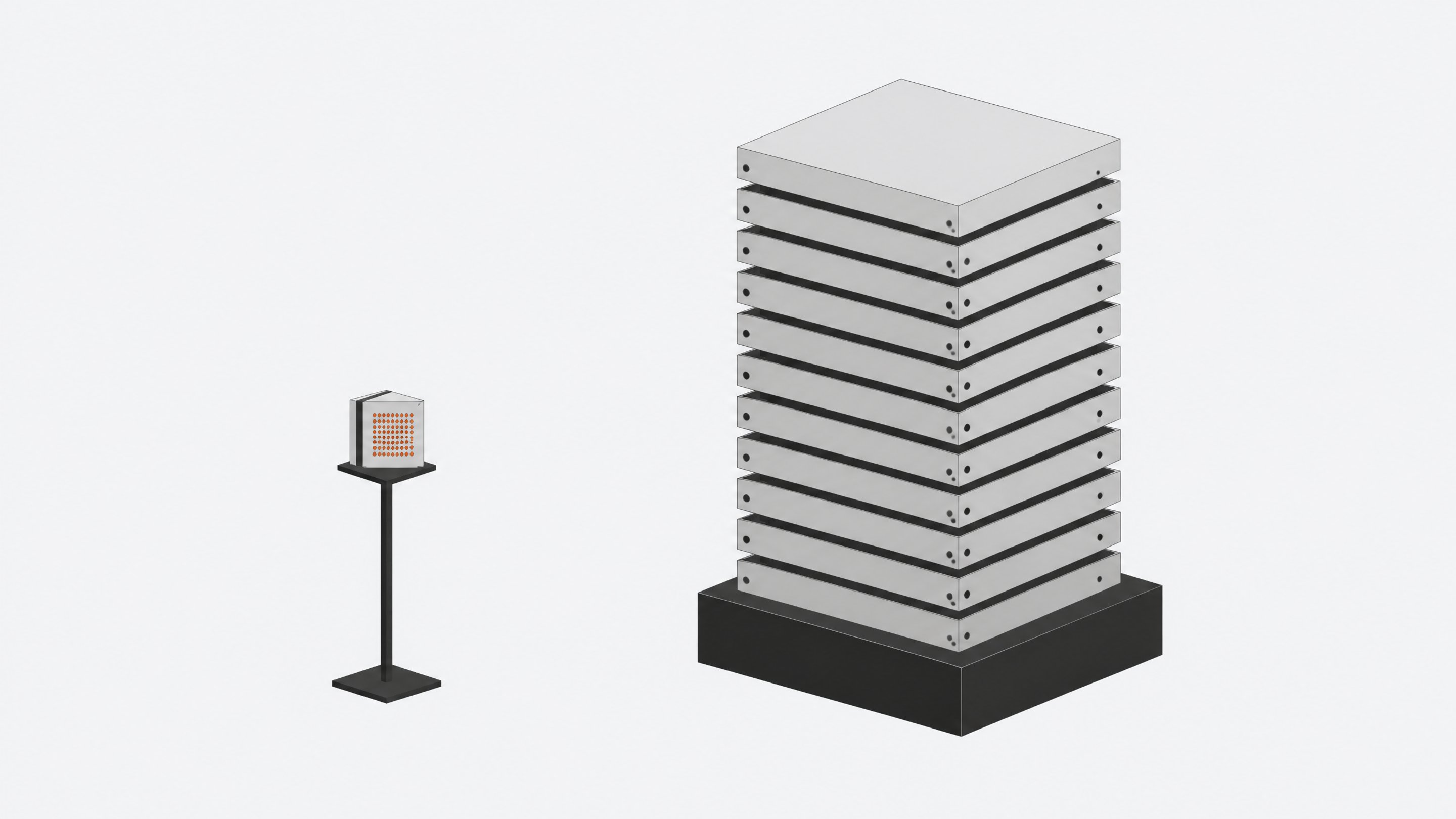
Building an internal AI workflow for a well-defined, high-frequency task now costs a few cents per run in raw inference. Renting the SaaS tool that does the same job costs, on average, $9,324 a year per employee.1 That gap isn't a rounding error. It's why build-vs-buy has quietly flipped for a whole category of internal software.
I spent years running security for companies that bought a lot of software. The pitch never changed: renting is safer than building, because vendors bring scale and expertise you don't have in-house. That still holds for plenty of software. It stops holding the moment the core work inside the tool is a language model doing reasoning that now costs almost nothing to run.
How cheap did AI reasoning actually get?
Start with the number that should be driving every SaaS renewal conversation this year. The cost of querying a model with GPT-3.5-level capability (64.8% on MMLU) fell from $20 per million tokens in November 2022 to $0.07 per million tokens by October 2024. A 280-fold drop in about eighteen months.2
It keeps going. By February 2025, matching GPT-4 Turbo-level performance on tough benchmarks like MMLU and GPQA cost as little as $0.18 per million tokens.3 Andreessen Horowitz tracks this as a steady 10x-per-year decline in the cost of equivalent model performance: a cumulative 1,000x collapse in three years, from $60 per million tokens for GPT-3-class output down to $0.06.4
Put a real workflow against that curve. A well-scoped internal task, classify this ticket, draft this summary, route this approval, might run a few thousand tokens of reasoning. At current frontier pricing, that's fractions of a cent. Even a genuinely complex multi-step decision, the kind that used to require a human and a form, lands around 18 cents once you account for a realistic token count. Compare that to a SaaS seat billed monthly whether the employee touches the tool once or a hundred times. The intelligence inside most of that software already costs pennies. The seat price never moved to reflect it.2
What was per-seat pricing actually pricing?
Per-seat pricing made sense in a world where the software's marginal cost per user was close to zero and the thing that scaled with headcount was usage. More employees meant more logins, more support tickets, more value delivered, so billing per head was a reasonable proxy for value and cost alike.
AI breaks that proxy. Bain's analysis of the shift is blunt about it: if a business needs fewer humans to operate the software, headcount-based pricing stops tracking value, and it stops tracking cost too, because every agentic action and every model call now carries a real, variable compute expense.5 Under flat per-seat pricing, your heaviest users, the ones running the most AI-driven work through the tool, become the least profitable accounts for the vendor. That's an unstable position for any business to hold for long.
Bain looked at more than 30 SaaS vendors and found the market hasn't fully resolved this yet. Roughly 35% simply raised per-seat prices and folded AI features into existing tiers. About 65% layered a hybrid usage meter for AI on top of the seat price. None had moved fully to usage or outcome-based pricing.5 That's a market caught mid-transition, not one that's found its footing. We covered the mechanics of this shift in more detail in why B2B SaaS costs so much more than the AI running it.
How much does it actually cost to build an internal AI workflow vs. buy a SaaS subscription?
Here's the comparison worth running before your next renewal. Average SaaS spend is now $9,324 per employee per year, up from $9,200 the previous quarter, with vendors adding separate AI line items on top of base licenses rather than replacing them.1 That's the buy side.
The build side, for a single well-defined workflow, is inference cost plus orchestration. If the task is genuinely narrow, one input type, one decision, low variance, you're often looking at cents per execution and a fixed, modest engineering cost to wire it up. Multiply a few cents by a few thousand executions a month and you're still well under what a single SaaS seat costs for the year, let alone what a whole team's seats cost.
Don't take the naive version of this math at face value, though. McKinsey's research on agentic economics found that a genuinely agentic task, one with multiple steps, tool calls, and self-checking, can consume roughly 1,000 times more tokens than a single-turn chat or code-reasoning task.6 The first-pass answer is cheap. The refinement, checking, and rework around it is not: McKinsey found about 60% of an agentic task's total cost sits in that refinement loop, not the initial response.6 That's the honest version of the 18-cent decision. It's real, but it assumes you've scoped the task tightly enough that the model isn't burning cycles re-checking itself in circles. We've written before about where that math actually crosses over in the build-vs-buy pricing shift for 2026, and it's worth reading before you commit engineering time.
Companies are already proving this out
This isn't theoretical. Retool's 2026 build-vs-buy research found that 35% of enterprise teams have already replaced at least one SaaS tool with a custom build, and 78% expect to build more custom internal tools this year.7 Workflow automation and internal admin tools, exactly the well-defined, high-frequency category this piece is about, top the list of what's getting replaced.7
The case studies are concrete, not aspirational.
- Harmonic replaced a $20,000-a-year third-party tool after deciding it was faster to rebuild it internally than wait on vendor support.8
- ClickUp built six internal AI tools connected to Salesforce, Zendesk, and Snowflake, cutting $200,000 a year in automation software spend in the process.8
- One founder built five AI agents over a month and cancelled $1,003 a month in SaaS subscriptions in a single afternoon.9
For a broader accounting of who's making this switch and where it works, see the real math on replacing SaaS subscriptions with AI APIs.
What does building an internal AI workflow actually cost beyond inference?
Before you cancel anything, be honest about what the build side actually costs beyond inference:
- Maintenance time. Bain's technology research found AI agent maintenance consumes 15-25% of the time savings the agents generate.9 That's not zero. It's a real, ongoing tax on the win.
- Budget overrun risk. Despite falling token prices, enterprise LLM spending tripled over the twelve months ending in 2025, and 93% of enterprises in a McKinsey survey report exceeding their AI budgets.6 Cheap tokens don't guarantee a cheap total bill once orchestration overhead piles up.
- Refinement overhead. Agentic tasks can burn 1,000x the tokens of a simple call, and most of that cost sits in checking and rework, not the first answer.6
- Direct API cost floor. Even small-scale agent experiments carry real, ongoing API fees, roughly $20 to $70 a month for a modest set of daily-use agents.9
None of this erases the math. It just means the 18-cent decision is a real number for a real class of task, not a blanket claim that AI makes all software free.
Shadow AI is the tell
If you want proof this shift is already happening whether IT approves of it or not, look at shadow AI. 59% of US employees admit to using AI tools their employer hasn't approved.10 Even among employees who do have sanctioned tools, 85% also use unapproved ones, mostly because the approved tools don't actually meet their workflow needs.10 Retool found the same pattern at the software level: 60% of builders have built software outside official IT oversight in the past year, a quarter of them frequently, and the top reasons cited are that building it themselves is faster or that existing SaaS doesn't fit.87
That's the market voting with its prompts before procurement has caught up. It's also exactly the governance gap that makes ungoverned building risky, not because the impulse is wrong, but because nobody's tracking what's running, on what data, with what access. Platforms built for orchestrating these workflows with actual visibility, like Remy, exist precisely because the alternative isn't "no one builds this," it's "everyone builds it quietly, with no one accountable for it."
When to build, when to still buy
Treat this as a portfolio decision, not a religion. McKinsey's framing is the right one: place each workload based on volume, predictability, data sensitivity, and required quality.6 In practice:
- High volume, stable, low sensitivity: build. A ticket router, a report generator, an internal lookup tool. High frequency makes the per-task savings compound fast, and low sensitivity means less governance overhead.
- Low volume, unpredictable, high sensitivity: keep buying. Legal review, security incident triage, anything where a wrong answer is expensive and rare enough that vendor-grade tooling and liability still earn their premium.
- Medium everything: pilot narrow, expand slowly. Build the smallest version of the workflow first, measure actual token cost and refinement overhead against the SaaS bill you're replacing, and only scale once the maintenance tax is proven manageable, not assumed away.
| Marginal cost per task | Upfront engineering effort | Ongoing maintenance burden | Built-in governance & visibility | Best for | |
|---|---|---|---|---|---|
| RecommendedBuild internal AI workflowHigh-volume, well-defined, low-sensitivity tasks | Fractions of a cent to ~18¢ | Medium | Medium | Low | Ticket routing, summarization, internal lookups |
| Buy SaaS subscription | $9,324/seat/year regardless of usage | Low | Low | High | Low-volume, unpredictable, high-sensitivity work |
The deciding question isn't "can AI do this cheaper." It almost always can, at the token level. The question is whether the task is narrow enough that cheap tokens translate into cheap outcomes, or whether it's the kind of open-ended reasoning where refinement overhead eats the savings before you notice.
The pricing reckoning already underway
The strongest evidence that this isn't a fringe argument is what SaaS vendors themselves are doing. None of the 30-plus vendors Bain studied have moved fully to usage or outcome pricing, but 65% have already added a hybrid AI meter on top of seats, an admission that flat per-seat billing no longer matches what the software actually costs to run or what it's actually worth.5 Average per-employee SaaS spend keeps climbing partly because of these bolted-on AI charges, not because the underlying intelligence got more expensive, a pattern laid out in full in the 2026 SaaS waste breakdown.1
That's a market quietly conceding the point. Per-seat pricing isn't dead yet, but it's cracking in exactly the places the inference-cost curve predicted it would: high-frequency, well-defined, internal work, where 18 cents a decision beats $9,324 a year, every time you run the numbers honestly.
For a well-defined, high-frequency task, raw inference typically costs a few cents to around 18 cents per complex decision at current frontier pricing.23 That compares to average SaaS spend of $9,324 per employee per year.1 The gap narrows once you add orchestration, refinement loops, and maintenance time, which can consume 15-25% of the time savings generated.9 The comparison still favors building for narrow, high-volume tasks.
Per-seat pricing assumed marginal usage was nearly free for the vendor. AI breaks that because every model call and agentic action carries real, variable compute cost, making the heaviest users the least profitable accounts under flat pricing.5 Most vendors have responded by layering usage-based AI meters on top of seats rather than replacing per-seat billing outright.5
Yes, if it happens without oversight. 60% of builders have already built software outside official IT oversight in the past year, and 59% of employees use AI tools their employer hasn't approved.810 The building impulse is proving itself economically sound, but it needs governance so someone can track what's running, on what data, and with what access.
High-volume, predictable, low-sensitivity workflows: things like ticket routing, internal report generation, and routine approvals. McKinsey recommends deciding workload by workload based on volume, predictability, data sensitivity, and required quality, rather than treating build-vs-buy as all-or-nothing.6
Beyond inference cost, expect ongoing maintenance (15-25% of time saved, per Bain), refinement overhead (agentic tasks can use 1,000x the tokens of a simple query, with 60% of cost in checking and rework), and a real risk of exceeding your AI budget despite falling token prices, as 93% of enterprises report doing.96
- 1SaaS spend per employee: 2026 Benchmarks, rightsizing and growth trendsVertice
- 2AI Index 2025: State of AI in 10 ChartsStanford HAI
- 3LLM inference prices have fallen rapidly but unequally across tasksEpoch AI
- 4Welcome to LLMflation – LLM inference cost is going down fastAndreessen Horowitz (a16z)
- 5Per-Seat Software Pricing Isn't Dead, but New Models Are Gaining SteamBain & Company
- 6Is that AI agent worth it? Agentic economics and the modern operating modelMcKinsey Quarterly (QuantumBlack)
- 7Retool's 2026 Build vs. Buy Report Reveals 35% of Enterprises Have Already Replaced SaaS With Custom SoftwareBusiness Wire (Retool)
- 8The build vs. buy shift: how vibe coding and shadow IT have reshaped enterprise softwareRetool
- 9I Replaced $1,003/Month in SaaS with 5 AI Agents: The Real Cost of 'SaaS Is Dead'BuildMVPFast
- 10Shadow AI soaring: 59% of employees hide AI use from their bossesCybernews